Sudan: UN chief Guterres urges army to reverse takeover after civilian protests


  • English
  • Arabic

UN Secretary General Antonio Guterres on Sunday called on Sudan’s generals to reverse their takeover of the country, as protesters kept roadblocks and staged rallies to build pressure on the junta.

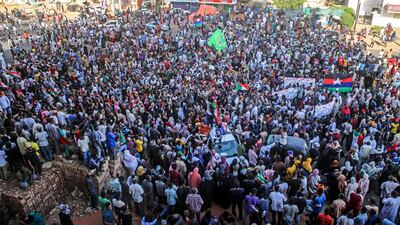
Tens of thousands took to the streets of the capital on Saturday in the largest pro-democracy protest since the military dismissed the transitional government and arrested civilian officials last week.

Mr Guterres said the military leaders should take heed of Saturday’s protests. “Time to go back to the legitimate constitutional arrangements,” he wrote on Twitter.

He was referring to a power-sharing deal that established joint military-civilian rule following the removal of president Omar Al Bashir and his Islamist government from power in April 2019.

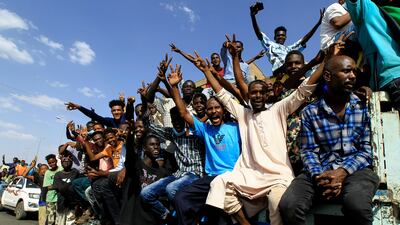
  • Protesters demonstrate against the Sudanese military's seizure of power and removal of the civilian government, in the capital Khartoum. Reuters
    Protesters demonstrate against the Sudanese military's seizure of power and removal of the civilian government, in the capital Khartoum. Reuters
  • Thousands of Sudanese people took to the streets in the capital of Khartoum, above, and other major cities across the country to demand the country's transition to democratic rule be put back on track. EPA
    Thousands of Sudanese people took to the streets in the capital of Khartoum, above, and other major cities across the country to demand the country's transition to democratic rule be put back on track. EPA
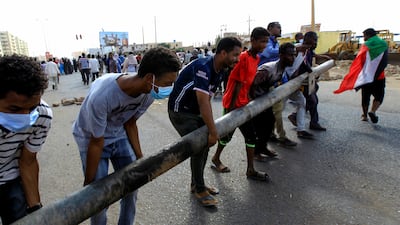
  • Protesters carry a barricade as they demonstrate against the Sudanese military, in the capital Khartoum. Reuters
    Protesters carry a barricade as they demonstrate against the Sudanese military, in the capital Khartoum. Reuters
  • A Sudanese protester flashes a victory sign near a burning tyre as thousands of people joined anti-coup protests in Khartoum. EPA
    A Sudanese protester flashes a victory sign near a burning tyre as thousands of people joined anti-coup protests in Khartoum. EPA
  • Thousands of Sudanese people participated in anti-military protests in the capital Khartoum. EPA
    Thousands of Sudanese people participated in anti-military protests in the capital Khartoum. EPA
  • A Sudanese protester dressed up as Spider-Man, stands on car during an anti-coup protest in the capital Khartoum. EPA
    A Sudanese protester dressed up as Spider-Man, stands on car during an anti-coup protest in the capital Khartoum. EPA
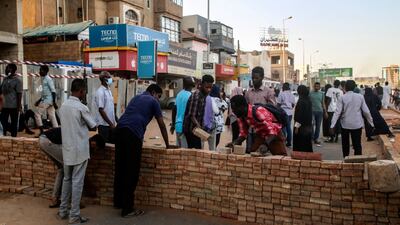
  • Demonstrators build a barricade on a street in the capital Khartoum during an anti-coup protest. EPA
    Demonstrators build a barricade on a street in the capital Khartoum during an anti-coup protest. EPA
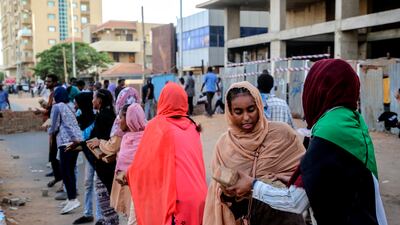
  • Sudanese women during anti-coup protests as a part of nationwide demonstrations against the military takeover of the government on October 25, in the capital Khartoum. EPA
    Sudanese women during anti-coup protests as a part of nationwide demonstrations against the military takeover of the government on October 25, in the capital Khartoum. EPA
  • Protesters raised slogans demanding the exit of Gen Abdel Fattah Al Burhan, in the capital Khartoum. AP Photo
    Protesters raised slogans demanding the exit of Gen Abdel Fattah Al Burhan, in the capital Khartoum. AP Photo
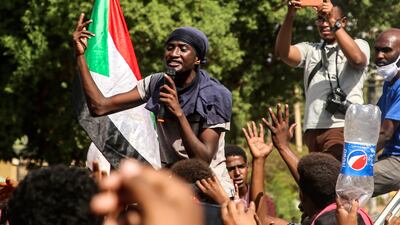
  • Protesters declared 'the revolution will continue' during a demonstration in Khartoum. AP
    Protesters declared 'the revolution will continue' during a demonstration in Khartoum. AP
  • 'Going back is impossible' was among slogans raised by Sudanese protesters in the capital Khartoum. AP
    'Going back is impossible' was among slogans raised by Sudanese protesters in the capital Khartoum. AP

The UN envoy for Sudan, Volker Perthes, said that on Sunday he met Prime Minister Abdalla Hamdok, who was under house arrest in the capital, Khartoum.

“We discussed options for mediation and the way forward for Sudan. I will continue these efforts with other Sudanese stakeholders,” Mr Perthes said.

Mr Guterres expressed concern about violence against protesters on Saturday, calling for perpetrators to be held accountable.

At least three people were shot dead when security forces opened fire on protesters in Omdurman, a city adjacent to the capital of Khartoum.

A doctors’ union said more than 110 people were injured by live rounds, tear gas and beatings in Omdurman and elsewhere in Sudan.

With Saturday’s deaths, the overall number of people killed since Monday’s coup rose to 12, according to the Sudan Doctors’ Committee and campaigners. More than 280 others were injured in the past week.

The coup happened after weeks of tensions between the military and civilians, and generals called for dissolving the transitional government.

Gen Abdel Fattah Al Buhran, who led the takeover, denied it was a coup and claimed he wanted to change "the course of the Sudanese transition".

He said the move was necessary to prevent a civil war, citing what he said were growing divisions among political groups. However, the takeover came less than a month before he was to have handed some power to a civilian official.

Gen Buhran also claimed that the transition to democracy would continue, saying he would install a government of technocrats soon, with the aim of holding elections in July 2023.

But the pro-democracy movement in Sudan fears the military has no intention of easing its grip and will appoint politicians it can control.

Meanwhile, the UN mission for Sudan is working to ease dialogue between military and civilian leaders.

A Sudanese military official said that a UN-supported national committee began separate meetings last week with Mr Hamdok and Gen Burhan to find common ground.

US President Joe Biden has called the coup a "grave setback", while the African Union has suspended Sudan's membership for the "unconstitutional" takeover.

The World Bank and the United States have frozen aid to Sudan, a move that will hit hard in a country in a dire economic crisis.

"No, no, to military rule," protesters carrying Sudanese flags at Saturday’s mass marches chanted as they roved around the capital and other cities.

As night fell on Saturday, many protests in Khartoum and the capital's twin city of Omdurman thinned out. But on Sunday morning, protesters were back on the streets.

They manned barricades in Khartoum using rocks and tyres to block roads as the civil disobedience campaign against the military entered its seventh day.

Most shops remain in Khartoum remained shut. In the capital, many government employees are refusing to work as part of the protest.

Soldiers and the paramilitary Rapid Support Forces were seen on many streets in Khartoum and Omdurman.

Security forces have set up random checkpoints on the streets, frisking passers-by and searching cars.

Phone lines, which were largely down on Saturday, were back apart from intermittent disruptions. Internet access has been cut since the takeover.

Sudan has enjoyed only rare democratic interludes since independence in 1956 and spent decades riven by civil war.


Avatar: Fire and Ash

Director: James Cameron

Starring: Sam Worthington, Sigourney Weaver, Zoe Saldana

Rating: 4.5/5

if you go

The flights
Fly direct to Kutaisi with Flydubai from Dh925 return, including taxes. The flight takes 3.5 hours. From there, Svaneti is a four-hour drive. The driving time from Tbilisi is eight hours.
The trip
The cost of the Svaneti trip is US$2,000 (Dh7,345) for 10 days, including food, guiding, accommodation and transfers from and to ­Tbilisi or Kutaisi. This summer the TCT is also offering a 5-day hike in Armenia for $1,200 (Dh4,407) per person. For further information, visit www.transcaucasiantrail.org/en/hike/

The biog

Name: Shamsa Hassan Safar

Nationality: Emirati

Education: Degree in emergency medical services at Higher Colleges of Technology

Favourite book: Between two hearts- Arabic novels

Favourite music: Mohammed Abdu and modern Arabic songs

Favourite way to spend time off: Family visits and spending time with friends

COMPANY%20PROFILE
%3Cp%3E%3Cstrong%3ECompany%3A%3C%2Fstrong%3E%20Sideup%3Cbr%3E%3Cstrong%3EStarted%3A%3C%2Fstrong%3E%202019%3Cbr%3E%3Cstrong%3EFounder%3A%3C%2Fstrong%3E%20Waleed%20Rashed%3Cbr%3E%3Cstrong%3EBased%3A%3C%2Fstrong%3E%20Cairo%2C%20Egypt%3Cbr%3E%3Cstrong%3EIndustry%3A%3C%2Fstrong%3E%20technology%2C%20e-commerce%3Cbr%3E%3Cstrong%3EFunds%20raised%20so%20far%3A%3C%2Fstrong%3E%20%241.2%20million%3Cbr%3E%3Cstrong%3EInvestors%3A%3C%2Fstrong%3E%20Launch%20Africa%20VC%2C%20500%20Global%2C%20Riyadh%20Angels%2C%20Alex%20Angels%2C%20Al%20Tuwaijri%20Fund%20and%20Saudi%20angel%20investor%20Faisal%20Al%20Abdulsalam%3C%2Fp%3E%0A
EVIL%20DEAD%20RISE
%3Cp%3E%3Cstrong%3EDirector%3A%20%3C%2Fstrong%3ELee%20Cronin%3Cbr%3E%3Cstrong%3EStars%3A%20%3C%2Fstrong%3EAlyssa%20Sutherland%2C%20Morgan%20Davies%2C%20Lily%20Sullivan%3Cbr%3E%3Cstrong%3ERating%3A%3C%2Fstrong%3E%205%2F5%3C%2Fp%3E%0A
THE SPECS

Engine: 6.0-litre, twin-turbocharged W12

Transmission: eight-speed automatic

Power: 626bhp

Torque: 900Nm

Price: Dh1,050,000

On sale: now

The specs

Engine: 3.8-litre twin-turbo flat-six

Power: 650hp at 6,750rpm

Torque: 800Nm from 2,500-4,000rpm

Transmission: 8-speed dual-clutch auto

Fuel consumption: 11.12L/100km

Price: From Dh796,600

On sale: now

The story in numbers

18

This is how many recognised sects Lebanon is home to, along with about four million citizens

450,000

More than this many Palestinian refugees are registered with UNRWA in Lebanon, with about 45 per cent of them living in the country’s 12 refugee camps

1.5 million

There are just under 1 million Syrian refugees registered with the UN, although the government puts the figure upwards of 1.5m

73

The percentage of stateless people in Lebanon, who are not of Palestinian origin, born to a Lebanese mother, according to a 2012-2013 study by human rights organisation Frontiers Ruwad Association

18,000

The number of marriages recorded between Lebanese women and foreigners between the years 1995 and 2008, according to a 2009 study backed by the UN Development Programme

77,400

The number of people believed to be affected by the current nationality law, according to the 2009 UN study

4,926

This is how many Lebanese-Palestinian households there were in Lebanon in 2016, according to a census by the Lebanese-Palestinian dialogue committee

Mercer, the investment consulting arm of US services company Marsh & McLennan, expects its wealth division to at least double its assets under management (AUM) in the Middle East as wealth in the region continues to grow despite economic headwinds, a company official said.

Mercer Wealth, which globally has $160 billion in AUM, plans to boost its AUM in the region to $2-$3bn in the next 2-3 years from the present $1bn, said Yasir AbuShaban, a Dubai-based principal with Mercer Wealth.

Within the next two to three years, we are looking at reaching $2 to $3 billion as a conservative estimate and we do see an opportunity to do so,” said Mr AbuShaban.

Mercer does not directly make investments, but allocates clients’ money they have discretion to, to professional asset managers. They also provide advice to clients.

“We have buying power. We can negotiate on their (client’s) behalf with asset managers to provide them lower fees than they otherwise would have to get on their own,” he added.

Mercer Wealth’s clients include sovereign wealth funds, family offices, and insurance companies among others.

From its office in Dubai, Mercer also looks after Africa, India and Turkey, where they also see opportunity for growth.

Wealth creation in Middle East and Africa (MEA) grew 8.5 per cent to $8.1 trillion last year from $7.5tn in 2015, higher than last year’s global average of 6 per cent and the second-highest growth in a region after Asia-Pacific which grew 9.9 per cent, according to consultancy Boston Consulting Group (BCG). In the region, where wealth grew just 1.9 per cent in 2015 compared with 2014, a pickup in oil prices has helped in wealth generation.

BCG is forecasting MEA wealth will rise to $12tn by 2021, growing at an annual average of 8 per cent.

Drivers of wealth generation in the region will be split evenly between new wealth creation and growth of performance of existing assets, according to BCG.

Another general trend in the region is clients’ looking for a comprehensive approach to investing, according to Mr AbuShaban.

“Institutional investors or some of the families are seeing a slowdown in the available capital they have to invest and in that sense they are looking at optimizing the way they manage their portfolios and making sure they are not investing haphazardly and different parts of their investment are working together,” said Mr AbuShaban.

Some clients also have a higher appetite for risk, given the low interest-rate environment that does not provide enough yield for some institutional investors. These clients are keen to invest in illiquid assets, such as private equity and infrastructure.

“What we have seen is a desire for higher returns in what has been a low-return environment specifically in various fixed income or bonds,” he said.

“In this environment, we have seen a de facto increase in the risk that clients are taking in things like illiquid investments, private equity investments, infrastructure and private debt, those kind of investments were higher illiquidity results in incrementally higher returns.”

The Abu Dhabi Investment Authority, one of the largest sovereign wealth funds, said in its 2016 report that has gradually increased its exposure in direct private equity and private credit transactions, mainly in Asian markets and especially in China and India. The authority’s private equity department focused on structured equities owing to “their defensive characteristics.”

Updated: October 31, 2021, 3:26 PM