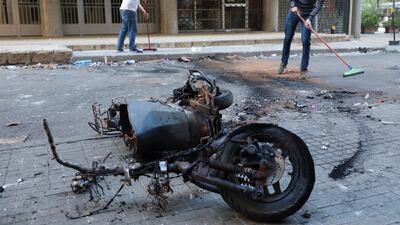
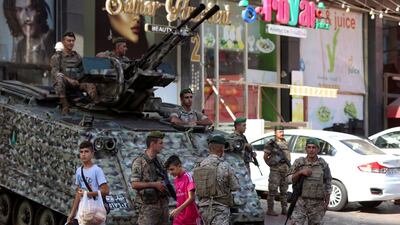
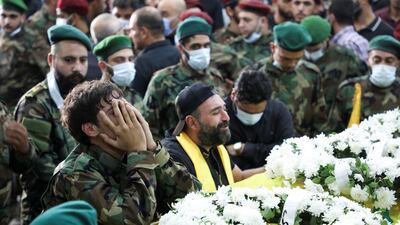
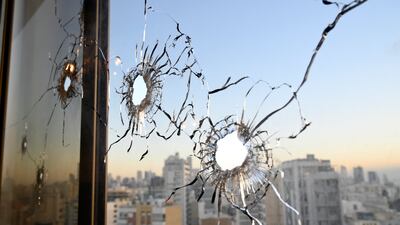
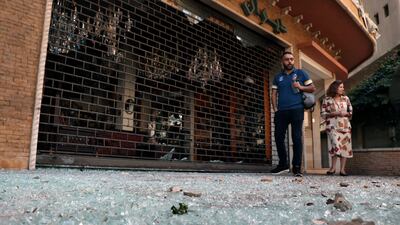
Lebanon’s military court pressed charges against 68 people on Monday after deadly clashes earlier this month over the investigation into the Beirut port explosion.
Judge Fadi Akiki laid charges of “murder, attempted murder, inciting sectarian strife, possession of unlicensed military weapons, and sabotage of public and private property” against individuals allegedly involved in the clashes.
The 68 include 18 already detained. The clashes have come to be referred to as the “Tayouneh events” in a reference to the Beirut neighbourhood where they occurred.
Fighting erupted shortly after protesters gathered in front of the Justice Palace on October 14 to demand the removal of the judge investigating the Beirut blast in August last year. Tarek Bitar has been publicly accused by leading members of Iran-backed group Hezbollah of working against them.
Seven people were shot dead in an area that had separated Muslim and Christian neighbourhoods during Lebanon’s 1975-1990 civil war. Local media has reported that three were members of Hezbollah and another three were supporters of its local Shiite Muslim ally Amal.
The two political parties had initially called for the protest along with Christian political party Marada.
Samir Geagea, the head of rival Christian party the Lebanese Forces, has since traded accusations with Hezbollah over who started shooting first.
Lebanon has been awash with weapons since the end of the civil war, but Hezbollah was the only militia that was allowed to remain armed to continue fighting Israel, which occupied south Lebanon until 2000. The group has since developed into a powerful regional militia.
Two days before the October 14 shooting, Hezbollah and Amal ministers had threatened to boycott Cabinet sessions as long as Mr Bitar kept going after top politicians.
Top officials representing numerous political parties have so far evaded accountability in the probe into the blast, which killed more than 215 people last year, by filing multiple lawsuits against Mr Bitar, repeatedly interrupted his work.
Beirut courts have so far rejected attempts to remove the investigative judge, who is not allowed to speak to the media, but two lawsuits are pending at the Court of Cassation.
Since taking over the probe in February, Mr Bitar has charged more than 50 officials and issued an arrest warrant against prominent Amal member and former finance minister Ali Hassan Khalil, and former public works minister Youssef Fenianos, a Marada politician.
Both men failed to attend interrogation sessions.
Tensions between rival political parties rose again last weekend after President Michel Aoun refused to ratify politicians' decision to move parliamentary elections from March 27 to May 8.
The move had been supported by numerous parties including Amal, which is headed by veteran Parliament Speaker Nabih Berri.
In a press statement, Amal accused Mr Aoun’s political party, the Free Patriotic Movement, on Saturday of conspiring with the Lebanese Forces to cause the October 14 clashes in Tayouneh and of intervening in Mr Bitar’s investigation.
A top adviser to Mr Aoun responded on Sunday, calling Amal’s accusations “shameful”.
It remains unclear when the Cabinet, which has prioritised negotiations with the IMF requesting a bailout as the local economy collapses, will meet again.

Timeline
2012-2015
The company offers payments/bribes to win key contracts in the Middle East
May 2017
The UK SFO officially opens investigation into Petrofac’s use of agents, corruption, and potential bribery to secure contracts
September 2021
Petrofac pleads guilty to seven counts of failing to prevent bribery under the UK Bribery Act
October 2021
Court fines Petrofac £77 million for bribery. Former executive receives a two-year suspended sentence
December 2024
Petrofac enters into comprehensive restructuring to strengthen the financial position of the group
May 2025
The High Court of England and Wales approves the company’s restructuring plan
July 2025
The Court of Appeal issues a judgment challenging parts of the restructuring plan
August 2025
Petrofac issues a business update to execute the restructuring and confirms it will appeal the Court of Appeal decision
October 2025
Petrofac loses a major TenneT offshore wind contract worth €13 billion. Holding company files for administration in the UK. Petrofac delisted from the London Stock Exchange
November 2025
180 Petrofac employees laid off in the UAE
MORE ON CORONAVIRUS & THE ECONOMY
MOUNTAINHEAD REVIEW
Starring: Ramy Youssef, Steve Carell, Jason Schwartzman
Director: Jesse Armstrong
Rating: 3.5/5
Mercer, the investment consulting arm of US services company Marsh & McLennan, expects its wealth division to at least double its assets under management (AUM) in the Middle East as wealth in the region continues to grow despite economic headwinds, a company official said.
Mercer Wealth, which globally has $160 billion in AUM, plans to boost its AUM in the region to $2-$3bn in the next 2-3 years from the present $1bn, said Yasir AbuShaban, a Dubai-based principal with Mercer Wealth.
“Within the next two to three years, we are looking at reaching $2 to $3 billion as a conservative estimate and we do see an opportunity to do so,” said Mr AbuShaban.
Mercer does not directly make investments, but allocates clients’ money they have discretion to, to professional asset managers. They also provide advice to clients.
“We have buying power. We can negotiate on their (client’s) behalf with asset managers to provide them lower fees than they otherwise would have to get on their own,” he added.
Mercer Wealth’s clients include sovereign wealth funds, family offices, and insurance companies among others.
From its office in Dubai, Mercer also looks after Africa, India and Turkey, where they also see opportunity for growth.
Wealth creation in Middle East and Africa (MEA) grew 8.5 per cent to $8.1 trillion last year from $7.5tn in 2015, higher than last year’s global average of 6 per cent and the second-highest growth in a region after Asia-Pacific which grew 9.9 per cent, according to consultancy Boston Consulting Group (BCG). In the region, where wealth grew just 1.9 per cent in 2015 compared with 2014, a pickup in oil prices has helped in wealth generation.
BCG is forecasting MEA wealth will rise to $12tn by 2021, growing at an annual average of 8 per cent.
Drivers of wealth generation in the region will be split evenly between new wealth creation and growth of performance of existing assets, according to BCG.
Another general trend in the region is clients’ looking for a comprehensive approach to investing, according to Mr AbuShaban.
“Institutional investors or some of the families are seeing a slowdown in the available capital they have to invest and in that sense they are looking at optimizing the way they manage their portfolios and making sure they are not investing haphazardly and different parts of their investment are working together,” said Mr AbuShaban.
Some clients also have a higher appetite for risk, given the low interest-rate environment that does not provide enough yield for some institutional investors. These clients are keen to invest in illiquid assets, such as private equity and infrastructure.
“What we have seen is a desire for higher returns in what has been a low-return environment specifically in various fixed income or bonds,” he said.
“In this environment, we have seen a de facto increase in the risk that clients are taking in things like illiquid investments, private equity investments, infrastructure and private debt, those kind of investments were higher illiquidity results in incrementally higher returns.”
The Abu Dhabi Investment Authority, one of the largest sovereign wealth funds, said in its 2016 report that has gradually increased its exposure in direct private equity and private credit transactions, mainly in Asian markets and especially in China and India. The authority’s private equity department focused on structured equities owing to “their defensive characteristics.”
UAE v Gibraltar
What: International friendly
When: 7pm kick off
Where: Rugby Park, Dubai Sports City
Admission: Free
Online: The match will be broadcast live on Dubai Exiles’ Facebook page
UAE squad: Lucas Waddington (Dubai Exiles), Gio Fourie (Exiles), Craig Nutt (Abu Dhabi Harlequins), Phil Brady (Harlequins), Daniel Perry (Dubai Hurricanes), Esekaia Dranibota (Harlequins), Matt Mills (Exiles), Jaen Botes (Exiles), Kristian Stinson (Exiles), Murray Reason (Abu Dhabi Saracens), Dave Knight (Hurricanes), Ross Samson (Jebel Ali Dragons), DuRandt Gerber (Exiles), Saki Naisau (Dragons), Andrew Powell (Hurricanes), Emosi Vacanau (Harlequins), Niko Volavola (Dragons), Matt Richards (Dragons), Luke Stevenson (Harlequins), Josh Ives (Dubai Sports City Eagles), Sean Stevens (Saracens), Thinus Steyn (Exiles)
UAE currency: the story behind the money in your pockets
Related