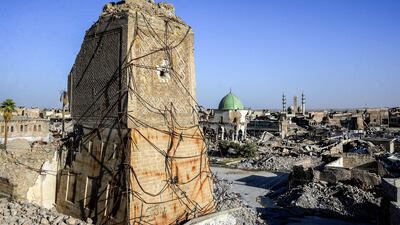
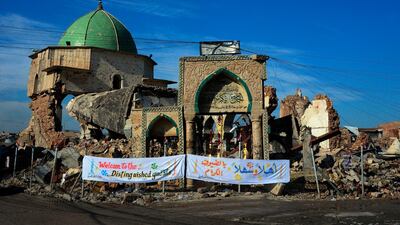
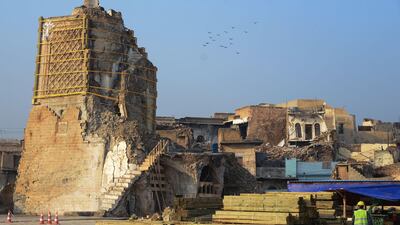
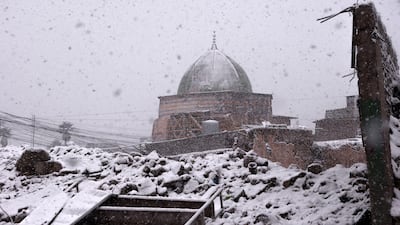
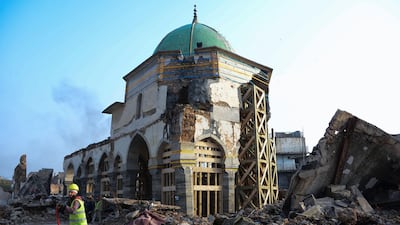
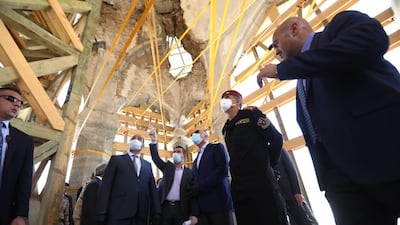
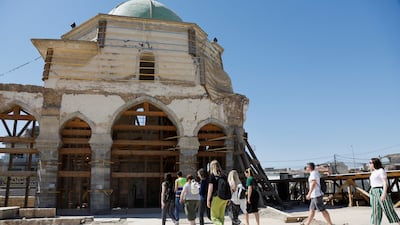
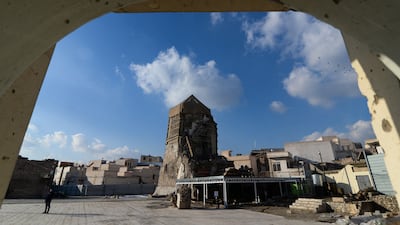
Iraq’s Al Nuri Mosque held its first ceremony in four years on Sunday amid efforts by the UN and UAE to rebuild the site blown up by ISIS.
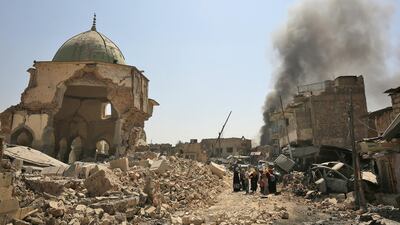
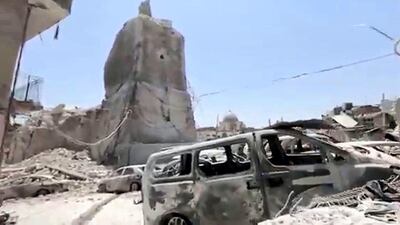
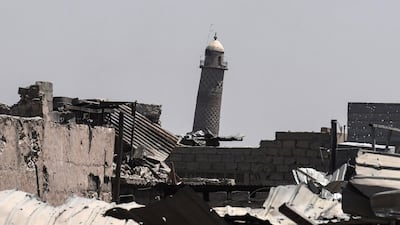
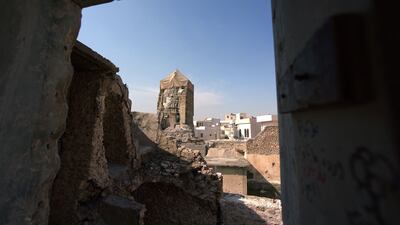
The 12th-century mosque and its famous leaning minaret were destroyed by the group in 2017 as government forces closed in on the last fighters from the terrorist group that once controlled the city and much of north-west Iraq.
But on Sunday, celebrations for the Prophet Mohammed's birthday began, with lights illuminating the area.
“Mosul is rising again! A part of the celebration of Prophet Mohammed’s birthday at Al Nuri Mosque, after many years of absence,” the UN cultural agency Unesco said on Twitter.
“Unesco and UAE will rebuild this iconic mosque!” it said.
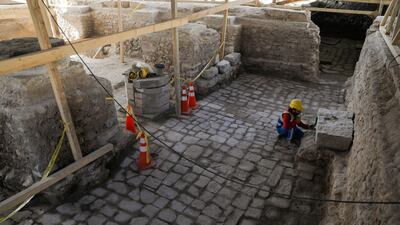
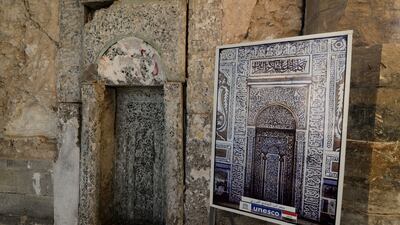
The UN's cultural agency launched the “revive the spirit of Mosul'' project in 2018 which has focused on restoring the country's religious heritage.
Plans included rebuilding Al Nuri Mosque, the 800-year-old Al Tahera Church and Al Saa'a Monastery.
The Emirates donated $50.4 million to fund the project, which will also create employment and training opportunities for local residents.
It is the first country to restore Christian churches in Iraq that were destroyed by ISIS.
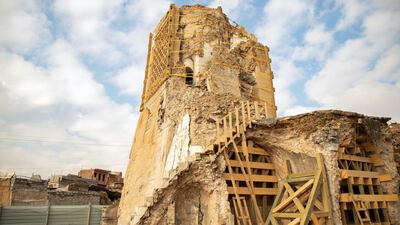
Pictures and videos on social media showed hundreds gathering at a compound in front of the mosque, the courtyard decorated with multicoloured lights that illuminated the building's gaping windows, the scaffolding that surrounds the site, and the minaret, only the base of which survived.
“I know it is not fully recovered yet, but you decide, take a look, you can see the difference, right?” Iraqi historian, Omar Mohammed said, using the alias “Mosul Eye” on Twitter.
“[ISIS] brings death, we bring life. Al Nuri Mosque,” he said.
In 2014, ISIS captured Mosul, and the group's leader at the time, Abu Bakr Al Baghdadi, used the mosque to announce he had established a caliphate in Iraq and Syria.
While the extremists occupied large areas of the country, the city's residents are considered to have borne the brunt of the group's tyrannical rule.
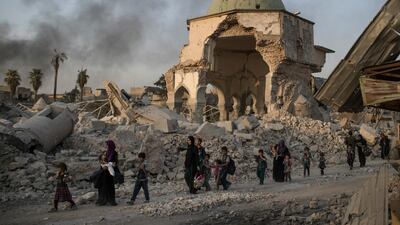
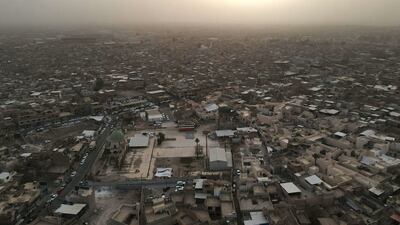
By the end of 2017, Mosul lay devastated after government forces successfully regained control of the city.
Much of the city is still filled with rubble today.

If you go
Flights
Emirates flies from Dubai to Phnom Penh with a stop in Yangon from Dh3,075, and Etihad flies from Abu Dhabi to Phnom Penh with its partner Bangkok Airlines from Dh2,763. These trips take about nine hours each and both include taxes. From there, a road transfer takes at least four hours; airlines including KC Airlines (www.kcairlines.com) offer quick connecting flights from Phnom Penh to Sihanoukville from about $100 (Dh367) return including taxes. Air Asia, Malindo Air and Malaysian Airlines fly direct from Kuala Lumpur to Sihanoukville from $54 each way. Next year, direct flights are due to launch between Bangkok and Sihanoukville, which will cut the journey time by a third.
The stay
Rooms at Alila Villas Koh Russey (www.alilahotels.com/ kohrussey) cost from $385 per night including taxes.
Dubai World Cup factbox
Most wins by a trainer: Godolphin’s Saeed bin Suroor(9)
Most wins by a jockey: Jerry Bailey(4)
Most wins by an owner: Godolphin(9)
Most wins by a horse: Godolphin’s Thunder Snow(2)
Wenger's Arsenal reign in numbers
1,228 - games at the helm, ahead of Sunday's Premier League fixture against West Ham United.
704 - wins to date as Arsenal manager.
3 - Premier League title wins, the last during an unbeaten Invincibles campaign of 2003/04.
1,549 - goals scored in Premier League matches by Wenger's teams.
10 - major trophies won.
473 - Premier League victories.
7 - FA Cup triumphs, with three of those having come the last four seasons.
151 - Premier League losses.
21 - full seasons in charge.
49 - games unbeaten in the Premier League from May 2003 to October 2004.
Mercer, the investment consulting arm of US services company Marsh & McLennan, expects its wealth division to at least double its assets under management (AUM) in the Middle East as wealth in the region continues to grow despite economic headwinds, a company official said.
Mercer Wealth, which globally has $160 billion in AUM, plans to boost its AUM in the region to $2-$3bn in the next 2-3 years from the present $1bn, said Yasir AbuShaban, a Dubai-based principal with Mercer Wealth.
“Within the next two to three years, we are looking at reaching $2 to $3 billion as a conservative estimate and we do see an opportunity to do so,” said Mr AbuShaban.
Mercer does not directly make investments, but allocates clients’ money they have discretion to, to professional asset managers. They also provide advice to clients.
“We have buying power. We can negotiate on their (client’s) behalf with asset managers to provide them lower fees than they otherwise would have to get on their own,” he added.
Mercer Wealth’s clients include sovereign wealth funds, family offices, and insurance companies among others.
From its office in Dubai, Mercer also looks after Africa, India and Turkey, where they also see opportunity for growth.
Wealth creation in Middle East and Africa (MEA) grew 8.5 per cent to $8.1 trillion last year from $7.5tn in 2015, higher than last year’s global average of 6 per cent and the second-highest growth in a region after Asia-Pacific which grew 9.9 per cent, according to consultancy Boston Consulting Group (BCG). In the region, where wealth grew just 1.9 per cent in 2015 compared with 2014, a pickup in oil prices has helped in wealth generation.
BCG is forecasting MEA wealth will rise to $12tn by 2021, growing at an annual average of 8 per cent.
Drivers of wealth generation in the region will be split evenly between new wealth creation and growth of performance of existing assets, according to BCG.
Another general trend in the region is clients’ looking for a comprehensive approach to investing, according to Mr AbuShaban.
“Institutional investors or some of the families are seeing a slowdown in the available capital they have to invest and in that sense they are looking at optimizing the way they manage their portfolios and making sure they are not investing haphazardly and different parts of their investment are working together,” said Mr AbuShaban.
Some clients also have a higher appetite for risk, given the low interest-rate environment that does not provide enough yield for some institutional investors. These clients are keen to invest in illiquid assets, such as private equity and infrastructure.
“What we have seen is a desire for higher returns in what has been a low-return environment specifically in various fixed income or bonds,” he said.
“In this environment, we have seen a de facto increase in the risk that clients are taking in things like illiquid investments, private equity investments, infrastructure and private debt, those kind of investments were higher illiquidity results in incrementally higher returns.”
The Abu Dhabi Investment Authority, one of the largest sovereign wealth funds, said in its 2016 report that has gradually increased its exposure in direct private equity and private credit transactions, mainly in Asian markets and especially in China and India. The authority’s private equity department focused on structured equities owing to “their defensive characteristics.”
LILO & STITCH
Starring: Sydney Elizebeth Agudong, Maia Kealoha, Chris Sanders
Director: Dean Fleischer Camp
Rating: 4.5/5