Sudanese soldiers secure the area as Omar Al Bashir leaves the office of the anti-corruption prosecutor in Khartoum in June 2019. Reuters

Sudan foils coup attempt by Al Bashir loyalists and arrests plotters


  • English
  • Arabic

Sudan said on Tuesday that it had thwarted an attempted coup by army officers and civilians loyal to the regime of ousted dictator Omar Al Bashir.

Prime Minister Abdalla Hamdok said the aim was to derail Sudan's transition to democratic rule two years after Al Bashir was removed by the military in the face of mass street protests.

“But our resolve was stronger and going back is impossible,” he told the nation in a televised address.

Separately, the military said in a statement that "most of the coup participants" – 21 officers and an unspecified number of troops – were arrested and that all positions taken by them were recaptured.

"The search and investigation are ongoing to capture the remainder of those involved," the military said.

It also published images of head of state Gen Abdul Fattah Al Burhan visiting the sprawling Al Shagara barracks on the outskirts of Khartoum, where the plotters are believed to have served.

Defence Minister Gen Yassin Ibrahim identified the coup leader as Lt. Gen Abdul Baqi Al Hassan Othman. He told reporters that he and 22 officers of various ranks and a number of soldiers he did not specify were behind the attempted coup.

He said the coup was swiftly foiled without casualties or material damage.

The latest attempted coup underlined the fragility of the transition to democratic rule in a country where elected governments and the military have vied for power since independence in 1956.

Sudanese head of state Gen. Abdul Farrah Al Burhan visiting the Al Shagara military complex on the outskirts of Khartoum where Tuesday’s coup plotters are known to have served. Photo: Sudanese Armed Forces Media Office

Army generals seized power from civilian governments in 1958, 1969 and 1989, giving the military more than 50 years in power. Beside those three successful coups, Sudan has experienced at least two dozen failed coups, some of them involving bloodshed.

Earlier on Tuesday, Information Minister Hamza Baloul sought to reassure the Afro-Arab nation that all was in hand.

“We assure the Sudanese people that the situation is fully under control,” Mr Baloul said in a live broadcast on state television. “The civilian and military leaders of the coup attempt have been arrested.”

He said army troops “liquidated the last coup pockets” in Al Shagara barracks.

“The relevant authorities are continuing to pursue the remnants of the vanquished regime who took part in the failed coup,” he added, without giving more details.

Sudanese head of state Gen. Abdul Farrah Al Burhan visiting the Al Shagara military complex on the outskirts of Khartoum where Tuesday’s coup plotters are known to have served. Photo: Sudanese Armed Forces Media Office

Mr Hamdok's later comments came during a joint meeting of his government and the Forces of Freedom and Change, a pro-democracy alliance which mobilised the street protests against Al Bashir in April 2019.

“The unity of the forces of freedom, revolution and change is both the guarantee for and immunity of a civilian and democratic transition; and realising the objectives of the revolution,” he said.

“The attempted coup requires a full and transparent review of the transition to arrive at a partnership based on the slogans and the principles of the revolution as well as a road that leads only to a democratic and civilian transition.”

Early on Tuesday, state radio and television interrupted regular programming to broadcast patriotic songs as hundreds of troops and tanks took to the streets of the capital.

Sudan's transitional Council includes two women. EPA

The plotters failed in their attempt to take over the state media building, a military source told The National.

They said a general from the armoured corps had planned to enter there to broadcast an announcement of a coup but was prevented by other elements in the military.

The source said the incident came after months of rumours.

“Such rumours are being recycled every now and then to destabilise state-building,” the source said.

The state TV and radio building, in Khartoum's twin city of Omdurman, has routinely been the first target of coup attempts.

Troops and tanks briefly closed the White Nile bridge linking Khartoum and Omdurman.

Military policemen were out across the city, but life in Khartoum appeared mostly normal by mid-morning.

In a telephone interview with The National, an army general and a Cabinet minister also blamed the coup attempt on Al Bashir loyalists.

The constitution does not give this authority to the civilian government and the military has been dragging its feet over doing the necessary purges
Samir Makeen

In a Facebook post, Sovereign Council spokesman Mohammed El Faky Suleiman urged the Sudanese to “rise up and defend your country and the transition” .

Pro-democracy activists complained that not enough was being done to purge Al Bashir loyalists from the military, police and security agencies. Many of the military's top brass and mid-ranking officers are known to be sympathetic.

Mr Hamdok's civilian-led government made the error of not having the upper hand in restructuring the military and security services, Samir Makeen, the deputy head of the National Commission of Human Rights, told The National.

“The constitution does not give this authority to the civilian government and the military has been dragging its feet over doing the necessary purges,” Mr Makeen, who is also a lawyer and human rights activist, said.

Mr Makeen resigned on September 12 to protest against what he described as the commission’s failure to make any tangible progress on human rights over the past two years. The commission has yet to accept his resignation.

The army ranks were filled with the remnants of the Al Bashir regime, Mr Makeen said. “We are not talking here about the rank and file,” he said. “We are talking about senior officers who call the shots.”

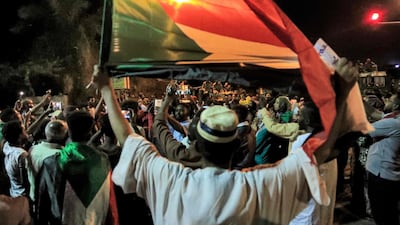
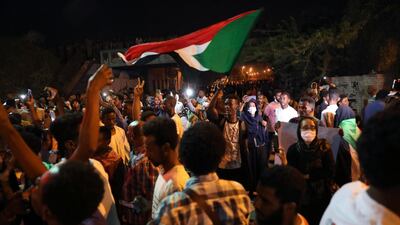
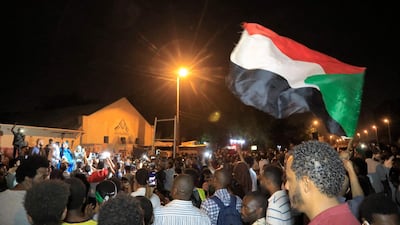
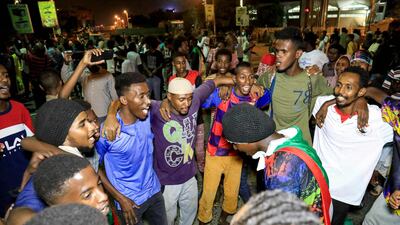
  • Demonstrators gather outside the army headquarters in Sudan's capital Khartoum on Ramadan 29 or May 11, 2021 to mark the anniversary of the killing of protesters during a raid on an anti-government sit-in in 2019. AFP
    Demonstrators gather outside the army headquarters in Sudan's capital Khartoum on Ramadan 29 or May 11, 2021 to mark the anniversary of the killing of protesters during a raid on an anti-government sit-in in 2019. AFP
  • Demonstrators gather outside the army headquarters in Sudan's capital Khartoum on Ramadan 29 or May 11, 2021 to mark the anniversary of the killing of protesters during a raid on an anti-government sit-in in 2019. AFP
    Demonstrators gather outside the army headquarters in Sudan's capital Khartoum on Ramadan 29 or May 11, 2021 to mark the anniversary of the killing of protesters during a raid on an anti-government sit-in in 2019. AFP
  • Demonstrators gather outside the army headquarters in Sudan's capital Khartoum on Ramadan 29 or May 11, 2021 to mark the anniversary of the killing of protesters during a raid on an anti-government sit-in in 2019. AFP
    Demonstrators gather outside the army headquarters in Sudan's capital Khartoum on Ramadan 29 or May 11, 2021 to mark the anniversary of the killing of protesters during a raid on an anti-government sit-in in 2019. AFP
  • Demonstrators gather outside the army headquarters in Sudan's capital Khartoum on Ramadan 29 or May 11, 2021 to mark the anniversary of the killing of protesters during a raid on an anti-government sit-in in 2019. AFP
    Demonstrators gather outside the army headquarters in Sudan's capital Khartoum on Ramadan 29 or May 11, 2021 to mark the anniversary of the killing of protesters during a raid on an anti-government sit-in in 2019. AFP

Minister of Religious Affairs Nasredeen Mofreh Ahmed condemned what he described as an attack on the nation's fledgling democracy.

“The enemies of the country and the glorious revolution are trying to abort this great national project,” Mr Ahmed said in a statement. “But we will, just as the revolutionary forces will, remain alive; and the attempts of the corrupt remnants of the vanished regime will be to no avail.”

The coup attempt came as the government grapples with a surge in street crime in Khartoum, which has prompted the authorities to send thousands of police and troops on to the streets.

The crime wave has compounded the difficulties of most Sudanese, who are struggling to cope with rising prices.

Mr Hamdok blamed Al Bashir loyalists for the sharp rise in crime as well as acts of sabotage in the capital and elsewhere, saying they were part of the preparations for Tuesday's foiled coup.

The military and civilian components of Sudan's transitional administration have also been at loggerheads. Each accuses the other of breaches of authority and being the cause of some of the country's woes.

Mr Hamdok's mention of the need to establish a new basis of “partnership” appeared to be a reference to the differences between the military and the government.


Tax authority targets shisha levy evasion

The Federal Tax Authority will track shisha imports with electronic markers to protect customers and ensure levies have been paid.

Khalid Ali Al Bustani, director of the tax authority, on Sunday said the move is to "prevent tax evasion and support the authority’s tax collection efforts".

The scheme’s first phase, which came into effect on 1st January, 2019, covers all types of imported and domestically produced and distributed cigarettes. As of May 1, importing any type of cigarettes without the digital marks will be prohibited.

He said the latest phase will see imported and locally produced shisha tobacco tracked by the final quarter of this year.

"The FTA also maintains ongoing communication with concerned companies, to help them adapt their systems to meet our requirements and coordinate between all parties involved," he said.

As with cigarettes, shisha was hit with a 100 per cent tax in October 2017, though manufacturers and cafes absorbed some of the costs to prevent prices doubling.

Avatar: Fire and Ash

Director: James Cameron

Starring: Sam Worthington, Sigourney Weaver, Zoe Saldana

Rating: 4.5/5

25-MAN SQUAD

Goalkeepers: Francis Uzoho, Ikechukwu Ezenwa, Daniel Akpeyi
Defenders: Olaoluwa Aina, Abdullahi Shehu, Chidozie Awaziem, William Ekong, Leon Balogun, Kenneth Omeruo, Jamilu Collins, Semi Ajayi 
Midfielders: John Obi Mikel, Wilfred Ndidi, Oghenekaro Etebo, John Ogu
Forwards: Ahmed Musa, Victor Osimhen, Moses Simon, Henry Onyekuru, Odion Ighalo, Alexander Iwobi, Samuel Kalu, Paul Onuachu, Kelechi Iheanacho, Samuel Chukwueze 

On Standby: Theophilus Afelokhai, Bryan Idowu, Ikouwem Utin, Mikel Agu, Junior Ajayi, Valentine Ozornwafor

Real estate tokenisation project

Dubai launched the pilot phase of its real estate tokenisation project last month.

The initiative focuses on converting real estate assets into digital tokens recorded on blockchain technology and helps in streamlining the process of buying, selling and investing, the Dubai Land Department said.

Dubai’s real estate tokenisation market is projected to reach Dh60 billion ($16.33 billion) by 2033, representing 7 per cent of the emirate’s total property transactions, according to the DLD.

COMPANY%20PROFILE
%3Cp%3E%3Cstrong%3ECompany%20name%3A%3C%2Fstrong%3E%20Alaan%3Cbr%3E%3Cstrong%3EStarted%3A%3C%2Fstrong%3E%202021%3Cbr%3E%3Cstrong%3EBased%3A%3C%2Fstrong%3E%20Dubai%3Cbr%3E%3Cstrong%3EFounders%3A%3C%2Fstrong%3E%20Parthi%20Duraisamy%20and%20Karun%20Kurien%3Cbr%3E%3Cstrong%3ESector%3A%3C%2Fstrong%3E%20FinTech%3Cbr%3E%3Cstrong%3EInvestment%20stage%3A%3C%2Fstrong%3E%20%247%20million%20raised%20in%20total%20%E2%80%94%20%242.5%20million%20in%20a%20seed%20round%20and%20%244.5%20million%20in%20a%20pre-series%20A%20round%3Cbr%3E%3Cbr%3E%3C%2Fp%3E%0A
Company%20profile
%3Cp%3E%3Cstrong%3EName%3A%20%3C%2Fstrong%3EPurpl%3C%2Fp%3E%0A%3Cp%3E%3Cstrong%3ECo-founders%3A%20%3C%2Fstrong%3EKarl%20Naim%2C%20Wissam%20Ghorra%2C%20Jean-Marie%20Khoueir%3C%2Fp%3E%0A%3Cp%3E%3Cstrong%3EBased%3A%20%3C%2Fstrong%3EHub71%20in%20Abu%20Dhabi%20and%20Beirut%3C%2Fp%3E%0A%3Cp%3E%3Cstrong%3EStarted%3A%20%3C%2Fstrong%3E2021%3C%2Fp%3E%0A%3Cp%3E%3Cstrong%3ENumber%20of%20employees%3A%20%3C%2Fstrong%3E12%3C%2Fp%3E%0A%3Cp%3E%3Cstrong%3ESector%3A%20%3C%2Fstrong%3EFinTech%3C%2Fp%3E%0A%3Cp%3E%3Cstrong%3EFunding%3A%20%3C%2Fstrong%3E%242%20million%26nbsp%3B%3C%2Fp%3E%0A

Mercer, the investment consulting arm of US services company Marsh & McLennan, expects its wealth division to at least double its assets under management (AUM) in the Middle East as wealth in the region continues to grow despite economic headwinds, a company official said.

Mercer Wealth, which globally has $160 billion in AUM, plans to boost its AUM in the region to $2-$3bn in the next 2-3 years from the present $1bn, said Yasir AbuShaban, a Dubai-based principal with Mercer Wealth.

Within the next two to three years, we are looking at reaching $2 to $3 billion as a conservative estimate and we do see an opportunity to do so,” said Mr AbuShaban.

Mercer does not directly make investments, but allocates clients’ money they have discretion to, to professional asset managers. They also provide advice to clients.

“We have buying power. We can negotiate on their (client’s) behalf with asset managers to provide them lower fees than they otherwise would have to get on their own,” he added.

Mercer Wealth’s clients include sovereign wealth funds, family offices, and insurance companies among others.

From its office in Dubai, Mercer also looks after Africa, India and Turkey, where they also see opportunity for growth.

Wealth creation in Middle East and Africa (MEA) grew 8.5 per cent to $8.1 trillion last year from $7.5tn in 2015, higher than last year’s global average of 6 per cent and the second-highest growth in a region after Asia-Pacific which grew 9.9 per cent, according to consultancy Boston Consulting Group (BCG). In the region, where wealth grew just 1.9 per cent in 2015 compared with 2014, a pickup in oil prices has helped in wealth generation.

BCG is forecasting MEA wealth will rise to $12tn by 2021, growing at an annual average of 8 per cent.

Drivers of wealth generation in the region will be split evenly between new wealth creation and growth of performance of existing assets, according to BCG.

Another general trend in the region is clients’ looking for a comprehensive approach to investing, according to Mr AbuShaban.

“Institutional investors or some of the families are seeing a slowdown in the available capital they have to invest and in that sense they are looking at optimizing the way they manage their portfolios and making sure they are not investing haphazardly and different parts of their investment are working together,” said Mr AbuShaban.

Some clients also have a higher appetite for risk, given the low interest-rate environment that does not provide enough yield for some institutional investors. These clients are keen to invest in illiquid assets, such as private equity and infrastructure.

“What we have seen is a desire for higher returns in what has been a low-return environment specifically in various fixed income or bonds,” he said.

“In this environment, we have seen a de facto increase in the risk that clients are taking in things like illiquid investments, private equity investments, infrastructure and private debt, those kind of investments were higher illiquidity results in incrementally higher returns.”

The Abu Dhabi Investment Authority, one of the largest sovereign wealth funds, said in its 2016 report that has gradually increased its exposure in direct private equity and private credit transactions, mainly in Asian markets and especially in China and India. The authority’s private equity department focused on structured equities owing to “their defensive characteristics.”

Updated: September 21, 2021, 7:03 PM