Lebanon: sharp drop in water supply raises health concerns


  • English
  • Arabic

The taps in Marwan Kassar's flat in Beirut run dry, sometimes for as long as a day at a time.

Basic state services such as water and electricity have long been lacking in Lebanon, but the Kassar family home in a leafy neighbourhood of the capital used to be relatively well supplied until a few months ago.

“You can’t wash the vegetables, you can’t flush the toilet, you can’t shower, you can’t wash your hands,” Mr Kassar, 23, told The National.

“It’s a very big inconvenience. It’s probably never been this bad in terms of overall living conditions.”

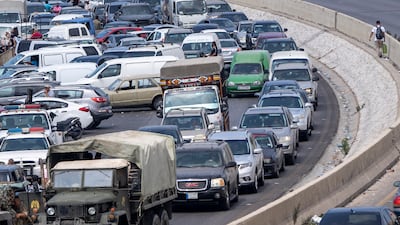
The water problem is the latest manifestation of Lebanon's two-year old economic crisis and is linked to the crippling fuel shortages created by a lack of foreign currency to pay for imports.

Lebanese are hopeful that the announcement of a new Cabinet on Friday – ending 13 months of a caretaker government and impasse – may improve conditions.

But in the meantime, without fuel oil for power plants or diesel for private generators, there is no electricity to pump water or run treatment plants.

The water supply in the densely populated Beirut and Mount Lebanon areas has dropped by about 40 per cent, said Jean Gebran, head of the local state-run water authority.

Some towns in the mountains north of Beirut receive only a few hours of water every two days.

Challenges are adding up. It will be disastrous if the crisis continues
Wassim Daher,
South Lebanon Water Establishment

“We have been severely rationing water for the past two to three weeks,” Mr Gebran told The National.

For many people, the solution is to buy water from private suppliers, but prices are soaring and are often unaffordable for impoverished locals.

UN children's agency Unicef estimates that 2.4 million people – a little under half the population – are experiencing water shortages.

Unicef supports Lebanon’s four water production plants by repairing boreholes, replacing and repairing pumps and procuring fuel and chlorine.

A Syrian mother collects water for cooking

Buying maintenance items often requires payment in cash dollars that public institutions cannot access due to the economic crisis.

Funding for an EU-backed project to support water production plants ran out last June, but Unicef requested an emergency loan of $1 million until further funds are received.

“We’re only buying time for decision makers to find a long-term solution,” said Unicef deputy head for Lebanon Ettie Higgins.

The key issue is to restore the supply of electricity to run the water system.

“The issue of water and energy are highly interlinked. We need to solve the energy problem to not suffer from further water problems,” said Nadim Farajalla, director of the climate change and environment programme at the Issam Fares Institute at the American University of Beirut.

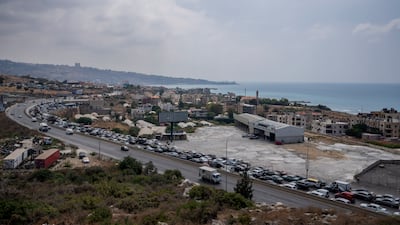
  • A crowded petrol station on the main road that links Beirut to south Lebanon. AP
    A crowded petrol station on the main road that links Beirut to south Lebanon. AP
  • Drivers come from every direction to fill their tanks with fuel. AP
    Drivers come from every direction to fill their tanks with fuel. AP
  • Chronic fuel shortages have plagued the country in recent months, with long queues at petrol stations a common sight. AP
    Chronic fuel shortages have plagued the country in recent months, with long queues at petrol stations a common sight. AP
  • Last month, central bank governor Riad Salameh announced that fuel imports would no longer be subsidised. AP
    Last month, central bank governor Riad Salameh announced that fuel imports would no longer be subsidised. AP
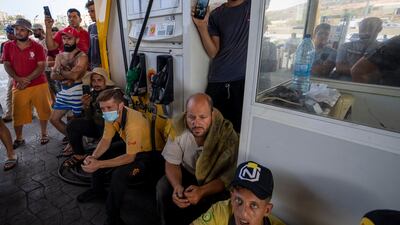
  • Worshippers listen as cleric Ali Al Hussein delivers a sermon during Friday prayers at a fuel station to protest against the severe shortages. AP
    Worshippers listen as cleric Ali Al Hussein delivers a sermon during Friday prayers at a fuel station to protest against the severe shortages. AP
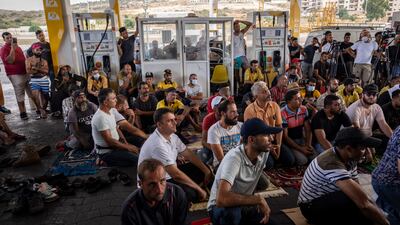
  • People listen to Al Hussein's sermon in the coastal town of Jiyeh, south of Beirut. AP
    People listen to Al Hussein's sermon in the coastal town of Jiyeh, south of Beirut. AP

Although widely used, electricity from private generators is much less cost-efficient than using state electricity, said Wassim Daher, head of water utility company the South Lebanon Water Establishment.

“We can pump up to 450 metres deep with government electricity – after that we start losing money,” he told The National.

“But if we are working on generators, that happens when we exceed 100 metres.”

Currently, the state provides the region’s pumping stations with only five or six hours of electricity a day, said Mr Daher.

Sometimes, there are 24-hour blackouts.

Most locals are prepared and have tanks on their roofs that store enough water for several days, but Mr Daher worries about how people will cope if water shortages persist.

“Challenges are adding up. It will be disastrous if the crisis continues,” he said.

“Our concern is that we reach a place where there will be an impact on the health of the population.”

No institution is immune from water cuts, and that includes hospitals, prisons, orphanages and schools, Mr Daher said.

“It’s not like electricity where you can just add a [power] line. We cannot send part of a water pipe to a hospital.”

Unicef echoed his concerns. “The cost of inaction will also impact hospitals, schools, and public healthcare centres. If they don’t have running water, disease outbreaks will increase in healthcare facilities,” it said in a July report on Lebanon’s water supply system.

Lack of access to safe water heightens the risk of outbreaks of waterborne disease, including acute watery diarrhoea and diseases long eradicated in Lebanon, such as cholera.

Diarrhoeal disease, often caused by bacteria ingested through contaminated food or water, is the second leading cause of death in children under 5, said the World Health Organisation.

Tap water is not commonly used for drinking in Lebanon because it is deemed unsafe, but if contaminated it might also affect health when used for cooking or bathing and may additionally contaminate reservoirs.

Local authorities have no control on the quality of water sold by private companies.

“Its quality is questionable,” said Mr Farajalla. “It may not be well treated and contain faecal coliform [bacteria] or pathogens that could affect people’s health.”

But quality is rarely the priority when water becomes scarce.

“I should be concerned about the source of the water because it’s probably not the cleanest,” Mr Kassar said, as he paid a private company to fill up his building’s tank.

“But at the end of the day, if you’ve got no solution, all you want is a temporary fix.”

McLaren GT specs

Engine: 4-litre twin-turbo V8

Transmission: seven-speed

Power: 620bhp

Torque: 630Nm

Price: Dh875,000

On sale: now

EA Sports FC 26

Publisher: EA Sports

Consoles: PC, PlayStation 4/5, Xbox Series X/S

Rating: 3/5

ESSENTIALS

The flights

Emirates flies direct from Dubai to Rio de Janeiro from Dh7,000 return including taxes. Avianca fliles from Rio to Cusco via Lima from $399 (Dhxx) return including taxes. 

The trip

From US$1,830 per deluxe cabin, twin share, for the one-night Spirit of the Water itinerary and US$4,630 per deluxe cabin for the Peruvian Highlands itinerary, inclusive of meals, and beverages. Surcharges apply for some excursions.

Ten tax points to be aware of in 2026

1. Domestic VAT refund amendments: request your refund within five years

If a business does not apply for the refund on time, they lose their credit.

2. E-invoicing in the UAE

Businesses should continue preparing for the implementation of e-invoicing in the UAE, with 2026 a preparation and transition period ahead of phased mandatory adoption. 

3. More tax audits

Tax authorities are increasingly using data already available across multiple filings to identify audit risks. 

4. More beneficial VAT and excise tax penalty regime

Tax disputes are expected to become more frequent and more structured, with clearer administrative objection and appeal processes. The UAE has adopted a new penalty regime for VAT and excise disputes, which now mirrors the penalty regime for corporate tax.

5. Greater emphasis on statutory audit

There is a greater need for the accuracy of financial statements. The International Financial Reporting Standards standards need to be strictly adhered to and, as a result, the quality of the audits will need to increase.

6. Further transfer pricing enforcement

Transfer pricing enforcement, which refers to the practice of establishing prices for internal transactions between related entities, is expected to broaden in scope. The UAE will shortly open the possibility to negotiate advance pricing agreements, or essentially rulings for transfer pricing purposes. 

7. Limited time periods for audits

Recent amendments also introduce a default five-year limitation period for tax audits and assessments, subject to specific statutory exceptions. While the standard audit and assessment period is five years, this may be extended to up to 15 years in cases involving fraud or tax evasion. 

8. Pillar 2 implementation 

Many multinational groups will begin to feel the practical effect of the Domestic Minimum Top-Up Tax (DMTT), the UAE's implementation of the OECD’s global minimum tax under Pillar 2. While the rules apply for financial years starting on or after January 1, 2025, it is 2026 that marks the transition to an operational phase.

9. Reduced compliance obligations for imported goods and services

Businesses that apply the reverse-charge mechanism for VAT purposes in the UAE may benefit from reduced compliance obligations. 

10. Substance and CbC reporting focus

Tax authorities are expected to continue strengthening the enforcement of economic substance and Country-by-Country (CbC) reporting frameworks. In the UAE, these regimes are increasingly being used as risk-assessment tools, providing tax authorities with a comprehensive view of multinational groups’ global footprints and enabling them to assess whether profits are aligned with real economic activity. 

Contributed by Thomas Vanhee and Hend Rashwan, Aurifer

You may remember …

Robbie Keane (Atletico de Kolkata) The Irish striker is, along with his former Spurs teammate Dimitar Berbatov, the headline figure in this season’s ISL, having joined defending champions ATK. His grand entrance after arrival from Major League Soccer in the US will be delayed by three games, though, due to a knee injury.

Dimitar Berbatov (Kerala Blasters) Word has it that Rene Meulensteen, the Kerala manager, plans to deploy his Bulgarian star in central midfield. The idea of Berbatov as an all-action, box-to-box midfielder, might jar with Spurs and Manchester United supporters, who more likely recall an always-languid, often-lazy striker.

Wes Brown (Kerala Blasters) Revived his playing career last season to help out at Blackburn Rovers, where he was also a coach. Since then, the 23-cap England centre back, who is now 38, has been reunited with the former Manchester United assistant coach Meulensteen, after signing for Kerala.

Andre Bikey (Jamshedpur) The Cameroonian defender is onto the 17th club of a career has taken him to Spain, Portugal, Russia, the UK, Greece, and now India. He is still only 32, so there is plenty of time to add to that tally, too. Scored goals against Liverpool and Chelsea during his time with Reading in England.

Emiliano Alfaro (Pune City) The Uruguayan striker has played for Liverpool – the Montevideo one, rather than the better-known side in England – and Lazio in Italy. He was prolific for a season at Al Wasl in the Arabian Gulf League in 2012/13. He returned for one season with Fujairah, whom he left to join Pune.

What drives subscription retailing?

Once the domain of newspaper home deliveries, subscription model retailing has combined with e-commerce to permeate myriad products and services.

The concept has grown tremendously around the world and is forecast to thrive further, according to UnivDatos Market Insights’ report on recent and predicted trends in the sector.

The global subscription e-commerce market was valued at $13.2 billion (Dh48.5bn) in 2018. It is forecast to touch $478.2bn in 2025, and include the entertainment, fitness, food, cosmetics, baby care and fashion sectors.

The report says subscription-based services currently constitute “a small trend within e-commerce”. The US hosts almost 70 per cent of recurring plan firms, including leaders Dollar Shave Club, Hello Fresh and Netflix. Walmart and Sephora are among longer established retailers entering the space.

UnivDatos cites younger and affluent urbanites as prime subscription targets, with women currently the largest share of end-users.

That’s expected to remain unchanged until 2025, when women will represent a $246.6bn market share, owing to increasing numbers of start-ups targeting women.

Personal care and beauty occupy the largest chunk of the worldwide subscription e-commerce market, with changing lifestyles, work schedules, customisation and convenience among the chief future drivers.

Our family matters legal consultant

Name: Hassan Mohsen Elhais

Position: legal consultant with Al Rowaad Advocates and Legal Consultants.

Analysis

Members of Syria's Alawite minority community face threat in their heartland after one of the deadliest days in country’s recent history. Read more

Desert Warrior

Starring: Anthony Mackie, Aiysha Hart, Ben Kingsley

Director: Rupert Wyatt

Rating: 3/5

THE BIO

Born: Mukalla, Yemen, 1979

Education: UAE University, Al Ain

Family: Married with two daughters: Asayel, 7, and Sara, 6

Favourite piece of music: Horse Dance by Naseer Shamma

Favourite book: Science and geology

Favourite place to travel to: Washington DC

Best advice you’ve ever been given: If you have a dream, you have to believe it, then you will see it.

FROM%20THE%20ASHES
%3Cp%3EDirector%3A%20Khalid%20Fahad%3C%2Fp%3E%0A%3Cp%3EStarring%3A%20Shaima%20Al%20Tayeb%2C%20Wafa%20Muhamad%2C%20Hamss%20Bandar%3C%2Fp%3E%0A%3Cp%3ERating%3A%203%2F5%3C%2Fp%3E%0A
Updated: September 12, 2021, 5:06 AM