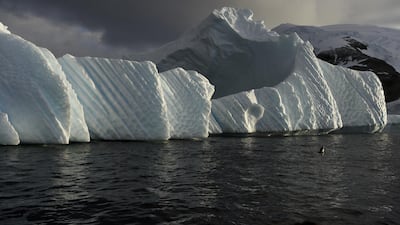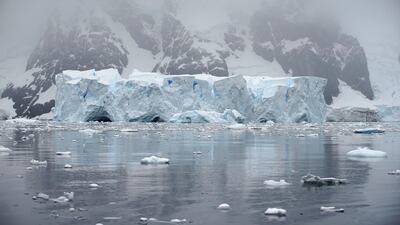
An iceberg floats in Andvord Bay, Antarctica. The Southern Ocean has been officially recognised by the National Geographic Society. Reuters

What is the Southern Ocean? National Geographic recognises water body as world's fifth ocean


  • English
  • Arabic

Its existence has been acknowledged by scientists for decades, but the National Geographic Society is hoping formal recognition of the Southern Ocean as the world’s fifth ocean will shine a much-needed spotlight on the conservation of the region.

The body of water encircling Antarctica is unique and therefore deserving of its own name, says the non-profit, which made the official recognition on World Oceans Day on Tuesday.

Since it began making maps in 1915, National Geographic has recognised four oceans: the Atlantic, Pacific, Indian and Arctic.

What is the Southern Ocean?

The Southern Ocean constitutes "most of the waters that surround Antarctica out to 60 degrees south latitude", the organisation says. Geographers have debated whether the waters had enough characteristics to deserve their own name.

“The Southern Ocean has long been recognised by scientists, but because there was never agreement internationally, we never officially recognised it,” National Geographic Society geographer Alex Tait says in an article published on its website.

“We’ve always labelled it, but we labelled it slightly differently [than other oceans]. This change was taking the last step and saying we want to recognise it because of its ecological separation.”

Who else recognises the Southern Ocean?

For marine names, National Geographic says it has followed the International Hydrographic Organisation, which works with the UN to standardise international names. The IHO first recognised the Southern Ocean in its 1937 guidelines but repealed that designation in 1953, citing controversy.

The US Board on Geographic Names, however, has used the name since 1999.

Another US body, the National Oceanic and Atmospheric Administration, also officially recognised the Southern Ocean in February.

How is the Southern Ocean different?

While the other oceans are defined by the continents that fence them in, the Southern Ocean is defined by a current, National Geographic says.

“The Antarctic Circumpolar Current flows from west to east around Antarctica, in a broad fluctuating band roughly centred around a latitude of 60 degrees south – the line that is now defined as the northern boundary of the Southern Ocean.

"Inside the ACC, the waters are colder and slightly less salty than ocean waters to the north.”

The decision to officially recognise the fifth ocean was intended to draw attention to its conservation, it says.

“By fencing in the frigid southern waters, the ACC helps keep Antarctica cold and the Southern Ocean ecologically distinct. Thousands of species live there and nowhere else,” it says.

The recognition will also affect how children use maps in school, Tait says.

"I think one of the biggest impacts is through education. "Students learn information about the ocean world through what oceans you're studying. If you don't include the Southern Ocean then you don't learn the specifics of it and how important it is."

As part of the new designation, National Geographic will update its maps and atlases.

________________

Read more: 

World Oceans Day: five coastal resorts that offer ocean conservation experiences to travellers

UK welcomes UAE's support on oceans initiative

________________

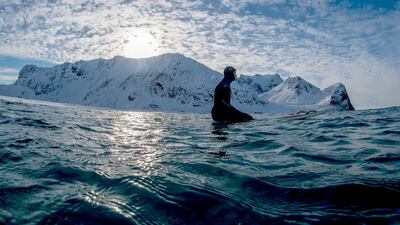
  • Surf instructor Tommy Olsen teachers beginners how to ride the waves in Norway's Lofoten Island in the Arctic Circle. AFP
    Surf instructor Tommy Olsen teachers beginners how to ride the waves in Norway's Lofoten Island in the Arctic Circle. AFP
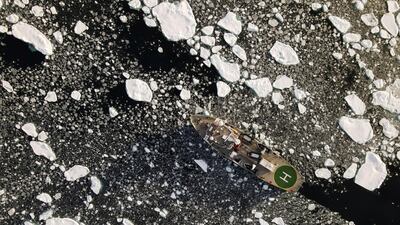
  • Greenpeace's 'Arctic Sunrise' ship navigates through floating ice in the Arctic Ocean. Reuters
    Greenpeace's 'Arctic Sunrise' ship navigates through floating ice in the Arctic Ocean. Reuters
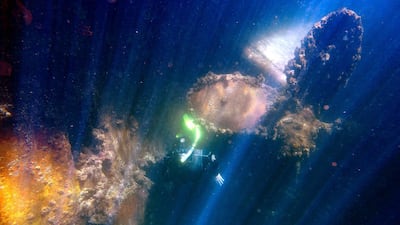
  • A snorkler identifies species growing on the hull of a ship during a marine biology survey in the Indian Ocean in False Bay, Cape Town. EPA
    A snorkler identifies species growing on the hull of a ship during a marine biology survey in the Indian Ocean in False Bay, Cape Town. EPA
  • An iceberg in the western Antarctic peninsula. AFP
    An iceberg in the western Antarctic peninsula. AFP
  • Millions of pieces of plastic, micro plastics and debris are visible in the ocean as a free diver collects litter during the Big Ocean Clean Up in Hermanus, South Africa. EPA
    Millions of pieces of plastic, micro plastics and debris are visible in the ocean as a free diver collects litter during the Big Ocean Clean Up in Hermanus, South Africa. EPA
  • Bioluminescent algae glows in the crashing waves as a lifeguard tower sits on an empty beach in Encinitas, California. Reuters
    Bioluminescent algae glows in the crashing waves as a lifeguard tower sits on an empty beach in Encinitas, California. Reuters
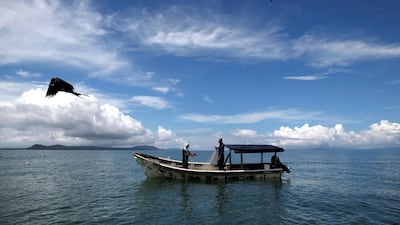
  • Two men prepare a net to fish in the port of Palo Seco, in the Gulf of Montijo in Mariato, Veraguas, Panama. EPA
    Two men prepare a net to fish in the port of Palo Seco, in the Gulf of Montijo in Mariato, Veraguas, Panama. EPA
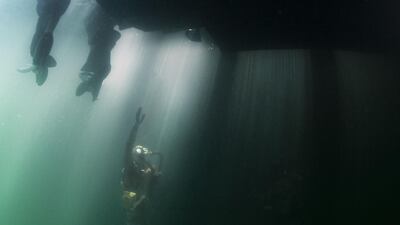
  • A sailor assigned to Naval Special Warfare Group 2 conducting military dive operations in the Atlantic Ocean off the US east coast. AFP
    A sailor assigned to Naval Special Warfare Group 2 conducting military dive operations in the Atlantic Ocean off the US east coast. AFP
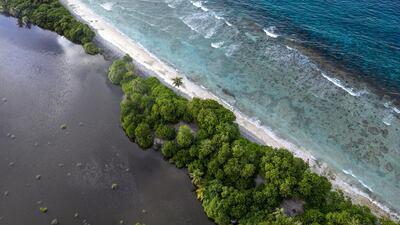
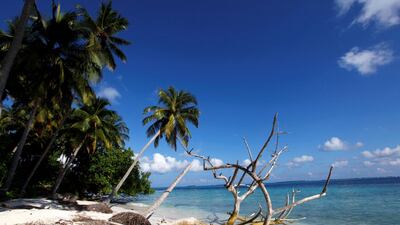
  • The Indian Ocean laps the Koattey wetlands in Hithadhoo, Maldives. Getty Images
    The Indian Ocean laps the Koattey wetlands in Hithadhoo, Maldives. Getty Images
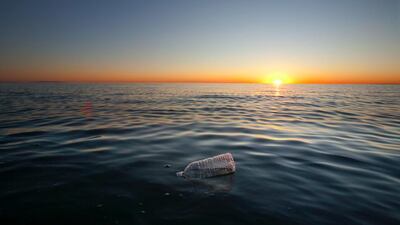
  • A plastic bottle floats in the water. Photo: National Geographic Abu Dhabi
    A plastic bottle floats in the water. Photo: National Geographic Abu Dhabi
  • World Oceans Day helps to raise awareness of issues blighting the environment, such as plastic pollution. Photo: National Geographic Abu Dhabi
    World Oceans Day helps to raise awareness of issues blighting the environment, such as plastic pollution. Photo: National Geographic Abu Dhabi
  • This powerful image highlights the growing problem of plastic pollution. Photo: National Geographic
    This powerful image highlights the growing problem of plastic pollution. Photo: National Geographic
  • A species of dolphin, known as the false killer whale, thrives in tropical and subtropical oceans. Photo: Dr Csaba Geczy
    A species of dolphin, known as the false killer whale, thrives in tropical and subtropical oceans. Photo: Dr Csaba Geczy
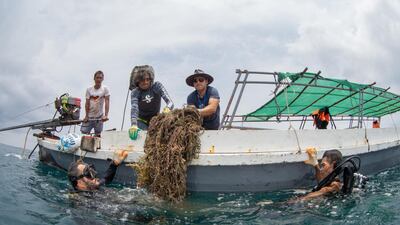
  • More than 300 kilograms of ghost nets were retrieved by the team of divers cleaning up the ocean in the Mergui archipelago, Myanmar.
    More than 300 kilograms of ghost nets were retrieved by the team of divers cleaning up the ocean in the Mergui archipelago, Myanmar.
  • Fish swim along the edges of a coral reef off Great Keppel Island in Australia. AP
    Fish swim along the edges of a coral reef off Great Keppel Island in Australia. AP
  • This satellite image from the US National Oceanic and Atmospheric Administration shows a plume of smoke from the Saddleridge wildfire streaming out over the Pacific Ocean. AP
    This satellite image from the US National Oceanic and Atmospheric Administration shows a plume of smoke from the Saddleridge wildfire streaming out over the Pacific Ocean. AP
  • The temperature of the world’s oceans is rising dramatically. Reuters
    The temperature of the world’s oceans is rising dramatically. Reuters
  • From the Great Barrier Reef to the Arabian Gulf and beyond, protecting the seas and oceans is about as urgent an issue as you could hope to find, marine scientists say. Getty Images
    From the Great Barrier Reef to the Arabian Gulf and beyond, protecting the seas and oceans is about as urgent an issue as you could hope to find, marine scientists say. Getty Images
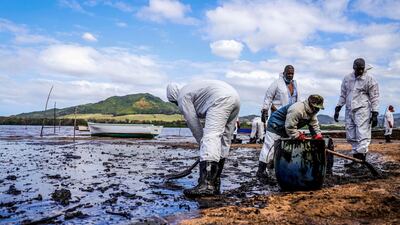
  • People scoop leaked oil from the vessel 'MV Wakashio' that ran aground and caused oil leakage near Blue Bay Marine Park in south-east Mauritius. AFP
    People scoop leaked oil from the vessel 'MV Wakashio' that ran aground and caused oil leakage near Blue Bay Marine Park in south-east Mauritius. AFP
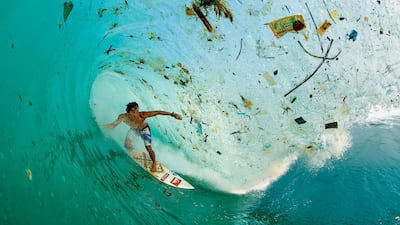
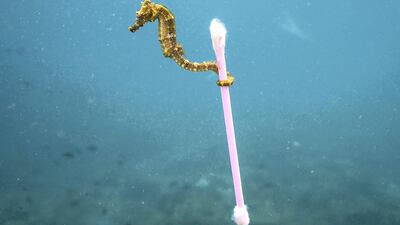
  • This award-winning image from 2017 proved a striking example of the damage being done to the ocean by discarded rubbish. Photo: Justin Hofman
    This award-winning image from 2017 proved a striking example of the damage being done to the ocean by discarded rubbish. Photo: Justin Hofman
The%20specs
%3Cp%3E%3Cstrong%3EEngine%3A%3C%2Fstrong%3E%201.8-litre%204-cyl%20turbo%0D%3Cbr%3E%3Cstrong%3EPower%3A%20%3C%2Fstrong%3E190hp%20at%205%2C200rpm%0D%3Cbr%3E%3Cstrong%3ETorque%3A%3C%2Fstrong%3E%20320Nm%20from%201%2C800-5%2C000rpm%0D%3Cbr%3E%3Cstrong%3ETransmission%3A%20%3C%2Fstrong%3ESeven-speed%20dual-clutch%20auto%0D%3Cbr%3E%3Cstrong%3EFuel%20consumption%3A%3C%2Fstrong%3E%206.7L%2F100km%0D%3Cbr%3E%3Cstrong%3EPrice%3A%3C%2Fstrong%3E%20From%20Dh111%2C195%0D%3Cbr%3E%3Cstrong%3EOn%20sale%3A%20%3C%2Fstrong%3ENow%3C%2Fp%3E%0A
Singham Again

Director: Rohit Shetty

Stars: Ajay Devgn, Kareena Kapoor Khan, Ranveer Singh, Akshay Kumar, Tiger Shroff, Deepika Padukone

Rating: 3/5

Scoreline

Arsenal 3
Aubameyang (28'), Welbeck (38', 81')
Red cards: El Neny (90' 3)

Southampton 2
Long (17'), Austin (73')
Red cards: Stephens (90' 2)

Ten tax points to be aware of in 2026

1. Domestic VAT refund amendments: request your refund within five years

If a business does not apply for the refund on time, they lose their credit.

2. E-invoicing in the UAE

Businesses should continue preparing for the implementation of e-invoicing in the UAE, with 2026 a preparation and transition period ahead of phased mandatory adoption. 

3. More tax audits

Tax authorities are increasingly using data already available across multiple filings to identify audit risks. 

4. More beneficial VAT and excise tax penalty regime

Tax disputes are expected to become more frequent and more structured, with clearer administrative objection and appeal processes. The UAE has adopted a new penalty regime for VAT and excise disputes, which now mirrors the penalty regime for corporate tax.

5. Greater emphasis on statutory audit

There is a greater need for the accuracy of financial statements. The International Financial Reporting Standards standards need to be strictly adhered to and, as a result, the quality of the audits will need to increase.

6. Further transfer pricing enforcement

Transfer pricing enforcement, which refers to the practice of establishing prices for internal transactions between related entities, is expected to broaden in scope. The UAE will shortly open the possibility to negotiate advance pricing agreements, or essentially rulings for transfer pricing purposes. 

7. Limited time periods for audits

Recent amendments also introduce a default five-year limitation period for tax audits and assessments, subject to specific statutory exceptions. While the standard audit and assessment period is five years, this may be extended to up to 15 years in cases involving fraud or tax evasion. 

8. Pillar 2 implementation 

Many multinational groups will begin to feel the practical effect of the Domestic Minimum Top-Up Tax (DMTT), the UAE's implementation of the OECD’s global minimum tax under Pillar 2. While the rules apply for financial years starting on or after January 1, 2025, it is 2026 that marks the transition to an operational phase.

9. Reduced compliance obligations for imported goods and services

Businesses that apply the reverse-charge mechanism for VAT purposes in the UAE may benefit from reduced compliance obligations. 

10. Substance and CbC reporting focus

Tax authorities are expected to continue strengthening the enforcement of economic substance and Country-by-Country (CbC) reporting frameworks. In the UAE, these regimes are increasingly being used as risk-assessment tools, providing tax authorities with a comprehensive view of multinational groups’ global footprints and enabling them to assess whether profits are aligned with real economic activity. 

Contributed by Thomas Vanhee and Hend Rashwan, Aurifer

The specs: 2018 Infiniti QX80

Price: base / as tested: Dh335,000

Engine: 5.6-litre V8

Gearbox: Seven-speed automatic

Power: 400hp @ 5,800rpm

Torque: 560Nm @ 4,000rpm

Fuel economy, combined: 12.1L / 100km

Traces%20of%20Enayat
%3Cp%3E%3Cstrong%3EAuthor%3A%3C%2Fstrong%3E%20Iman%20Mersal%3Cbr%3E%3Cstrong%3EPublisher%3A%3C%2Fstrong%3E%20And%20Other%20Stories%3Cbr%3E%3Cstrong%3EPages%3A%3C%2Fstrong%3E%20240%3C%2Fp%3E%0A
SPEC%20SHEET%3A%20APPLE%20IPAD%20PRO%20(12.9%22%2C%202022)
%3Cp%3E%3Cstrong%3EDisplay%3A%3C%2Fstrong%3E%2012.9-inch%20Liquid%20Retina%20XDR%2C%202%2C732%20x%202%2C048%2C%20264ppi%2C%20wide%20colour%2C%20True%20Tone%2C%20ProMotion%2C%201%2C600%20nits%20max%2C%20Apple%20Pencil%20hover%3C%2Fp%3E%0A%3Cp%3E%3Cstrong%3EChip%3A%3C%2Fstrong%3E%20Apple%20M2%2C%208-core%20CPU%2C%2010-core%20GPU%2C%2016-core%20Neural%20Engine%3C%2Fp%3E%0A%3Cp%3E%3Cstrong%3EMemory%3A%3C%2Fstrong%3E%20Storage%20%E2%80%93%20128GB%2F256GB%2F512GB%20%2F%201TB%2F2TB%3B%20RAM%20%E2%80%93%208GB%2F16GB%3C%2Fp%3E%0A%3Cp%3E%3Cstrong%3EPlatform%3A%3C%2Fstrong%3E%20iPadOS%2016%3C%2Fp%3E%0A%3Cp%3E%3Cstrong%3EMain%20camera%3A%3C%2Fstrong%3E%20Dual%2012MP%20wide%20(f%2F1.8)%20%2B%2010MP%20ultra-wide%20(f%2F2.4)%2C%202x%20optical%2F5x%20digital%2C%20Smart%20HDR%204%3C%2Fp%3E%0A%3Cp%3E%3Cstrong%3EVideo%3A%3C%2Fstrong%3E%20ProRes%204K%20%40%2030fps%2C%204K%20%40%2024%2F25%2F30%2F60fps%2C%20full%20HD%20%40%2025%2F30%2F60fps%2C%20slo-mo%20%40%20120%2F240fps%3C%2Fp%3E%0A%3Cp%3E%3Cstrong%3EFront%20camera%3A%3C%2Fstrong%3E%20TrueDepth%2012MP%20ultra-wide%20(f%2F2.4)%2C%202x%2C%20Smart%20HDR%204%2C%20Centre%20Stage%2C%20Portrait%2C%20Animoji%2C%20Memoji%3B%20full%20HD%20%40%2025%2F30%2F60fps%3C%2Fp%3E%0A%3Cp%3E%3Cstrong%3EAudio%3A%3C%2Fstrong%3E%20Four-speaker%20stereo%3C%2Fp%3E%0A%3Cp%3E%3Cstrong%3EBiometrics%3A%3C%2Fstrong%3E%20Face%20ID%2C%20Touch%20ID%3C%2Fp%3E%0A%3Cp%3E%3Cstrong%3EI%2FO%3A%3C%2Fstrong%3E%20USB-C%2C%20smart%20connector%20(for%20folio%2Fkeyboard)%3C%2Fp%3E%0A%3Cp%3E%3Cstrong%3EBattery%3A%3C%2Fstrong%3E%20Up%20to%2010%20hours%20on%20Wi-Fi%3B%20up%20to%20nine%20hours%20on%20cellular%3C%2Fp%3E%0A%3Cp%3E%3Cstrong%3EFinish%3A%3C%2Fstrong%3E%20Silver%2C%20space%20grey%3C%2Fp%3E%0A%3Cp%3E%3Cstrong%3EIn%20the%20box%3A%3C%2Fstrong%3E%20iPad%2C%20USB-C-to-USB-C%20cable%2C%2020-watt%20power%20adapter%3C%2Fp%3E%0A%3Cp%3E%3Cstrong%3EPrice%3A%3C%2Fstrong%3E%20WiFi%20%E2%80%93%20Dh4%2C599%20(128GB)%20%2F%20Dh4%2C999%20(256GB)%20%2F%20Dh5%2C799%20(512GB)%20%2F%20Dh7%2C399%20(1TB)%20%2F%20Dh8%2C999%20(2TB)%3B%20cellular%20%E2%80%93%20Dh5%2C199%20%2F%20Dh5%2C599%20%2F%20Dh6%2C399%20%2F%20Dh7%2C999%20%2F%20Dh9%2C599%3C%2Fp%3E%0A
The National Archives, Abu Dhabi

Founded over 50 years ago, the National Archives collects valuable historical material relating to the UAE, and is the oldest and richest archive relating to the Arabian Gulf.

Much of the material can be viewed on line at the Arabian Gulf Digital Archive - https://www.agda.ae/en

The major Hashd factions linked to Iran:

Badr Organisation: Seen as the most militarily capable faction in the Hashd. Iraqi Shiite exiles opposed to Saddam Hussein set up the group in Tehran in the early 1980s as the Badr Corps under the supervision of the Iran Revolutionary Guards Corps (IRGC). The militia exalts Iran’s Supreme Leader Ali Khamenei but intermittently cooperated with the US military.

Saraya Al Salam (Peace Brigade): Comprised of former members of the officially defunct Mahdi Army, a militia that was commanded by Iraqi cleric Moqtada Al Sadr and fought US and Iraqi government and other forces between 2004 and 2008. As part of a political overhaul aimed as casting Mr Al Sadr as a more nationalist and less sectarian figure, the cleric formed Saraya Al Salam in 2014. The group’s relations with Iran has been volatile.

Kataeb Hezbollah: The group, which is fighting on behalf of the Bashar Al Assad government in Syria, traces its origins to attacks on US forces in Iraq in 2004 and adopts a tough stance against Washington, calling the United States “the enemy of humanity”.

Asaeb Ahl Al Haq: An offshoot of the Mahdi Army active in Syria. Asaeb Ahl Al Haq’s leader Qais al Khazali was a student of Mr Al Moqtada’s late father Mohammed Sadeq Al Sadr, a prominent Shiite cleric who was killed during Saddam Hussein’s rule.

Harakat Hezbollah Al Nujaba: Formed in 2013 to fight alongside Mr Al Assad’s loyalists in Syria before joining the Hashd. The group is seen as among the most ideological and sectarian-driven Hashd militias in Syria and is the major recruiter of foreign fighters to Syria.

Saraya Al Khorasani:  The ICRG formed Saraya Al Khorasani in the mid-1990s and the group is seen as the most ideologically attached to Iran among Tehran’s satellites in Iraq.

(Source: The Wilson Centre, the International Centre for the Study of Radicalisation)

THE BIO

Favourite car: Koenigsegg Agera RS or Renault Trezor concept car.

Favourite book: I Am Pilgrim by Terry Hayes or Red Notice by Bill Browder.

Biggest inspiration: My husband Nik. He really got me through a lot with his positivity.

Favourite holiday destination: Being at home in Australia, as I travel all over the world for work. It’s great to just hang out with my husband and family.