South Korean carmakers have made Neil Armstong-esque strides in recent years, with both Hyundai and Kia now turning out offerings that are, in many cases, better than their Japanese rivals. Then there’s Genesis, a premium offshoot of Hyundai that has been quietly percolating in the background, gradually honing its game to the extent that its latest products are no longer merely cheap alternatives to models from Lexus and Infiniti.
The newly launched GV80 is arguably the most ambitious Genesis vehicle to date. It’s the first SUV from the brand, and its Dh299,000 ($81,415) starting price tag puts it up against not only the Japanese upmarket brands, but also Euro heavyweights such as the Range Rover Velar, Audi Q7, Mercedes GLE and Maserati Levante. Not a small task, in other words.
Impressive surface
The ingredients are promising, as the GV80’s visually arresting bodywork has hints of the Bentley Bentayga in it, although most will agree it’s a far better-looking wagon than the posh Brit. There’s little chance of the Genesis being mistaken for anything else, thanks in no small part to that massive crest-shaped grille, which is flanked by distinctive two-tier headlights. The profile has a sporty taper to it, while the sharp-edged derriere is also well resolved. Chances are, your neighbour will be impressed when he or she ambles over for a closer look.
Downsides? Sadly, anything that’s coated in shiny chrome is, in fact, plastic – and that includes the ginormous grille that’s such a key element in the GV80’s design. However, few are likely to realise this unless they tap it with their fingernail and hear an unimpressive “clack”, rather than a nice metallic “ping”.
The cabin appears to have an upmarket ambience, but here, too, the thrifty Genesis bean-counters have ensured that anything that looks like wood or metal … isn’t. The plastic bonanza detracts from the car’s upmarket aspirations and is a tad disappointing in a vehicle that will set you back nearly Dh300,000.
That said, the Nappa leather seats are cosseting, whether you’re in the front or back, and there’s acres of sprawling room everywhere. We sampled the range-topping 4WD Royal, which comes with goodies such as bling-tastic 22-inch wheels, a large digitised instrument cluster, 14.5-inch central touchscreen, power-operated tailgate and more safety kit and driver aids than you can poke a stick at.
Steady performer
The GV80 doesn’t disappoint once underway, as that 3.5-litre twin-turbo V6 serves up ample grunt, although it begins to sound coarse if you mash the throttle and get the revs soaring. However, it’s suitably muted at steady cruising speeds, and there’s not much to fault with the eight-speed auto, which goes about its work smoothly and unobtrusively.
Apart from its supple ride, the GV80 feels decently taut and nimble, in spite of its lofty stature (1,715 millimetres) and hefty girth (2,240 kilograms). You can tip it into corners with a decent level of vigour without the big SUV degenerating into a soggy understeering mess.
Although the V6 is the only powertrain offered locally in the UAE for now, a less expensive 2.5-litre four-cylinder turbo variant – with healthy outputs of 300 horsepower and 421Nm – will be added to the GV80 range in due course.
_________________
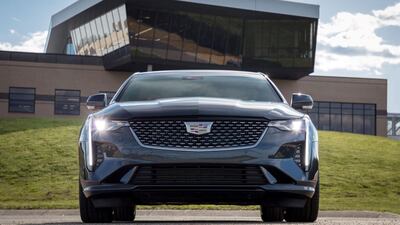
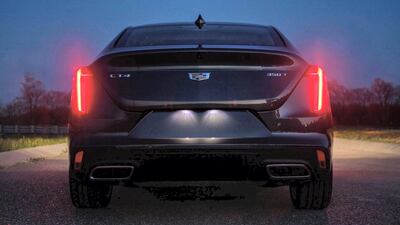
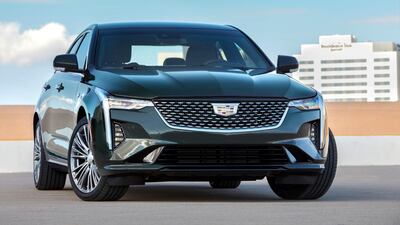
How the Cadillac CT-4 gives refined edge to power
The Cadillac CT-4 has power and a touch of refinement. All photos courtesy Cadillac
Sleek lines on the CT-4.
The CT-4 has nine interior colour and trim environments to choose from.
Many will spot that as a Cadillac light configuration without needing to see anything more.
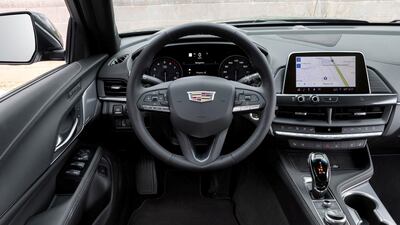
Seating at the front has numerous settings, as well as seat heating, ventilation and lumbar massage options.
The CT-4, pictured here in its V-Series guise, comes in four versions.
There is a good range of kit in the CT-4.
_________________
Tech talk
There’s a decent level of refinement in the way the GV80 rides and handles. Genesis has incorporated its own version of Mercedes-Benz’s Magic Body Control in the newbie, and this tech uses a front-facing camera to scan the road and pre-emptively adjust the suspension to soak up whatever imperfections lie ahead – be it a pothole or a speed bump.
Overall, there’s much to like about the way the GV80 has been packaged and how it drives. The Genesis designers and engineers have got so much right with this car that it’s a pity they don’t go the extra half-mile and incorporate genuine materials throughout the vehicle. Every car incorporates plastic to some degree, but, in an offering with overtly premium aspirations, it’s almost a given that the obvious touch-and-see elements that are presented as wood and metal should be nothing else.
As it stands, the GV80 is further evidence of Genesis’s unrelenting pursuit of excellence.

COMPANY PROFILE
Name: Kumulus Water
Started: 2021
Founders: Iheb Triki and Mohamed Ali Abid
Based: Tunisia
Sector: Water technology
Number of staff: 22
Investment raised: $4 million
Score
Third Test, Day 2
New Zealand 274
Pakistan 139-3 (61 ov)
Pakistan trail by 135 runs with 7 wickets remaining in the innings
EU fishing vessels guaranteed access to UK waters for 12 years
Co-operation on security initiatives and procurement of defence products
Youth experience scheme to work, study or volunteer in UK and EU countries
Smoother border management with use of e-gates
Cutting red tape on import and export of food
Why your domicile status is important
Your UK residence status is assessed using the statutory residence test. While your residence status – ie where you live - is assessed every year, your domicile status is assessed over your lifetime.
Your domicile of origin generally comes from your parents and if your parents were not married, then it is decided by your father. Your domicile is generally the country your father considered his permanent home when you were born.
UK residents who have their permanent home ("domicile") outside the UK may not have to pay UK tax on foreign income. For example, they do not pay tax on foreign income or gains if they are less than £2,000 in the tax year and do not transfer that gain to a UK bank account.
A UK-domiciled person, however, is liable for UK tax on their worldwide income and gains when they are resident in the UK.
UAE currency: the story behind the money in your pockets
Engine: Two permanent-magnet synchronous AC motors
Transmission: two-speed
Power: 671hp
Torque: 849Nm
Range: 456km
Price: from Dh437,900
On sale: now
Europe’s rearming plan
Suspend strict budget rules to allow member countries to step up defence spending
Create new "instrument" providing €150 billion of loans to member countries for defence investment
Use the existing EU budget to direct more funds towards defence-related investment
Engage the bloc's European Investment Bank to drop limits on lending to defence firms
Create a savings and investments union to help companies access capital
Hili 2: Unesco World Heritage site
The site is part of the Hili archaeological park in Al Ain. Excavations there have proved the existence of the earliest known agricultural communities in modern-day UAE. Some date to the Bronze Age but Hili 2 is an Iron Age site. The Iron Age witnessed the development of the falaj, a network of channels that funnelled water from natural springs in the area. Wells allowed settlements to be established, but falaj meant they could grow and thrive. Unesco, the UN's cultural body, awarded Al Ain's sites - including Hili 2 - world heritage status in 2011. Now the most recent dig at the site has revealed even more about the skilled people that lived and worked there.
Avatar: Fire and Ash
Director: James Cameron
Starring: Sam Worthington, Sigourney Weaver, Zoe Saldana
Rating: 4.5/5
The National's picks
4.35pm: Tilal Al Khalediah 5.10pm: Continous 5.45pm: Raging Torrent 6.20pm: West Acre 7pm: Flood Zone 7.40pm: Straight No Chaser 8.15pm: Romantic Warrior 8.50pm: Calandogan 9.30pm: Forever Young
Mercer, the investment consulting arm of US services company Marsh & McLennan, expects its wealth division to at least double its assets under management (AUM) in the Middle East as wealth in the region continues to grow despite economic headwinds, a company official said.
Mercer Wealth, which globally has $160 billion in AUM, plans to boost its AUM in the region to $2-$3bn in the next 2-3 years from the present $1bn, said Yasir AbuShaban, a Dubai-based principal with Mercer Wealth.
“Within the next two to three years, we are looking at reaching $2 to $3 billion as a conservative estimate and we do see an opportunity to do so,” said Mr AbuShaban.
Mercer does not directly make investments, but allocates clients’ money they have discretion to, to professional asset managers. They also provide advice to clients.
“We have buying power. We can negotiate on their (client’s) behalf with asset managers to provide them lower fees than they otherwise would have to get on their own,” he added.
Mercer Wealth’s clients include sovereign wealth funds, family offices, and insurance companies among others.
From its office in Dubai, Mercer also looks after Africa, India and Turkey, where they also see opportunity for growth.
Wealth creation in Middle East and Africa (MEA) grew 8.5 per cent to $8.1 trillion last year from $7.5tn in 2015, higher than last year’s global average of 6 per cent and the second-highest growth in a region after Asia-Pacific which grew 9.9 per cent, according to consultancy Boston Consulting Group (BCG). In the region, where wealth grew just 1.9 per cent in 2015 compared with 2014, a pickup in oil prices has helped in wealth generation.
BCG is forecasting MEA wealth will rise to $12tn by 2021, growing at an annual average of 8 per cent.
Drivers of wealth generation in the region will be split evenly between new wealth creation and growth of performance of existing assets, according to BCG.
Another general trend in the region is clients’ looking for a comprehensive approach to investing, according to Mr AbuShaban.
“Institutional investors or some of the families are seeing a slowdown in the available capital they have to invest and in that sense they are looking at optimizing the way they manage their portfolios and making sure they are not investing haphazardly and different parts of their investment are working together,” said Mr AbuShaban.
Some clients also have a higher appetite for risk, given the low interest-rate environment that does not provide enough yield for some institutional investors. These clients are keen to invest in illiquid assets, such as private equity and infrastructure.
“What we have seen is a desire for higher returns in what has been a low-return environment specifically in various fixed income or bonds,” he said.
“In this environment, we have seen a de facto increase in the risk that clients are taking in things like illiquid investments, private equity investments, infrastructure and private debt, those kind of investments were higher illiquidity results in incrementally higher returns.”
The Abu Dhabi Investment Authority, one of the largest sovereign wealth funds, said in its 2016 report that has gradually increased its exposure in direct private equity and private credit transactions, mainly in Asian markets and especially in China and India. The authority’s private equity department focused on structured equities owing to “their defensive characteristics.”