

Lamborghinis are synonymous with many attributes: lung-compressing acceleration, brain-boggling cornering/braking dynamics and edgy, traffic-stopping styling are merely the obvious ones.
No less intrinsic than these qualities is an operatic V12 engine, as this has been a key ingredient of the marque’s flagship models, ever since the company was founded in 1963 by Ferruccio Lamborghini.
For diehard Raging Bull aficionados, it’s heartening to see Lamborghini is staying true to its V12 heritage with the soon-to-be-launched Revuelto hypercar, even as many other carmakers embrace a pure-electric strategy in the belief that battery power is the only sustainable solution for the automotive industry.
Lamborghini’s top brass is well aware of the talisman effect of a naturally aspirated V12, as this engine configuration provides inimitable characteristics – not the least of which is a spine-tingling soundtrack. The Bolognese carmaker says it’s committed to extending the V12 lineage for as many years as possible, even as ever-tightening emissions regulations are increasing the challenge of doing so.
In a glorious celebration of its 60th birthday this year, Lamborghini provided us with the once-in-a-lifetime opportunity to sample virtually the entire ancestral bloodline of its modern-day Revuelto V12 flagship on sinuous roads winding across the Bolognese hills.
Join us as we put you in the driver’s seat of a succession of historic Lambo V12 icons.
400 GT 2+2

Lamborghini’s first production car, the 350 GT, was built from 1964-66 and it was succeeded in 1966 by the 400 GT 2+2, which carried over the former’s essence, albeit with a few key changes.
As denoted by its 2+2 designation, the newcomer was equipped with rear seats (unlike its two-seat predecessor), and its bodywork was fabricated from steel in lieu of aluminium. In addition, the V12 was enlarged from 3.5 to 3.9 litres, bumping up power from 280 to 320hp.
Of all the classic Lamborghinis assembled for our somewhat surreal V12 drive day, the 400 GT 2+2 is the one I can’t stop ogling. It may be almost 60 years old, but the car has a timeless beauty that will likely endure even a hundred years from now.
Unlike the aggressive, sharply contoured Lambos of today, the 400 GT’s bodywork – crafted by Milan-based coachbuilder Carrozzeria Touring – is replete with sensual curves, while its long-snout/short-tail proportions signal its orientation as a Grand Tourer, rather than lap-record chaser.
The 400 GT’s 3.9-litre V12 fires up with less drama than I had anticipated. There’s an exotic timbre to its soundtrack, but it’s not by any means shouty. The svelte grand tourer glides away from standstill with effortless refinement. The five-speed manual transmission is light and slick, and the V12 has enough low-down torque to not necessitate feathering the clutch.

Winding through the Bolognese hills, I’m teleported back to the Swinging Sixties. The 400 GT’s driving position is hardly ideal, as my head is virtually in line with the top of the windscreen once I’ve adjusted the seat to comfortably reach the pedals. You learn to adjust to this after a few kilometres, and the same goes for the large wooden-rimmed steering, which has so much play that copious wheel twirling is required to keep the car on track across the winding roads we’re traversing. As for the tiny windscreen wipers, they may as well not be there as they sweep only a small portion of the screen.
The 400 GT isn’t especially quick by today’s standards, but that hardly matters. You instead savour its loping touring ability, and all your senses are bathed by the Lambo’s old-world charm. You could easily envisage crossing a continent in this stylish grand tourer, unlike the next car I hop into…
Miura SV

The sublimely sculpted Miura is a car that would never have come into existence if Lamborghini’s three top engineers at the time – Gian Paolo Dallara, Paolo Stanzani and Bob Wallace – hadn’t taken it upon themselves to develop in their spare time a prototype they dubbed P400.
Ferruccio Lamborghini had envisioned his eponymous marque as being a purveyor of grand tourers rather than hardcore performance cars, but the Miura – which the P400 evolved into – changed all that. Such was the rapturous response to the Marcello Gandini-styled coupe concept at its 1966 Geneva motor show debut that Lamborghini simply had to build it.
The initial P400 designation was shorthand for ‘Posteriore 400’, reflecting the car’s rear-mid-engined layout and the 4.0-litre capacity of its V12. Later models were referred to as the P400S and P400SV, and the latter is the car we’re driving today.
With a quartet of three-barrel Weber carburettors and more aggressive cam timing, the Miura SV eked out a formidable 385hp and 400Nm, prompting a British journalist to dub it a “supercar”, which is how this term came into being.

If the driving position in the 400 GT was compromised, in the Miura it’s even more so. The steering wheel is too far away (there’s no reach adjustment), the pedals are amusingly small and the gated gearshift is anything but slick. There’s no power steering, so a fair degree of elbow grease is required to get the car rotated through tight corners.
That said, once you settle into a rhythm you discover that brisk progress is possible in the Miura SV. The key is to exercise discretion – not only due to the fact this car is now worth an eye-watering 4 million euros, but also because there’s little hope of catching the rear end if it were to step out in mid-corner.
Noise levels in the compact cabin are borderline deafening, so you need to shout if you hope to converse with your passenger. Driving the Miura SV is a thrill, but there’s almost a sense of relief when I hand it back to its minders.
Countach 25th Anniversary

The Countach looked as otherworldly as a spaceship when it debuted as the LP500 concept at the 1971 Geneva motor show, and its revolutionary design also explains its non-bull-themed name. “Countach” is an expression of surprise in the Piedmontese dialect.
The wedge-shaped Countach didn’t differ from the Miura merely in the styling department as its revamped chassis layout had the V12 engine mounted longitudinally (rather than transversely) behind the cabin. The initial LP400 model carried over the 3,929cc V12 from the Miura, but the last-of-the-series Countach 25th Anniversary we’re driving today scored an enlarged 5.2-litre motor that thumped out 455hp and 500Nm – heady outputs for its era.
Even today – more than half a century after its debut – the Countach is a visually arresting car. Personally, I feel the 25th Anniversary model lost the aesthetic purity of the original design as the body kit tacked onto it – designed by none other than Horacio Pagani – was simply awful. Even so, this Countach variant now swaps hands for north of half a million euros.
It’s almost laughable how non-user-friendly the Countach is. Merely getting into the car requires a limbo manoeuvre between the high doorsill and scissor door as there’s a narrow aperture between the two. It doesn’t get any better once you’re inside. The top of the side window scrapes against your noggin, the pedal box is almost toy-sized and, once again, wrapping your fingertips around the steering wheel requires an uncomfortable stretch.
Slotting the gated shift into first gear (and all subsequent gears) requires a strong forearm, and it also takes a fair degree of muscle to hustle the car across winding mountain roads as steering effort is Schwarzenegger-esque. A finessing approach doesn’t work with this car. You need to manhandle it. Do that and you’ll find a grin gradually creeping across your face.
The Countach 25th Anniversary is as loud, raw and visceral as it gets – even more so than the Miura SV. They say you should never meet your heroes, but I’m glad I encountered this one, even with all its flaws.
Diablo VT 6.0 SE

Arriving almost two decades after the original Countach, the Diablo was a long overdue replacement as its predecessor felt distinctly dated in its latter years.
The Diablo’s 5.7-litre V12 featured multipoint fuel injection, rather than carburettors, making for much smoother idling and power delivery. Other standard features included a fully adjustable steering wheel and seats, electric windows, an Alpine stereo system and power steering from 1993 onwards. Anti-lock brakes were also added a few years after the Diablo’s debut.
But the biggest innovation the Diablo ushered in was the 1993 introduction of all-wheel-drive – the new VT suffix was shorthand for ‘viscous traction’ as a viscous centre differential sent up to 25 per cent of torque to the front wheels.
We’re mounted up in a rare version today as Lamborghini built just 42 units of the series-ending Diablo VT 6.0 SE, with our car’s luminescent "Oro Elios" gold paintwork being one of two hues offered on this model.
The VT 6.0 was developed during Audi’s watch (they bought Lamborghini in 1998) and it featured a host of upgrades mandated by the new German owners. The contrast with the ergonomically challenged Countach is immediately apparent as the Diablo’s cabin is altogether more inviting and not nearly as cramped. The dashboard and centre console are upholstered in soft-touch leather, and it’s far easier to conjure up an agreeable driving position.

The V12 is still loud from within the cabin, but not nearly as raucous as the Countach. As before, the recalcitrant gated shift requires a firm hand, while steering effort is still on the high side, even though it’s power-assisted.
That said, the Diablo feels much better tied down than its ancestors, instilling far more confidence in exploring its grip limits. Once you start leaning on it, the VT 6.0 SE covers ground with impressive rapidity. The 6.0-litre engine belts out 557hp and 620Nm, and it feels decently fast in a straight line, even by today’s standards.
Although rough and crude compared with Lamborghini’s modern-day offerings, the Diablo VT 6.0 SE was the first tangible link between the company’s cottage-industry past and more corporatised future under Audi.
Murcielago LP 640 Versace

The first Lamborghini to be created from scratch under Audi’s stewardship, the Murcielago was a game-changer. Benefiting from the financial clout and R&D resources of the Volkswagen Group, the newcomer was a discernibly slicker and better-rounded offering than any of its predecessors.
Penned by talented Belgian Luc Donckerwolke, the Murcielago set the stylistic tone for Lamborghini’s future models, with the Gallardo, Aventador and Huracan that followed over the next decade clearly drawing their design inspiration from the former.
The Murcielago retained the longitudinal V12 of the Countach and Diablo, but its displacement was pushed out to 6.2 and later 6.5 litres, with the latter capacity carrying through to even the recently revealed Revuelto. The Murcielago was the last Lamborghini V12 model to be offered with a manual gearbox, but in 2003 the e-gear sequential transmission was introduced, and from that point only five percent of cars had three pedals.
Today we’re driving the Murcielago LP 640 Versace – one of only 20 such cars built by the factory. Incidentally, the new alphanumeric suffix, which Lamborghini still uses in its current models, stands for "Longitudinale Posteriore" (longitudinal rear engine) plus the engine’s output in horsepower.
The Versace limited-edition cars were offered in white or black, with Gianni Versace’s aesthetic tweaks including bespoke livery on the car’s flanks, plus special two-tone Versace leather trim inside and a Gianni Versace logo plaque on the centre console. Each unit came with matching Versace luggage, along with driving shoes and gloves.
The Murcielago is the first car we drive today that doesn’t feel antiquated. Yes, it’s not as searingly fast and grippy as today’s Lambos, and nor is it equipped with such a vast arsenal of electronic driver aids. Even so, the LP 640 devours the spaghetti-like roads we’re traversing with great vigour. The e-gear sequential gearbox is slow-witted compared to today’s lightning-fast dual-clutch units, but it was nonetheless a significant advancement in its day.
Importantly, the Murcielago was the first Lamborghini supercar that catered to drivers of all levels. Although explosive and engaging when pedalled rapidly, the car could still be driven by a grandmother. The same certainly couldn’t be said for any of its predecessors.
-
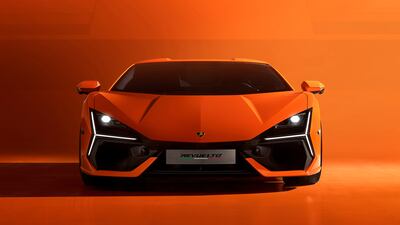
The Lamborghini Revuelto V12 supercar has been unveiled. All photos: Lamborghini -

Following the brand's traditions, the car is named after a storied fighting bull, with Revuelto translating to wild and turbulent -

Although the Revuelto retains Lamborghini’s V12 engine layout, the debutant is the company’s first plug-in hybrid model -

The 6.5-litre V12 combustion engine is supplemented by a trio of electric motors -

The petrol-electric powertrain goes from 0-100kph in less than 2.5 seconds, with a top speed of more than 350kph -
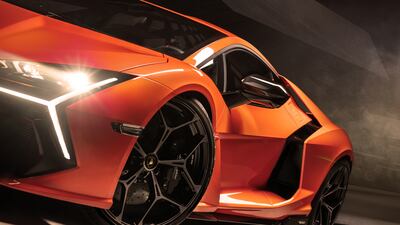
Stopping power comes via Carbon Ceramic Brakes Plus, with 410mm x 38mm discs at the front and 390mm x 32mm discs at the rear -

The Revuelto reduces CO2 emissions by 30 per cent compared to the Aventador Ultimae -

Electric torque vectoring boosts agility through tight corners and enhances stability through high-speed bends -
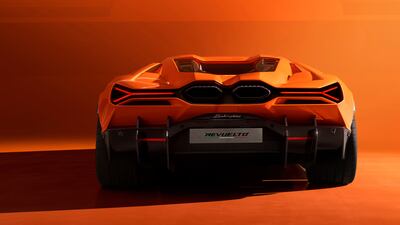
The car will roll out from mid-2023 and is estimated to be priced at nearly Dh2 million



