



Georges Hobeika presented its autumn/winter 2022-23 haute couture collection in Paris on Monday — and, it was a family affair.
The Lebanese fashion house announced earlier in the week Jad Hobeika, son of founder Georges, would be joining as co-creative director.
“Jad has had a hand in the maison's creative process since 2019, starting with the Birds of Paradise collection for autumn/winter of that year. Now, he and his father will work on equal footing, sharing the responsibilities of collections and business strategies alike,” a company representative revealed on Instagram.
Scroll through the gallery above for pictures from the collection
The announcement coincides with the maison’s 27th anniversary. Georges launched his eponymous brand in Lebanon in 1995. He first presented in the French capital in 2001 and has been a regular feature at Paris Haute Couture Week ever since.
“It’s an honour to be a part of this journey, to contribute to evolving a fashion house that is brimming with dreams and creativity,” Jad wrote of his appointment.
Called Eternal Gifts, the fashion house's latest haute couture collection marked the duo’s official debut as a team. Dubbed “a love letter to planet Earth and humanity”, the collection was brought to life by the seamstresses in the maison’s Beirut atelier and referenced waterfalls, waves, flowers and the sun.
The presentation opened with a short white sequinned and feathered dress, which glistened as it caught the light. This ethereal effect was carried into look two, where silver sequins and crystal beading were emblazoned across a long skirt and cropped top.
Hobeika’s expertise in bridal wear was apparent in white sequin-covered gowns and full skirts with a mirror-like finish, uplifted with feather detailing. Men, too, wore loose-fitting, all-ivory suits with crystal detailing at the collar, or oversized jackets in soft shades of powder blue.
Rare pops of colour came in the form of an oversized yellow bow, which extended to the floor, a yellow balloon dress with a single, barely-there strap, consisting of a delicate strand of crystals snaking its way up over the shoulder, or a short yellow cape dress with oversized crystal buttons.
There were form-fitting gowns in nude and white, and wide structured skirts paired with cropped long-sleeve tops with strands of beading across the front.
Shimmering tassels brought a sense of movement to one diaphanous 1920s-inspired dress, while a 3D effect was created on another with floral shapes, which extended out and wound their way around the bodice.
The palette was eventually expanded to include gentle hues of turquoise, the palest pinks, mint greens and baby blue, in the form of a kaftan with enormous feathered sleeves, and then on to lime greens, fuchsias and peachy oranges. Long flowing sleeves trailed the floor and were offset by thigh-high slits and midriff-baring cut-outs, in a collection overwhelmingly sensual and feminine.
Qasimi embraces tribal nomadism for spring/summer 2023 in London — in pictures
-
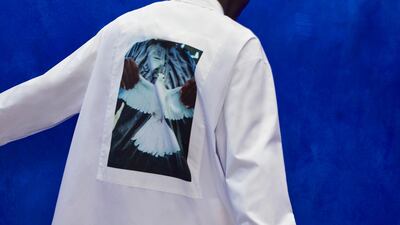
A peace dove, with held wings, by Qasimi, spring/summer 2023. All photos: Qasimi -
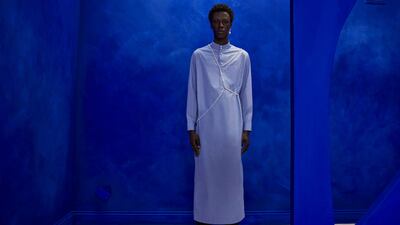
A kandura with pearl 'holster' and worn over stovepipe trousers. -

The spring/summer 2023 collection had elements taken from military camouflage. -
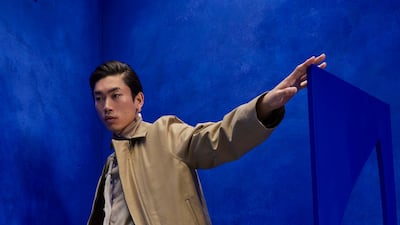
Sand-toned trousers tied at the ankle. -
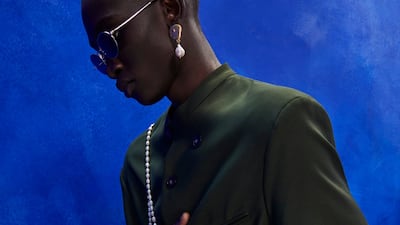
Military elements were softened with pearl 'holsters'. -
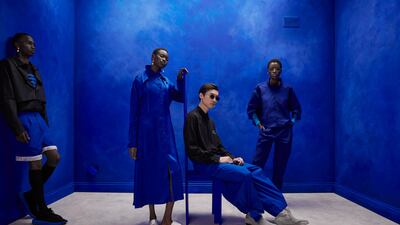
Looks in intense, indigo blue. -

Belts worn as crossbody harnesses. -

A long, fluid dress.



