
Crafter Claire Armstrong did not cry when a favourite sweater shrunk in the wash. Instead, her creativity, coupled with a reuse and upcycle philosophy, was inspired, and she made something new from her reduced garment in the shape of woolly Scandi ball decorations.
“The woolly sweater Scandi decorations didn’t require a lot of concentration,” says Armstrong, who cut and sewed while watching the snowy Scandinavian tundra on Norwegian slow TV to really get into the mood. Apparently, there’s “160 hours of real-time reindeer migration” available on Netflix for anyone seeking winter wonderland flavour to enhance their seasonal crafting.
Armstrong has always loved making things and used to run a weekly club; her resulting blog, Pillarboxblue.com, now provides a platform from which her ideas can be shared with an interested audience. Crafting has recently had something of a renaissance, possibly sparked by the realisation that such pursuits can be meditative and mindful, as well as artsy, productive and cost-saving.
Here, Armstrong takes The National through four festive projects, using easily sourced and inexpensive materials that can be repurposed into contemporary seasonal decorations.
Scandinavian woolly jingles
Materials
Sweater or felt scraps in various bright colours. To ensure sweater pieces do not fray, machine-wash whole woollen jumpers (those with 70 per cent wool or more) using washing powder on a hot setting, to transform it to felt. The hot water and the agitation help to shrink the fabric and makes fibres tightly pack together. Finish in the tumble dryer to finalise the transformation process. Additionally, old socks, scarves and woolly hats are also useful resources.
Strong cotton thread for sewing
Upholstery needles
Stuffing (the contents of an old pillow will do)
Coloured wool or twine for hanging
Mini craft bells for embellishment
Method
-
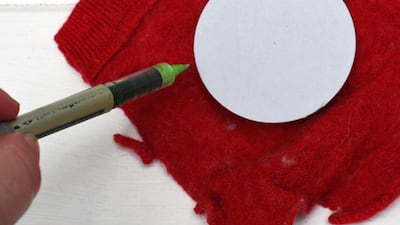
Trace out and cut paper circles of varying sizes on unused sweaters or other old woollen items. Photo:Pillarboxblue.com -
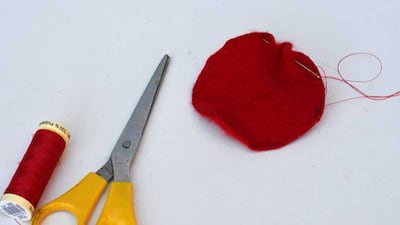
Cut out three felt circles per Scandi jingle. Photo:Pillarboxblue.com -
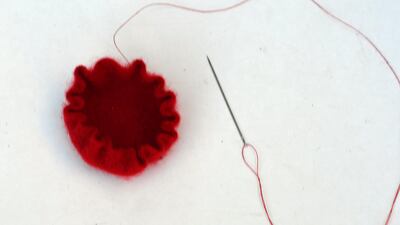
Stitch around the perimeter, gather the material as you go, then pull the threads to form a bowl. Photo:Pillarboxblue.com -
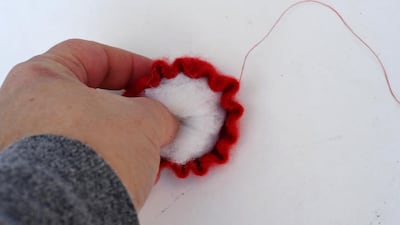
Add a little stuffing. Photo:Pillarboxblue.com -
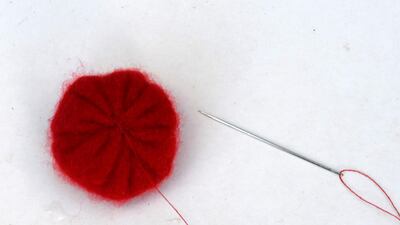
Draw the thread inwards to close the circle, then roll the ball around to get a uniform shape. Photo: Pillarboxblue.com -
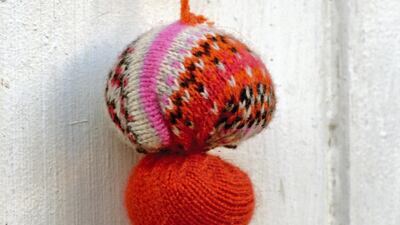
Thread a bell up through the three woollen balls and finish with a loop to hang. Photo:Pillarboxblue.com


1. Make a variety of circular templates on a plain sheet of paper with a diameter range of 6cm to 9cm (draw around cups or glasses if you don't have a compass). Place these on your felt, draw around them, then cut out the shape. Continue until you have a collection of pieces in a variety of colours and sizes. Three circles of different sizes are needed to complete a single Scandi jingle.
2. Stitch around the perimeter of each piece, about 3mm in, gathering the material as you progress. When the lap is completed, pull the threads gently to form a bowl shape.
3. Add a little stuffing
4. Draw the thread inwards to close the circle and seal the ball. Cut any loose thread, then roll the ball around in your hands to make its shape uniform.
5. Finally, tie a small bell to some coloured wool or twine, thread this up through three balls of ascending size, and tie and finish with a loop at the top.
Rustic stars and crescents
Materials (all available at Speedex Tools)
Wood block
Nails
Hammer
Pliers or wire-cutters
String
Galvanised steel wire (coat hanger thickness)
Method
-
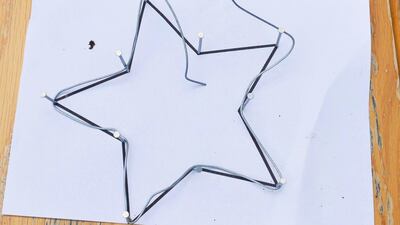
Sketch and cut out your design, place over wood and hammer a nail into each angle point. Photo: Pillarboxblue.com -
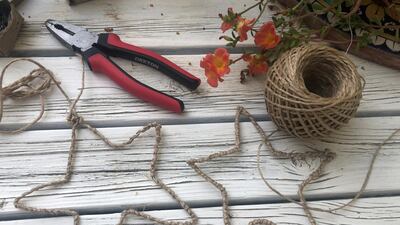
Once you've wrapped wire around the nails, use pliers to define the shape. Photo: Pillarboxblue.com -
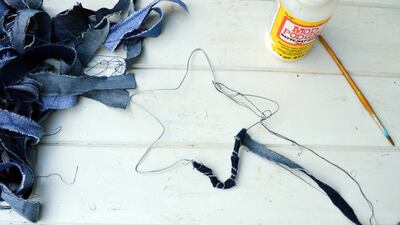
Wind fabric or string until the wire is covered. Photo: Pillarboxblue.com -
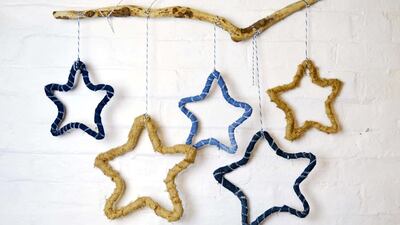
Add a hanging string. Photo: Pillarboxblue.com -
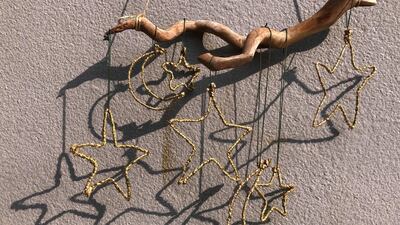
DIY wire stars and crescents sprayed with gold paint. Photo: Pillarboxblue.com


1. Sketch out your design (of stars and crescents as shown here, or shapes such as camels, palm trees or hearts) with a simple outline.
2. Cut out and place it over wood and hammer a nail into each angle point of your model. Wrap the wire around the nails going inside and out to create the angles. When the bends are made, remove from the nails and secure at the top. Use the pliers if the shape requires further definition.
3. Begin winding fabric or string around the shape until the wire is completely covered. Secure with a pin or some glue,
4. Add a hanging string. Once the basic shapes are made, they can either be displayed as a group or hung individually.
5. Consider using spray paint, palm fronds, coloured ribbon or decoupage. This piece would not look out of place at any time of the year and provides plenty of scope to customise to various schemes.
Felt stitched baubles
Materials
Cream or white sweater (see instructions on how to transform woollen clothing to felt under Scandi jingles)
Round tin to draw around
Marker
Black cotton thread, and needles
Contrasting ribbon or silk thread for hanging
Method
-
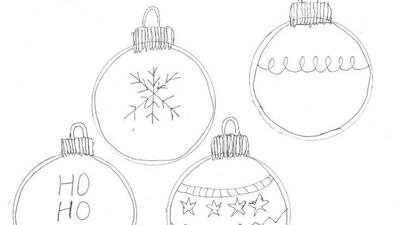
Sample bauble shapes and styles. Photo: Pillarboxblue.com -
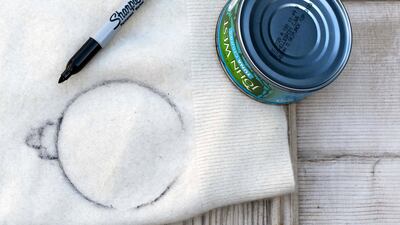
Draw a bauble top shape on your fabric, then cut two of the same pattern. Photo: Pillarboxblue.com -
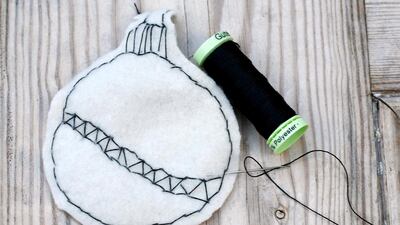
Sketch out the design and copy in a backstitch with black thread on one felt piece. Photo: Pillarboxblue.com -
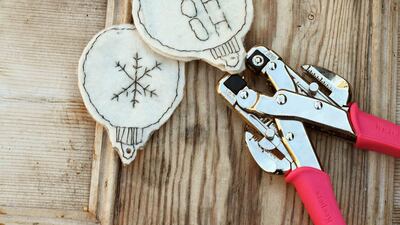
Glue the backing piece and punch a hole. Photo: Pillarboxblue.com -
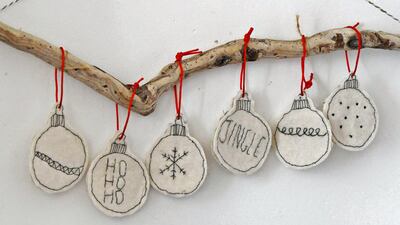
Add hanging ribbon or chord, then string the baubles together. Photo: Pillarboxblue.com


1. Draw around the tin on your fabric and add a "bauble top" shape, which is large enough for a hole punch to pierce. Cut out two of the same pattern pieces per decoration (one to stitch and one to glue to the rear side to hide the reverse working).
2. Sketch out the embroidery design and copy in a simple backstitch with black thread on one felt piece.
3. Glue the backing piece, and punch a hole.
4. Add a hanging ribbon or chord at the top.
Paper map rosettes
Materials
Old road maps, atlas pages or print maps from online (consider using maps of special places in the UAE)
Coloured buttons
Ribbon for hanging
Method
-

Cut along a map in straight lines to your desired length. Photo: Pillarboxblue.com -

Concertina-fold the two strips. Photo: Pillarboxblue.com -
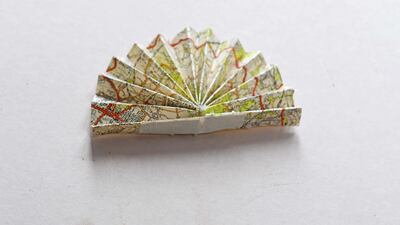
Glue a strip of paper across the long side of each semi-circle to hold the shape together Photo: Pillarboxblue.com -
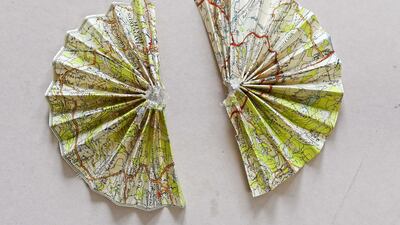
Glue the two semi-circular folded pieces to make a circle. Photo: Pillarboxblue.com -
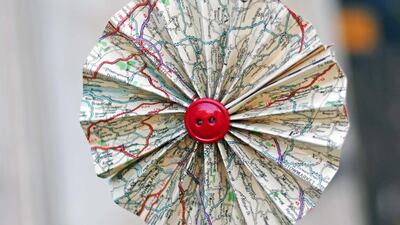
Add a button to the centre of the rosette and a ribbon for hanging. Photo: Pillarboxblue.com -
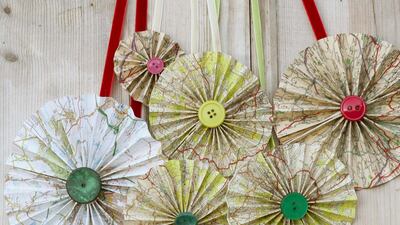
Rosettes can be used a group or as individually decorations. Photo: Pillarboxblue.com


1. These can be made in a variety of sizes, work on making the length of the paper five times its width, so for a rosette that is 10cm diameter, use two strips of map paper that are 5cm wide and 25cm long. To ensure straight edges, rule lines across the map before cutting.
2. Next, concertina fold (like a fan) so each fold is 7mm to 10mm apart.
3. Glue a strip of paper across the long side of each semi-circle to hold the shape together before glueing the whole. The rosette is made from two joined semi-circular folded pieces that are glued together.
4. Add a button to the centre of the rosette and a ribbon for hanging. Display as a group directly on the wall or hang individually as tree decorations.
Additional seasonal crafting ideas and inspiration can be found at Pillarboxblue.com. Schedules of socially distanced, face-to-face DIY and crafting workshops can be found at Speedextools.com/events

