

Salone del Mobile is back for its 60th year.
Milan’s eagerly awaited annual design fair is the largest since the pandemic began, with themes of sustainability, designing with nature and eco-friendly materials at its heart.
Italian designer and associate professor at Dubai Institute of Design and Innovation, Gionata Gatto, has taken the 2022 theme in his stride, showcasing Coloniae, a collection of objects that explore the relationship between people and plants.
It has been designed for JCP Universe as part of its Alternate Life Forms exhibit.
Living and working between Venice, Rotterdam and Dubai, Gatto came to the UAE in 2019, to curate the programme at the Dubai institute's Department of Design Products, which views design pieces as capable of interacting with people and other objects in their surroundings.

This notion is at the forefront of Coloniae, which offers vases, tables, room dividers and other objects meant to be taken over by the houseplants growing in and around them, engaging the owner more actively than a static sculpture or side table.
“The idea is to start thinking how we use our domestic space in relation to plants and living flora, and I wanted to understand how well plants could actually colonise objects,” Gatto tells The National.
“Think of all the architecture that’s been left abandoned and how plants take over these spaces. I wanted to explore something similar, but with a view of understanding how we can create dialogue with these plants and the objects they take over.
“I worked with different institutions in Europe that explore how plants can respond to environmental stimuli in a kind of intelligent fashion,” he says. “The interesting question is how far are we willing to go? How far are we prepared to compromise our domestic spaces in favour of plants?”

The relationship between plants and humans is a long-time interest of his, says Gatto, who wrote his PhD on the topic. The collection was intended to be shown last year, but Covid-19 meant a diminished Salone in 2021, so the project was delayed.
With pandemic lockdowns still fresh in everyone’s mind, many have a new appreciation for nature and the environment, with more people craving and seeking out greenery.
As well as baking bread and knitting, the number of people taking up gardening and potting as a hobby saw a surge in popularity.
Gatto has designed some of the pieces to interlock, allowing the plants to grow across more than one object and render each immovable.
The series is part-design, part-human experiment, exploring how much of humanity’s desire to control will be relinquished to prioritise the well-being of nature.

Through it, Gatto questions whether humans can truly live alongside nature, as opposed to having plants as mere decoration in personal spaces.
“I like to think about design in these terms, as speculative artefacts that have the scope of generating debate or discussion around certain themes. Rather than designing something with an answer, maybe design can pose a question instead,” Gatto says.
“We are thinking about nature in a different way other than it being something inside or outside. In a way, we are part of it, so the problem comes from the fact that we see ourselves as being divided from nature,” he says. “For me, it was interesting to see, perhaps after such a [long] time of being indoors, if plants can play a different role in our domestic space.”
Gatto doesn’t intend to provide specific instructions on how people should use the furniture, or whether plants should be pruned or cut back to keep them comfortably manageable.
He hopes a plant will completely eclipse the object it's placed in or on, making it the centre of the design scheme, rather than the pot or vase.
All the pieces are made using perforated aluminium sheets coated in copper or bronze, allowing the plants to rise over the surfaces and take root in the gaps left between 10 millimetre holes. The material provides the necessary structure for climbing plants to take over with ease.
Gatto thoroughly researched the root systems of various species before deciding on the material and which plants would be suitable for the collection — he chose those that didn’t need a lot of soil to grow in. These include ivy, orchids and large-leaved monstera.
“Then there is the philodendron, which is another indoor species that needs this sort of gripping surface in order to grow,” Gatto says. “We're trying out different plants and each object is specifically designed to host a [particular] species.”
Salone del Mobile runs until June 12 in Fiera Rho, Milan
Museum of the Future’s garden contains 100 plant species from across the UAE — in pictures
-
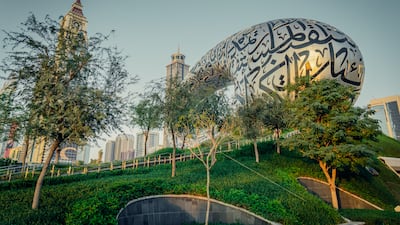
The Museum of the Future’s garden has been designed on the green plinth holding the striking structure. All photos: The Museum of the Future -

In the garden there are about 100 species of trees and plants. -

The different horticultural species reflect the UAE's natural diversity and ecological heritage. -

Palm trees standing tall outside Dubai's Museum of the Future. -

Ghaf, sidr, palm and acacia trees are all growing in the gardens, trees that are well adapted to local environmental conditions. -

The gardens are equipped with a smart, automated irrigation system and support local bee and bird population. -

Museum of the Future’s gardens are set to be an attraction in and of themselves when it opens on February 22.



