
It’s almost impossible to look at the elegant curving lines of the new Ajman Ruler’s Court in the heart of the emirate and not see the future of government and civic buildings. A relaxed, welcoming ambience, collaborative workspaces, an abundance of natural light and a thought-provoking collection of locally curated artworks have conspired to create a space that’s luxurious and tech-forward, but also embodies the spirit of Ajman.
Walking through the sliding doors, an impressive central staircase takes centre stage. Inspired by the desert’s shifting dunes and home to clusters of custom-designed four-metre-high palm tree sculptures by Emirati designer Khalid Shafar, the vibe couldn’t be further from the often intimidating architecture that has typified government buildings across the world.
“We were inspired by places that match our aspirations, which reflected where we want to be,” says Marwan Al Muhairi, director general of Ajman Ruler’s Court. “Having this spirit within the building helps everyone to be aligned and collaborate on the same vision towards building the future of Ajman and the future of the UAE.”
The new Ruler’s Court, across the street from the previous offices that are still in use as the transition continues, is the culmination of more than three years of creative collaboration between Dubai architecture and interior design studio Roar and the office of Sheikh Humaid bin Rashid Al Nuaimi, Supreme Council Member and Ruler of Ajman.
It is a partnership that has centred on the importance of the people who would work there, alongside the heritage to which it pays homage and the future generations it will serve.
-
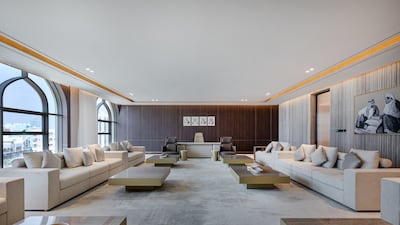
The chairman's office in the new Ajman Ruler's Court, which was designed by Pallavi Dean's team at Roar. All photos: Roar Design Studio -
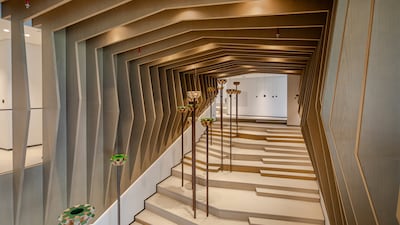
Staircase Art: Khalid Shafar's palm tree sculptures enrich the staircase from the ground to the first floor, blending natural inspiration with modern design. Photo: Roar Design Studio -
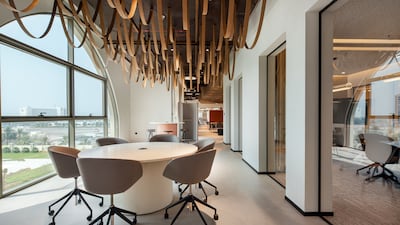
A collaboration space with earthy ceiling art -
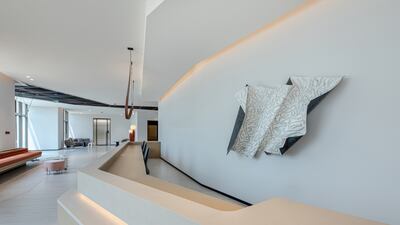
Ajman artist Akil's calligraphy-inspired sculpture adds depth and character to the reception -
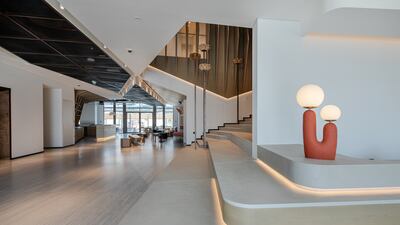
The reception also features a a distinctively layered ceiling design to create a visually dynamic entrance -
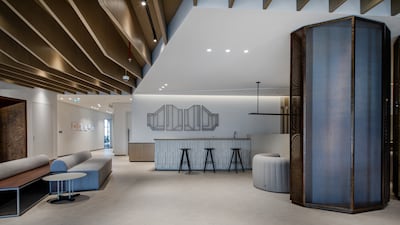
Abu Dhabi artist Afra Al Dhaheri’s piece behind the hospitality counter is in harmony with the angular ceiling design -
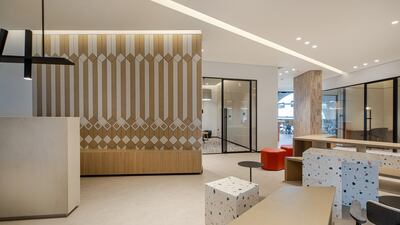
A wall pattern mirrors the 3D design of the hospitality counter’s panels, complemented by a seating area with the word 'Ajman' in Arabic -
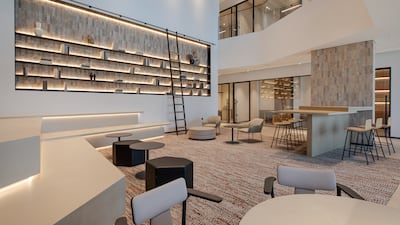
The seating area, too, is a study in the cohesion of art and architecture -

An aerial view of the collaboration space on the first floor showcases the open and accessible design -
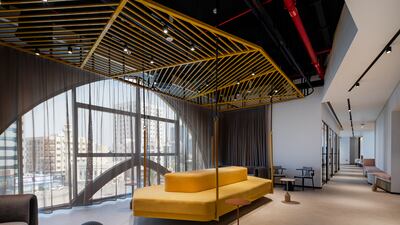
A yellow suspended sofa on the top level -

The VIP majlis


Of art and architecture
“We dug deep into Ajman’s history,” says Pallavi Dean, founder and creative director of Roar, of the inspiration for the court. “There’s a very rich tradition of pottery and clay pottery here, so we thought how we could bring some of that natural and urban feel into the material palette. We looked at the structure of the dhow that, when fabricated, has a ribbed form that we then used. It was about building on the sense of Ajman rather than a pastiche of the nation.”
For many office buildings, government or otherwise, art is often an afterthought, hung to cover bare walls with little consideration for aesthetics, least of all symbolism. At the Ajman Ruler’s Court, however, the art was part of the project’s DNA from the beginning.
“Most of the art is by Emirati or UAE-based artists,” says Al Muhairi. “One of the things we planned to do right from the start was to support local artists and create a space where art mixes in a right way with the working environment. We chose pieces that represents the different areas and eras of the UAE, reflecting on our history and also looking to the future.”

The absence of straight lines in favour of curves is intentional throughout the building. It's a design technique that's reflected in the gentle movement of the giant yellow suspended sofa on the top level, and in a seating area that, when viewed from above, spells Ajman in Arabic.
A piece by Ajman artist Akil fuses Arabic calligraphy with sculptural components, alongside sculptures by Azza Al Qubaisi, who is renowned for her combined use of natural materials and metal.
In the reception area, Sheikh Humaid’s private lift is framed by brass panels and wood details that draw inspiration from traditional Areesh houses – structures built entirely using materials from palm trees. Elsewhere, laser-cut calligraphy by Ajman artist Jamal Habroush Al Suwaidi showcases inspiring quotes from Sheikh Humaid and Sheikh Ammar bin Humaid Al Nuaimi, Crown Prince of Ajman and chairman of the Ajman Executive Council, capturing the essence of ancient Al Barwa letters that leaders traditionally wrote to one another.
“What has been really good about this project is that the client has a keen design eye,” says Dean. “Both the ruler and crown prince were very much orchestrating and guiding us through the process. Every time we presented, His Highness Sheikh Humaid would say: ‘Have you thought about this?’”
The relationship between form and function in architecture has been a fraught one over the years, but to Dean, the hierarchy is clear: “There is no form versus function, it is function first”.
Empathy in design

Sara Jamil, Roar’s senior interior designer, adds: “We have a user-centric space and employ empathy in the design. You spend a huge amount of your life indoors, and eight to 10 hours of your life in the workplace, so it has to be functional. We curated an experience and made sure the aesthetics were in line with that experience.”
The people-first focus of the project is a sentiment shared by Al Muhairi. “We understand that dedicated, customised aesthetics that focus on creating a space for collaboration and getting people to work together without boundaries or in silos will create a better space for protecting and creating synergies between different teams.”
Roar worked with its in-house psychologist using “evidence-based design” to conceive the Ajman Ruler’s Court in which six departments benefit from an agile workspace featuring sit-stand desks, lounge-style seating and focus pods as well as a central admin to, as Al Muhairi puts it “make sure everyone shares the same eco-system”.
Dean adds: “I feel like this building serves as a gallery, a platform where we showcase the future talent of the Emirates. It’s like viewing Ajman through their lens.”

