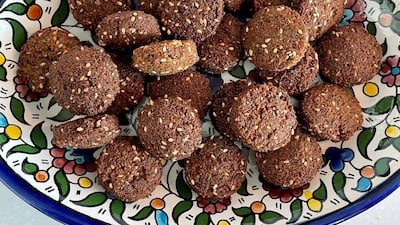
Falafel by Ramzi Ghannoum. Courtesy Ramzi Ghannoum / Table Tales

Ramadan recipe: homemade falafel


  • English
  • Arabic

Join The National and Table Tales on a culinary journey around the Middle East to savour the quintessential dishes that embody the spirit of Ramadan. From table staples to family favourites, this series of recipes – one for each day of Ramadan – pays homage to the holy month and the home cook alike.

Alongside shawarmas, these well-loved, deep-fried fritters are synonymous with Middle Eastern street food. Hanan Sayed Worrell of Table Tales says: “Traditionally, falafel is a favourite starter at our Ramadan table. My husband, Steve, usually picks up a dozen or so from the street food shop in our neighbourhood, during the last hour before breaking the fast. At that time, the restaurants are bustling with last-minute orders and the falafel is freshly fried.

“When we stayed at home last year during the most unusual Ramadan, I decided to finally attempt to make falafel. I called our dear friend Ramzi for his recipe, which he generously shared. Ramzi, is a passionate cook and falafel ranks high among his favourites – he refers to it as ‘food for kings’. This recipe is easy to make and also to personalise.”

Recipe contributor Ramzi Ghannoum. Courtesy Ramzi Ghannoum / Table Tales

Recipe contributor Ramzi Ghannoum says: “I got hooked on falafel during military service in Jordan. Falafel with mortadella, cucumber and tomato sandwiches were my daily meals for almost two years. Since then, I have had a strong relationship with falafel, experimenting with many variations over the years, including stuffed ones.”

Ramzi Ghannoum's falafel

Makes 36

Estimated time: 50 minutes, plus soaking

Ingredients: 

  • 375g dried chickpeas (don't substitute with canned, as they are cooked)
  • 125g dried fava beans (can be substituted with more chickpeas)
  • 150g onion
  • 100g scallion
  • 4 cloves garlic
  • 1½ cup fresh parsley, packed
  • 1 cup fresh coriander, packed
  • ¼ green bell pepper
  • ¼ red bell pepper
  • 1 small green chilli (optional)
  • 1 tsp salt
  • 1½ tsp cumin
  • 1 tsp coriander, ground
  • 1 tsp black pepper
  • ½ tsp baking powder
  • ½ tsp baking soda
  • ½ cup sesame seeds (optional)
  • 2-3 cups vegetable oil, for frying
Arguablly, falafel is best served in a sandwich. Courtesy Ramzi Ghannoum / Table Tales

Method:

  1. Place the dried chickpeas in a large bowl and add enough cool water to cover them by at least five centimetres. Soak overnight to rehydrate. Drain the soaked chickpeas, rinse, then pat dry.
  2. Put the uncooked chickpeas in the bowl of a food processor fitted with a steel blade. Add the onions, scallions, garlic, herbs, all the bell peppers and spices. Pulse the mixture until blended, but not pureed, scraping the bowl down as necessary. You should be able to press a handful together and have it hold its shape (it will be loose and a little crumbly).
  3. Transfer the falafel mixture to a bowl and cover. At this stage, the mix can be frozen in a sealed container. It can also be refrigerated for a few days.
  4. When ready to cook, add the baking powder and baking soda to the mixture and let it rest for 15 minutes in the fridge.
  5. Use a tablespoon or falafel scoop to form the mixture into balls about the size of walnuts. Flatten in the palm of your hand, coat each side with sesame seeds (if using), place on a plate. Repeat with as many falafel as you plan to cook.
  6. Heat about 8cm of oil in deep saucepan or wok to 190°C. Fry the falafel in batches, placing them gently into the oil and without crowding in the pan, until they are browned on the bottom. Carefully flip the falafel to brown the other side; the process should take three to four minutes in total.
  7. Transfer the cooked falafel to a plate lined with paper towels, sprinkle with a little salt, and then repeat with the remaining falafel balls.
  8. Serve immediately with tahini, pickles and sliced tomatoes as a garnish if you're making falafel sandwiches.

This dish has been brought to you by Ramzi Ghannoum and curated by international recipe hunter Hanan Sayed Worrell, author of Table Tales: The Global Nomad Cuisine of Abu Dhabi. The Table Tales concept celebrates the people and stories that give flavour to recipes of the Middle East.

______________

Read more: 

Ramadan recipes: daily dishes to try from the 'Table Tales' series

Ramadan recipe: Fattoush, a salad with herbs and spice

Ramadan recipe: Sambousa puff – pastry with meat, cheese and herbs

______________

The Details

Article 15
Produced by: Carnival Cinemas, Zee Studios
Directed by: Anubhav Sinha
Starring: Ayushmann Khurrana, Kumud Mishra, Manoj Pahwa, Sayani Gupta, Zeeshan Ayyub
Our rating: 4/5 

THE%20HOLDOVERS
%3Cp%3E%3Cstrong%3EDirector%3A%20%3C%2Fstrong%3EAlexander%20Payne%3C%2Fp%3E%0A%3Cp%3E%3Cstrong%3EStarring%3A%3C%2Fstrong%3E%20Paul%20Giamatti%2C%20Da'Vine%20Joy%20Randolph%2C%20Dominic%20Sessa%3C%2Fp%3E%0A%3Cp%3E%3Cstrong%3ERating%3A%3C%2Fstrong%3E%204.5%2F5%3C%2Fp%3E%0A
Company%20Profile
%3Cp%3E%3Cstrong%3EName%3A%3C%2Fstrong%3E%20Ovasave%3Cbr%3E%3Cstrong%3EStarted%3A%3C%2Fstrong%3E%20November%202022%3Cbr%3E%3Cstrong%3EFounders%3A%3C%2Fstrong%3E%20Majd%20Abu%20Zant%20and%20Torkia%20Mahloul%3Cbr%3E%3Cstrong%3EBased%3A%3C%2Fstrong%3E%20Abu%20Dhabi%3Cbr%3E%3Cstrong%3ESector%3A%3C%2Fstrong%3E%20Healthtech%3Cbr%3E%3Cstrong%3ENumber%20of%20staff%3A%3C%2Fstrong%3E%20Three%20employees%3Cbr%3E%3Cstrong%3EInvestment%20stage%3A%3C%2Fstrong%3E%20Pre-seed%3Cbr%3E%3Cstrong%3EInvestment%3A%3C%2Fstrong%3E%20%24400%2C000%3C%2Fp%3E%0A
HOW TO WATCH

Facebook: TheNationalNews  

Twitter: @thenationalnews  

Instagram: @thenationalnews.com  

TikTok: @thenationalnews 

Ten tax points to be aware of in 2026

1. Domestic VAT refund amendments: request your refund within five years

If a business does not apply for the refund on time, they lose their credit.

2. E-invoicing in the UAE

Businesses should continue preparing for the implementation of e-invoicing in the UAE, with 2026 a preparation and transition period ahead of phased mandatory adoption. 

3. More tax audits

Tax authorities are increasingly using data already available across multiple filings to identify audit risks. 

4. More beneficial VAT and excise tax penalty regime

Tax disputes are expected to become more frequent and more structured, with clearer administrative objection and appeal processes. The UAE has adopted a new penalty regime for VAT and excise disputes, which now mirrors the penalty regime for corporate tax.

5. Greater emphasis on statutory audit

There is a greater need for the accuracy of financial statements. The International Financial Reporting Standards standards need to be strictly adhered to and, as a result, the quality of the audits will need to increase.

6. Further transfer pricing enforcement

Transfer pricing enforcement, which refers to the practice of establishing prices for internal transactions between related entities, is expected to broaden in scope. The UAE will shortly open the possibility to negotiate advance pricing agreements, or essentially rulings for transfer pricing purposes. 

7. Limited time periods for audits

Recent amendments also introduce a default five-year limitation period for tax audits and assessments, subject to specific statutory exceptions. While the standard audit and assessment period is five years, this may be extended to up to 15 years in cases involving fraud or tax evasion. 

8. Pillar 2 implementation 

Many multinational groups will begin to feel the practical effect of the Domestic Minimum Top-Up Tax (DMTT), the UAE's implementation of the OECD’s global minimum tax under Pillar 2. While the rules apply for financial years starting on or after January 1, 2025, it is 2026 that marks the transition to an operational phase.

9. Reduced compliance obligations for imported goods and services

Businesses that apply the reverse-charge mechanism for VAT purposes in the UAE may benefit from reduced compliance obligations. 

10. Substance and CbC reporting focus

Tax authorities are expected to continue strengthening the enforcement of economic substance and Country-by-Country (CbC) reporting frameworks. In the UAE, these regimes are increasingly being used as risk-assessment tools, providing tax authorities with a comprehensive view of multinational groups’ global footprints and enabling them to assess whether profits are aligned with real economic activity. 

Contributed by Thomas Vanhee and Hend Rashwan, Aurifer

Abu Dhabi GP schedule

Friday: First practice - 1pm; Second practice - 5pm

Saturday: Final practice - 2pm; Qualifying - 5pm

Sunday: Etihad Airways Abu Dhabi Grand Prix (55 laps) - 5.10pm

How much do leading UAE’s UK curriculum schools charge for Year 6?
  1. Nord Anglia International School (Dubai) – Dh85,032
  2. Kings School Al Barsha (Dubai) – Dh71,905
  3. Brighton College Abu Dhabi - Dh68,560
  4. Jumeirah English Speaking School (Dubai) – Dh59,728
  5. Gems Wellington International School – Dubai Branch – Dh58,488
  6. The British School Al Khubairat (Abu Dhabi) - Dh54,170
  7. Dubai English Speaking School – Dh51,269

*Annual tuition fees covering the 2024/2025 academic year

SPECS
%3Cp%3E%3Cstrong%3EEngine%3C%2Fstrong%3E%3A%202-litre%20direct%20injection%20turbo%20%0D%3Cbr%3E%3Cstrong%3ETransmission%3C%2Fstrong%3E%3A%207-speed%20automatic%20%0D%3Cbr%3E%3Cstrong%3EPower%3C%2Fstrong%3E%3A%20261hp%20%0D%3Cbr%3E%3Cstrong%3ETorque%3C%2Fstrong%3E%3A%20400Nm%20%0D%3Cbr%3E%3Cstrong%3EPrice%3C%2Fstrong%3E%3A%20From%20Dh134%2C999%26nbsp%3B%3C%2Fp%3E%0A
Who's who in Yemen conflict

Houthis: Iran-backed rebels who occupy Sanaa and run unrecognised government

Yemeni government: Exiled government in Aden led by eight-member Presidential Leadership Council

Southern Transitional Council: Faction in Yemeni government that seeks autonomy for the south

Habrish 'rebels': Tribal-backed forces feuding with STC over control of oil in government territory

Hales' batting career

Tests 11; Runs 573; 100s 0; 50s 5; Avg 27.38; Best 94

ODIs 58; Runs 1,957; 100s 5; 50s 11; Avg 36.24; Best 171

T20s 52; Runs 1,456; 100s 1; 50s 7; Avg 31.65; Best 116 not out

The specs
 
Engine: 3.0-litre six-cylinder turbo
Power: 398hp from 5,250rpm
Torque: 580Nm at 1,900-4,800rpm
Transmission: Eight-speed auto
Fuel economy, combined: 6.5L/100km
On sale: December
Price: From Dh330,000 (estimate)

Voices: How A Great Singer Can Change Your Life
Nick Coleman
Jonathan Cape

Who was Alfred Nobel?

The Nobel Prize was created by wealthy Swedish chemist and entrepreneur Alfred Nobel.

  • In his will he dictated that the bulk of his estate should be used to fund "prizes to those who, during the preceding year, have conferred the greatest benefit to humankind".
  • Nobel is best known as the inventor of dynamite, but also wrote poetry and drama and could speak Russian, French, English and German by the age of 17. The five original prize categories reflect the interests closest to his heart.
  • Nobel died in 1896 but it took until 1901, following a legal battle over his will, before the first prizes were awarded.
PROFILE

Name: Enhance Fitness 

Year started: 2018 

Based: UAE 

Employees: 200 

Amount raised: $3m 

Investors: Global Ventures and angel investors 

Mercer, the investment consulting arm of US services company Marsh & McLennan, expects its wealth division to at least double its assets under management (AUM) in the Middle East as wealth in the region continues to grow despite economic headwinds, a company official said.

Mercer Wealth, which globally has $160 billion in AUM, plans to boost its AUM in the region to $2-$3bn in the next 2-3 years from the present $1bn, said Yasir AbuShaban, a Dubai-based principal with Mercer Wealth.

Within the next two to three years, we are looking at reaching $2 to $3 billion as a conservative estimate and we do see an opportunity to do so,” said Mr AbuShaban.

Mercer does not directly make investments, but allocates clients’ money they have discretion to, to professional asset managers. They also provide advice to clients.

“We have buying power. We can negotiate on their (client’s) behalf with asset managers to provide them lower fees than they otherwise would have to get on their own,” he added.

Mercer Wealth’s clients include sovereign wealth funds, family offices, and insurance companies among others.

From its office in Dubai, Mercer also looks after Africa, India and Turkey, where they also see opportunity for growth.

Wealth creation in Middle East and Africa (MEA) grew 8.5 per cent to $8.1 trillion last year from $7.5tn in 2015, higher than last year’s global average of 6 per cent and the second-highest growth in a region after Asia-Pacific which grew 9.9 per cent, according to consultancy Boston Consulting Group (BCG). In the region, where wealth grew just 1.9 per cent in 2015 compared with 2014, a pickup in oil prices has helped in wealth generation.

BCG is forecasting MEA wealth will rise to $12tn by 2021, growing at an annual average of 8 per cent.

Drivers of wealth generation in the region will be split evenly between new wealth creation and growth of performance of existing assets, according to BCG.

Another general trend in the region is clients’ looking for a comprehensive approach to investing, according to Mr AbuShaban.

“Institutional investors or some of the families are seeing a slowdown in the available capital they have to invest and in that sense they are looking at optimizing the way they manage their portfolios and making sure they are not investing haphazardly and different parts of their investment are working together,” said Mr AbuShaban.

Some clients also have a higher appetite for risk, given the low interest-rate environment that does not provide enough yield for some institutional investors. These clients are keen to invest in illiquid assets, such as private equity and infrastructure.

“What we have seen is a desire for higher returns in what has been a low-return environment specifically in various fixed income or bonds,” he said.

“In this environment, we have seen a de facto increase in the risk that clients are taking in things like illiquid investments, private equity investments, infrastructure and private debt, those kind of investments were higher illiquidity results in incrementally higher returns.”

The Abu Dhabi Investment Authority, one of the largest sovereign wealth funds, said in its 2016 report that has gradually increased its exposure in direct private equity and private credit transactions, mainly in Asian markets and especially in China and India. The authority’s private equity department focused on structured equities owing to “their defensive characteristics.”
