Join The National and Table Tales on a culinary journey around the Middle East to savour the quintessential dishes that embody the spirit of Ramadan. From table staples to family favourites, this series of recipes – one for each day of Ramadan – pays homage to the holy month and the home cook alike.
Some years ago, a tropical greenhouse in Universiti Putra Malaysia was the stage for a five-month-long experiment on the benefits of purslane, which is also referred to as the "fountain of youth".
The most definitive study of its kind, it attributed to this humble herb superlative phrases such as high antioxidant properties; richest vegetable source of omega-3; and high levels of vitamins E, C and beta-carotene.
It is little wonder that purslane is now considered a superfood, owing to its antibacterial characteristics and detoxifying action. It packs the highest amount of vitamin A present in any leafy vegetable, which is excellent to maintain healthy vision and cell integrity, while omega-3 fatty acids lower the risk of heart disease. It is also low in calories, with about 16 per 100 grams.
As famed Afrikaans poet and doctor C Louis Leipoldt noted at the turn of the 20th century: “Purslane was, in the old days, and should be today, a favourite vegetable.”
You’d be forgiven for believing that purslane is a sparse herb that needs to be grown in hyper-idyllic conditions on the foothills of some fabled mountain. The truth is it can and does grow everywhere and was, inaccurately, considered an annoying garden weed until a few years ago. In fact, the crunchy green leaves are an integral part of Middle East cuisine (you might know them better as baqle).
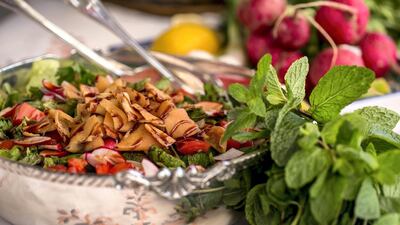
Purslane is also the key ingredient in a plate of fattoush.
As Hanan Sayed Worrell, of Tables Tales, notes: “The Levantine salad may be a straightforward mixture of vegetables, herbs and bread, which can be easily adaptable to personal taste and to what you have in the fridge that day, but its hero ingredient – purslane – makes fattoush a delicious and nutritious daily feature at the iftar table.”
The salad also benefits from the presence of sumac, another ingredient that’s high in antioxidants. The reddish-purple spice is known for its fruity, almost tart flavour, and it can be lavishly rubbed on meat or sprinkled on hummus for added colour and zest.

In fattoush, a generous dash of sumac gives the simple dressing – provided for this series by chef Emad Zalloum of Sambusek fame – a tangy lift.
Chef Emad Zalloum's fattoush (bread and purslane salad)
Serves 6 to 8
Preparation and cooking time: 20 minutes
Ingredients for the dressing:
- 4 tbsp white vinegar
- 4 tbsp balsamic vinegar
- 120ml olive oil
- 100g tomato
- Salt and black pepper, to taste
Ingredients for the salad:
- Cooking oil, to fry
- 2 pitas, cut into 2cm squares
- 1 head romaine lettuce, chopped
- 100g purslane
- 10g mint, chopped
- 10g parsley
- 450g tomatoes, cut into 1cm pieces
- 340g cucumbers, sliced
- 28g radishes, sliced
- 2 spring onions, sliced
- 1½ tbsp sumac

Method for the dressing:
- Mix all the ingredients in a blender for 3 minutes.
- Set aside until the salad is ready to serve.
Method for the salad:
- Heat the oil in a skillet and shallow-fry the pita bread for 3 to 5 minutes, until golden brown.
- Remove the bread with a slotted spoon and drain on paper towel.
- Combine all the prepared vegetables and herbs in a large bowl and mix well. The quantities are suggestions and can be varied according to taste.
- Just before serving, toss the salad with the dressing and sprinkle with the sumac.
- Scatter the pita croutons over the salad and give it one more toss. The croutons should be added last so they don't get soggy.
This dish has been brought to you by chef Emad Zalloum and curated by international recipe hunter Hanan Sayed Worrell, author of Table Tales: The Global Nomad Cuisine of Abu Dhabi. The Table Tales concept celebrates the people and stories that give flavour to recipes of the Middle East.

