
A smokehouse in Al Quoz is heating things up among barbecue lovers. Big T BBQ Kitchen is a Texas-style brisket smokehouse owned and operated by Palestinian chef Fadel “Big Tasty” Faour.
His passion and enthusiasm for smoked meats and all things barbecue spurred Faour to open Big T last December, and the unassuming joint has already become the go-to spot for in-the-know foodies craving hearty, flavourful meats that are cooked low and slow.
That is, if they can find a spot. The restaurant, which only operates on Friday, Saturday and Sunday, often has a wait time of 30 to 45 minutes. It's why the team says they made “the executive decision to remain open for the first time on a Thursday, especially for the Eid holiday”.
The unassuming joint might not look like much from the outside, but once you step inside, you'll be hit with the mouth-watering smell of slow-cooked meats and other savoury aromas. The atmosphere is casual and welcoming, with bustling but friendly staff, who are happy to guide you through the menu. The walls are decorated with photos of smiling customers and messages of encouragement and praise.
Rite of passage
-
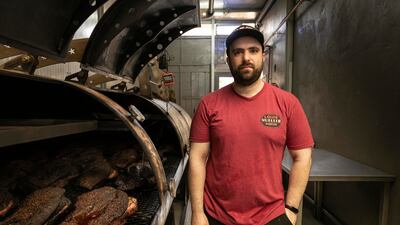
Palestinian chef and owner of Big T BBQ Kitchen, Fadel Faour shows the custom-made smoker imported from Texas. All photos: Antonie Robertson / The National -
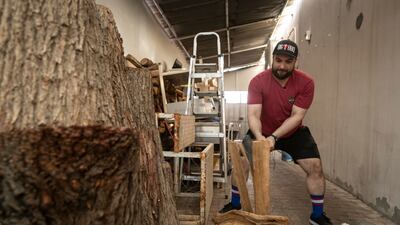
Faour imports his oak wood from Texas -

The meat is cooked for between nine and 16 hours -

The wood fire lends the tender and juicy meat a smoky flavour -
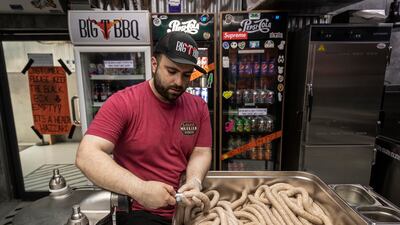
All dishes are made in-house from scratch, including the hand-made sausages and coleslaw -

The restaurant is best known for its Texas-style brisket -
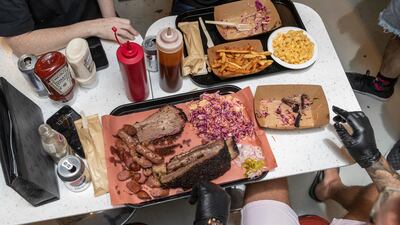
Other must-try items include the ribs and mac and cheese -
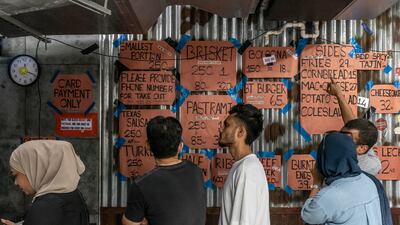
Prepare to wait for a minimum of 30 minutes at Big T, which is only open on Friday, Saturday and Sunday -
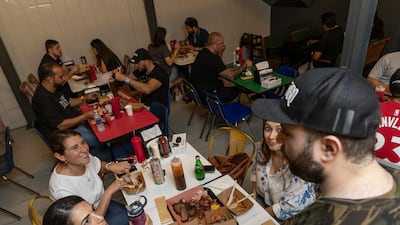
Chef Faour says the relaxed, home-grown and no-frills dining experience is a deliberate decision


“I grew up in the UAE and decided I wanted to be a cook when I was 19,” Faour tells The National. He chose a school – the Institute of Culinary Education in Manhattan – on the back of a Google search.
“I thought that looks cool, let’s go there. But when I got there, all I wanted to do was come back to Dubai. The place was scary! People sleeping on the streets, fighting, fires … But then one thing led to another and I fell in love with New York City. It grows on you, it becomes your home. Best years of my life, man.”
When one of his friends moved from New York to Texas, he offered to host Faour. “I didn't know what to expect, but I went along. I'd just come from the war zone that is New York, where everyone’s fighting you. In Texas, everyone is polite; they call you sir and open the door for you. So I decided to explore this beautiful, big and relaxed place.”
Faour began looking up good places to eat and work, and that’s when he discovered a whole other cuisine, that of the Texan brisket and barbecue.
“I did a month here, a month there, doing butchery, volunteering, sometimes being paid, and sometimes not. But all the people I met, the pit masters and restaurant owners were very friendly and hospitable, and they taught me a lot. I still talk to them to this day.”
The budding chef decided to buy his first smoker even before Big T’s was conceptualised. “I just had to own one of these because the scarcity of it attracted me. I had to wait a year for one, and then stored it in my friend’s warehouse in Dallas because I didn't know where else to put it.”
Money matters
When Faour moved back to New York 18 months later, he realised opening a restaurant there was an “extremely expensive” proposition.
“Around that time, my dad also sat me down and gave me a talk. He said: ‘You’ve been travelling and messing around so much in your 30s that you’re not making any money, so come back. So I sold the apartment that I had acquired through the family’s chocolate business in order to start Big T.
“But, as it turns out, I got scammed out of all the money, and had nothing at one point. So I had to take money from my mom, dad and sister. That's why this place was very low budget in the beginning. Now we have made it nicer, and grown it step by step.”
Coming of age
The restaurant may have upped its ambience, but the brisket is the real star of this show. A first-hand taste reveals why: the meat is tender and juicy yet with a covetable smoky flavour thanks to spending up to 16 hours in the smoker. This is fuelled by oak wood especially imported from Texas.
The ribs are another must-try, served with a perfectly balanced sweet-spicy sauce. From among the sides, the mac and cheese is creamy and comforting, and the corn bread is freshly baked. End your meal with the signature Big T BBQ cheesecake.
Faour says a big part of the restaurant’s appeal is its home-grown vibe. “You can come as you are, wearing whatever you like. That's the kind of place I wanted this to be because Dubai has a lot of fancy spots. Here nobody judges each other, they come for the food quality and the relaxed vibe.
“Despite not being as hidden as we were before, we still have the charm of a small, family-owned business. We don't have a marketing team, or anyone answering the phone. But I think it reminds people of their homes, of beloved mom-and-pop shops left behind,” he says.
He admits the service can be a “bit unstable because we might have a long line waiting or we sell out of something, but we are working hard to be fast and make it as smooth as possible”.
Taste of success
Explaining his rather unusual moniker, Faour says: “Big Tasty was what people started calling me during my gym days in the powerlifting community, when I'd go to all the meets wearing a cape, looking all relaxed and funny.”
He says a lot of people, including some of his current co-workers and acquaintances in New York still don't know his real name. “Big Tasty allowed Big T’s to become a thing. When I was thinking about names for the restaurant, I thought I might call it Industry Barbecue, but my friends were like: ‘No, boy, you have to call it Big T because that’s you.’”

