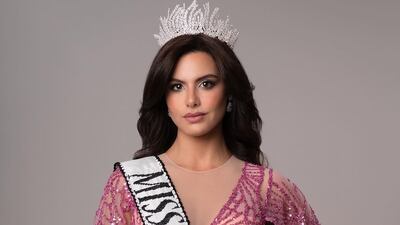
Earlier this year, when the opportunity to represent Palestine at the Miss Europe Continental beauty pageant was presented to Nadeen Ayoub, the model and fitness trainer from Ramallah jumped at the chance.
Ayoub, 24, who had only recently finished university in Ontario, Canada, had no prior pageantry experience but says she felt compelled to participate.
"Palestine hardly ever gets represented in global competitions ... or anything for that matter," she tells The National. "So I thought I'd do it for my country.
"Also, I thought it would be a nice vacation in Italy, which is where the competition was," she adds, laughing.
Ayoub admits she wasn't really taking the competition seriously. But when she placed in the top five among the 53 countries being represented, something changed in her.
"I realised how close I came to winning and thought if I prepared myself, I could really make a big impact," she recalls.
Ayoub, who was named Miss Palestine 2022 soon after, made history last month by placing in the final four of the Miss Earth global pageant — the first time someone from Palestine has ranked so high in a major beauty competition.
The environment-focused Miss Earth is one of the Big Four annual beauty contests, along with Miss World, Miss Universe and Miss International, and has been held mostly in the Philippines since it was launched in 2001. While the 2022 title was won by Mina Sue Choi of South Korea, the contest places "elemental" titles on the rest of the finalists — Miss Fire, Miss Water and Miss Air.
Ayoub was crowned Miss Earth-Water while Andrea Aguilera of Colombia was crowned Miss Earth-Fire and Sheridan Mortlock from Australia was named Miss Earth-Air.
Ayoub, a fan favourite during the preliminary rounds, says she gave the competition her all this time around.
"For me, it was an opportunity to be a voice for the Palestinian people, and be up there and speak about us on a global stage," she says. "I was not just there as a beauty queen, but I was representing my country, its culture, designers and artists — everyone who helped me along the way to represent my country."
But it was when she made it to the final 12 early on in the competition that Ayoub says she really felt she could actually win big.
"I've always had a stubborn confidence, so I was just enjoying the process. But when my name was called for the final 12, I was like 'Whoa! This is getting real'. That's when I really got into competition mode," she recalls.
She also relished the decisive final question posed to the final four: "What is one thing you want to right in this world and how would you right it?"
"I would want to fight the ignorance and selfishness of people," Ayoub said, drawing loud cheers from the audience. "Because I think that is the main problem that we are facing today, with all of the issues including environmental catastrophes, which are made by humans.
"It starts with education," she added. "That's how we can solve the selfishness and ignorance that we see today, and save planet Earth."
Ayoub says the question meant a lot to her, because it gave her the opportunity to speak as a Palestinian to the world, even beyond the pageant's environmental theme.
"It was a chance for me to really speak my heart, to say things as I saw it," she says. "By then, I didn't just see it as a competition where I'm up there trying to win, I saw it as a chance to use my voice as a Palestinian would, an opportunity we rarely get."
Still in Manila following the Miss Earth pageant, Ayoub, who splits her time between Canada and Palestine, will soon head back to Ramallah, where she hopes to continue her environmental work across the Middle East.
She will also continue to work with the Miss Palestine Organisation and help inspire the next generation of beauty queens to become global ambassadors for her country.
"I want to continue spreading awareness about the beauty of Palestine and give artists and fashion designers and talented people in Palestine a platform and a voice," she says.
"I hope that I have paved the way for other women in Palestine and the Arab world to be represented in a global competition. Because these platforms are not just about beauty, they are important platforms where you can really add your voice to issues and be an advocate for important causes."
Scroll through the gallery for more pictures from the Miss Earth 2022 competition
Ten tax points to be aware of in 2026
1. Domestic VAT refund amendments: request your refund within five years
If a business does not apply for the refund on time, they lose their credit.
2. E-invoicing in the UAE
Businesses should continue preparing for the implementation of e-invoicing in the UAE, with 2026 a preparation and transition period ahead of phased mandatory adoption.
3. More tax audits
Tax authorities are increasingly using data already available across multiple filings to identify audit risks.
4. More beneficial VAT and excise tax penalty regime
Tax disputes are expected to become more frequent and more structured, with clearer administrative objection and appeal processes. The UAE has adopted a new penalty regime for VAT and excise disputes, which now mirrors the penalty regime for corporate tax.
5. Greater emphasis on statutory audit
There is a greater need for the accuracy of financial statements. The International Financial Reporting Standards standards need to be strictly adhered to and, as a result, the quality of the audits will need to increase.
6. Further transfer pricing enforcement
Transfer pricing enforcement, which refers to the practice of establishing prices for internal transactions between related entities, is expected to broaden in scope. The UAE will shortly open the possibility to negotiate advance pricing agreements, or essentially rulings for transfer pricing purposes.
7. Limited time periods for audits
Recent amendments also introduce a default five-year limitation period for tax audits and assessments, subject to specific statutory exceptions. While the standard audit and assessment period is five years, this may be extended to up to 15 years in cases involving fraud or tax evasion.
8. Pillar 2 implementation
Many multinational groups will begin to feel the practical effect of the Domestic Minimum Top-Up Tax (DMTT), the UAE's implementation of the OECD’s global minimum tax under Pillar 2. While the rules apply for financial years starting on or after January 1, 2025, it is 2026 that marks the transition to an operational phase.
9. Reduced compliance obligations for imported goods and services
Businesses that apply the reverse-charge mechanism for VAT purposes in the UAE may benefit from reduced compliance obligations.
10. Substance and CbC reporting focus
Tax authorities are expected to continue strengthening the enforcement of economic substance and Country-by-Country (CbC) reporting frameworks. In the UAE, these regimes are increasingly being used as risk-assessment tools, providing tax authorities with a comprehensive view of multinational groups’ global footprints and enabling them to assess whether profits are aligned with real economic activity.
Contributed by Thomas Vanhee and Hend Rashwan, Aurifer
Ireland v Denmark: The last two years
Denmark 1-1 Ireland
7/06/19, Euro 2020 qualifier
Denmark 0-0 Ireland
19/11/2018, Nations League
Ireland 0-0 Denmark
13/10/2018, Nations League
Ireland 1 Denmark 5
14/11/2017, World Cup qualifier
Denmark 0-0 Ireland
11/11/2017, World Cup qualifier
Women’s T20 World Cup Asia Qualifier
ICC Academy, November 22-28
UAE fixtures
Nov 22, v Malaysia
Nov 23, v Hong Kong
Nov 25, v Bhutan
Nov 26, v Kuwait
Nov 28, v Nepal
ICC T20I rankings
14. Nepal
17. UAE
25. Hong Kong
34. Kuwait
35. Malaysia
44. Bhutan
UAE squad
Chaya Mughal (captain), Natasha Cherriath, Samaira Dharnidharka, Kavisha Egodage, Mahika Gaur, Priyanjali Jain, Suraksha Kotte, Vaishnave Mahesh, Judit Peter, Esha Rohit, Theertha Satish, Chamani Seneviratne, Khushi Sharma, Subha Venkataraman
Some of Darwish's last words
"They see their tomorrows slipping out of their reach. And though it seems to them that everything outside this reality is heaven, yet they do not want to go to that heaven. They stay, because they are afflicted with hope." - Mahmoud Darwish, to attendees of the Palestine Festival of Literature, 2008
His life in brief: Born in a village near Galilee, he lived in exile for most of his life and started writing poetry after high school. He was arrested several times by Israel for what were deemed to be inciteful poems. Most of his work focused on the love and yearning for his homeland, and he was regarded the Palestinian poet of resistance. Over the course of his life, he published more than 30 poetry collections and books of prose, with his work translated into more than 20 languages. Many of his poems were set to music by Arab composers, most significantly Marcel Khalife. Darwish died on August 9, 2008 after undergoing heart surgery in the United States. He was later buried in Ramallah where a shrine was erected in his honour.
The%20specs
%3Cp%3E%3Cstrong%3EEngine%3A%20%3C%2Fstrong%3E2.3-litre%204cyl%20turbo%0D%3Cbr%3E%3Cstrong%3EPower%3A%20%3C%2Fstrong%3E299hp%20at%205%2C500rpm%0D%3Cbr%3E%3Cstrong%3ETorque%3A%20%3C%2Fstrong%3E420Nm%20at%202%2C750rpm%0D%3Cbr%3E%3Cstrong%3ETransmission%3A%20%3C%2Fstrong%3E10-speed%20auto%0D%3Cbr%3E%3Cstrong%3EFuel%20consumption%3A%20%3C%2Fstrong%3E12.4L%2F100km%0D%3Cbr%3E%3Cstrong%3EOn%20sale%3A%20%3C%2Fstrong%3ENow%0D%3Cbr%3E%3Cstrong%3EPrice%3A%20%3C%2Fstrong%3EFrom%20Dh157%2C395%20(XLS)%3B%20Dh199%2C395%20(Limited)%3C%2Fp%3E%0A
HIJRA
Starring: Lamar Faden, Khairiah Nathmy, Nawaf Al-Dhufairy
Director: Shahad Ameen
Rating: 3/5
Globalization and its Discontents Revisited
Joseph E. Stiglitz
W. W. Norton & Company
The Details
Article 15
Produced by: Carnival Cinemas, Zee Studios
Directed by: Anubhav Sinha
Starring: Ayushmann Khurrana, Kumud Mishra, Manoj Pahwa, Sayani Gupta, Zeeshan Ayyub
Our rating: 4/5
The Sand Castle
Director: Matty Brown
Stars: Nadine Labaki, Ziad Bakri, Zain Al Rafeea, Riman Al Rafeea
Rating: 2.5/5
Mercer, the investment consulting arm of US services company Marsh & McLennan, expects its wealth division to at least double its assets under management (AUM) in the Middle East as wealth in the region continues to grow despite economic headwinds, a company official said.
Mercer Wealth, which globally has $160 billion in AUM, plans to boost its AUM in the region to $2-$3bn in the next 2-3 years from the present $1bn, said Yasir AbuShaban, a Dubai-based principal with Mercer Wealth.
“Within the next two to three years, we are looking at reaching $2 to $3 billion as a conservative estimate and we do see an opportunity to do so,” said Mr AbuShaban.
Mercer does not directly make investments, but allocates clients’ money they have discretion to, to professional asset managers. They also provide advice to clients.
“We have buying power. We can negotiate on their (client’s) behalf with asset managers to provide them lower fees than they otherwise would have to get on their own,” he added.
Mercer Wealth’s clients include sovereign wealth funds, family offices, and insurance companies among others.
From its office in Dubai, Mercer also looks after Africa, India and Turkey, where they also see opportunity for growth.
Wealth creation in Middle East and Africa (MEA) grew 8.5 per cent to $8.1 trillion last year from $7.5tn in 2015, higher than last year’s global average of 6 per cent and the second-highest growth in a region after Asia-Pacific which grew 9.9 per cent, according to consultancy Boston Consulting Group (BCG). In the region, where wealth grew just 1.9 per cent in 2015 compared with 2014, a pickup in oil prices has helped in wealth generation.
BCG is forecasting MEA wealth will rise to $12tn by 2021, growing at an annual average of 8 per cent.
Drivers of wealth generation in the region will be split evenly between new wealth creation and growth of performance of existing assets, according to BCG.
Another general trend in the region is clients’ looking for a comprehensive approach to investing, according to Mr AbuShaban.
“Institutional investors or some of the families are seeing a slowdown in the available capital they have to invest and in that sense they are looking at optimizing the way they manage their portfolios and making sure they are not investing haphazardly and different parts of their investment are working together,” said Mr AbuShaban.
Some clients also have a higher appetite for risk, given the low interest-rate environment that does not provide enough yield for some institutional investors. These clients are keen to invest in illiquid assets, such as private equity and infrastructure.
“What we have seen is a desire for higher returns in what has been a low-return environment specifically in various fixed income or bonds,” he said.
“In this environment, we have seen a de facto increase in the risk that clients are taking in things like illiquid investments, private equity investments, infrastructure and private debt, those kind of investments were higher illiquidity results in incrementally higher returns.”
The Abu Dhabi Investment Authority, one of the largest sovereign wealth funds, said in its 2016 report that has gradually increased its exposure in direct private equity and private credit transactions, mainly in Asian markets and especially in China and India. The authority’s private equity department focused on structured equities owing to “their defensive characteristics.”
Classification of skills
A worker is categorised as skilled by the MOHRE based on nine levels given in the International Standard Classification of Occupations (ISCO) issued by the International Labour Organisation.
A skilled worker would be someone at a professional level (levels 1 – 5) which includes managers, professionals, technicians and associate professionals, clerical support workers, and service and sales workers.
The worker must also have an attested educational certificate higher than secondary or an equivalent certification, and earn a monthly salary of at least Dh4,000.
Find the right policy for you
Don’t wait until the week you fly to sign up for insurance – get it when you book your trip. Insurance covers you for cancellation and anything else that can go wrong before you leave.
Some insurers, such as World Nomads, allow you to book once you are travelling – but, as Mr Mohammed found out, pre-existing medical conditions are not covered.
Check your credit card before booking insurance to see if you have any travel insurance as a benefit – most UAE banks, such as Emirates NBD, First Abu Dhabi Bank and Abu Dhabi Islamic Bank, have cards that throw in insurance as part of their package. But read the fine print – they may only cover emergencies while you’re travelling, not cancellation before a trip.
Pre-existing medical conditions such as a heart condition, diabetes, epilepsy and even asthma may not be included as standard. Again, check the terms, exclusions and limitations of any insurance carefully.
If you want trip cancellation or curtailment, baggage loss or delay covered, you may need a higher-grade plan, says Ambareen Musa of Souqalmal.com. Decide how much coverage you need for emergency medical expenses or personal liability. Premium insurance packages give up to $1 million (Dh3.7m) in each category, Ms Musa adds.
Don’t wait for days to call your insurer if you need to make a claim. You may be required to notify them within 72 hours. Gather together all receipts, emails and reports to prove that you paid for something, that you didn’t use it and that you did not get reimbursed.
Finally, consider optional extras you may need, says Sarah Pickford of Travel Counsellors, such as a winter sports holiday. Also ensure all individuals can travel independently on that cover, she adds. And remember: “Cheap isn’t necessarily best.”