Artificial intelligence is driving a wave of change across industry and society, which can positively affect everyday lives, particularly in developing countries.
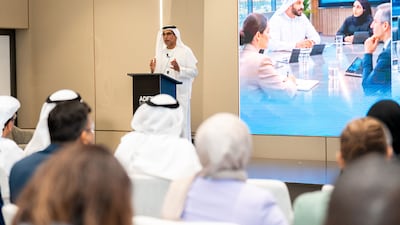
This was among the leading messages at the AI For Development Forum as the Abu Dhabi Exports Office (Adex) brought into focus the potential, demand for and realities of AI.
Across speeches, panel discussions, video presentations and networking conversations, the Abu Dhabi event emphasised the need for genuine human impact as well as security and sovereignty as technological progress crosses borders and “makes the impossible, possible”.
The forum came a year after the UAE launched the $1 billion AI For Development fund to support sustainable development, including deployment of AI and advanced technologies across developing countries, particularly in Africa. It is implemented through Adex, the export financing arm of Abu Dhabi Fund for Development (ADFD), in co-operation with the UAE Aid Agency.
The huge opportunity of Africa was central to much of the discussion on Yas Island.
Remarking on AI’s swift emergence, Mohamed Al Suwaidi, ADFD director general and chairman of the Adex Export Executive Committee, said steam engines took 80 years to reach lower-income countries, electricity 40 years, and the internet 20 years.
“Generative AI reached almost every economy on earth in 16 months,” he said during a keynote address.
“Speed is not the measure of AI, but impact is. Can AI help farmers produce more? Can it help communities manage scarce water resources better? Can it make essential services more efficient? That’s the real test. And as technology moves faster, development must move with it,” he said.
Recalling the UAE’s pioneering appointment of an AI Minister of State, he added: “We chose to prepare ourselves for the future rather than to react to it. Today, under the vision of our wise leadership, that ambition reaches beyond our borders.”
Through export finance, Adex turns “ambition into action” by connecting UAE-developed technologies with international markets, supporting solutions that respond to evolving national needs, such as intelligence that enhances public safety and connected government systems that improve digital services.
Mr Al Suwaidi described a “straightforward” Adex approach to executing the AI for Development Initiative, placing advanced tech where it “builds stronger economies and creates better lives”.
He said: “We start with the challenge, not the technology. We listen to our partners across Africa. We identify where UAE technologies and expertise make a measurable difference. Then we bring together the technology, financing, expertise, and partnership needed to deliver.”
Applying AI for good
Opening the forum, Saif Al Qubaisi, Adex assistant officer of business development, said: “AI can do a lot, but what matters most is what we can do with AI.”
And Mansoor Al Mansoori, chief executive of G42 International, gave real-world examples, explaining that AI ambitions were generating impact as the fund unlocked Africa’s development potential.
“This initiative comes when digital infrastructure is more critical and AI applications more powerful than ever before,” he said in his keynote.
“But while intelligence is becoming abundant, impact is not guaranteed. What separates the two is local context, human judgment, and strategic partnerships.
“Technology and finance are available from many partners. What is rare is experience and execution.”
Mr Al Mansoori said the UAE was an example of what could be achieved, making the journey from a young nation to a digital economy within a generation.
“Our aim is not simply to export technology but to turn technological capabilities into lasting impact,” he said.
“Adex makes that possible. It provides financial capacity and the long-term horizon that allows national ambition to become national infrastructure.”
The African journey began in 2021 in Angola as a first example of how the UAE could partner with a country to build its digital foundation, national infrastructure, and government analytic capabilities.
It did this through Presight, a G42 company and an Abu Dhabi global leader in big data analytics and AI, Mr Al Mansoori said.
Angolan success has since developed into broader ambition across Africa, including smart, safe city infrastructure in Togo and national-scale projects in Ivory Coast and Uganda.
“In transformation of this scale, the choice of partner becomes a strategic decision,” Mr Al Mansoori said. “A trusted partnership should leave a country with a greater capability and greater sovereignty over its own fate and technological and economic future. The UAE is committed to building that partnership across Africa so that abundant intelligence translates into local impact.”
Call to action
The forum identified healthcare, smart city development, education, energy and environment, public services, and agriculture among prime targets for positive AI implementation. It said turning possibility into progress takes more than innovation, however, and demands infrastructure, investment and partnerships as key connections that “bring technology into the real world”.
Mr Al Suwaidi called on UAE exporters and technology companies to explore Africa’s markets, priorities and partners – and African partners to bring their priorities to the UAE, explore available technology, engage with innovators, and take advantage of financing available through Adex “to turn promising ideas into real projects”.
“Start the conversation. Find the right partner, identify the challenge you can solve together, and turn that conversation into action,” he said. “Everything progress requires is within this room.”
He also urged young people to be part of the AI conversation, not simply as future users but as active contributors to its development and application. “We need more than people who understand AI; we need people who know how to put it to work.” Mr Al Suwaidi said.
Meanwhile, forum delegates heard that AI’s value was emerging in the problems it was solving. A video presentation suggested: “Technology’s greatest achievement is not what it can do, but what it can change”.
This resonated during breakout discussions held either side of, and during, three panel sessions, including “Emirati Exporters and The AI Sector”.
Salim Al Alawi, vice president of business development at Orbitworks, described his company’s space manufacturing capability and how its differentiated AI-enabled satellite services will use on-board intelligence to analyse and process data for infrastructure and environmental monitoring, urban planning, maritime awareness, and even protecting resources in places such as Africa from illegal mining.
“The use cases are endless … because what we’re doing is combining two powerful capabilities, AI and space,” he said.
“If you have a space asset that is informing you of what’s happening, without doing the field surveying et cetera that takes time and is sometimes in areas hard to reach, that will empower and enable decision-making that would add to the GDP of every country.”
Martin Yates, government technology adviser at Presight, discussed work in Africa and other markets, including cloud data centres, smart city systems and agentic government processes, and emphasised knowing the local market, culture and priorities, and building close relationships on the ground.
“Africa is such an amazing continent, full of diversity and energy and possibilities, and it’s something to be incredibly proud about that the UAE is there supporting, making that dream into a reality.”
UAE leads the way
Dr Yousif Alzaabi, Inception42’s director of government affairs, said the UAE had positioned itself as a trustworthy nation and a trustworthy tech partner. “The beauty of what we have here is there is an orchestral interplay between regulations and also innovation,” he added.
Afreximbank’s director of digital business and innovation, Emeka Onyia, told the 'Financing Africa’s digital future' panel that AI infrastructure was a priority for the bank as AI “has supercharged everything”.
“How do we enable our member states and our shareholders to be able to leverage the power of infrastructure, AI, data centres, power, to be able to do more and trade more?,” he asked.
Mr Onyia cited Nigeria’s requirement for regulated payment data to be stored in-country as driving data centre demand and advocated regional approaches whereby shared data centres can jointly serve smaller countries, “because once there’s demand, investment usually follows”.
Stefaniya llina, Adex MBA-senior officer for export and structured finance, revealed that since the $1 billion initiative was announced, it had received inquiries for more than $1 billion.
“I would say that more than 10 per cent of that one billion is being currently deployed,” she said. “We are very proud to say UAE exporters have been very proactively coming to us and asking us for capacity in various countries in Africa.”
The closing panel session, 'Artificial intelligence for positive impact', drilled further into where AI can benefit – in areas such as health; how it impacts leadership and skill sets; and where research is taking the technology.
Adding to input from Khalifa University and ADIA Lab, Wadia Ait Hamza, director of leadership programmes at The Academy at Mohammed bin Zayed University, said: “One of the most important aspects about AI is that it augments our capability, but capability is not wisdom. And leaders who know that know that they need to pay attention to what AI can do and what AI cannot do.”
Mr Hamza added: “It’s evolving every day … every hour, so it’s important to start catching up and upskilling ourselves, from top to bottom.”
This page was produced by The National in partnership with Abu Dhabi Exports Office