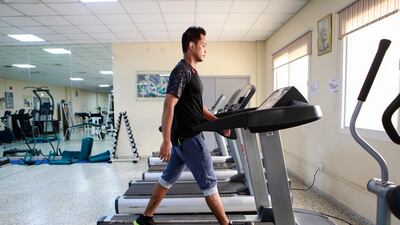
Weight-loss drugs Mounjaro, Wegovy and Ozempic have been found to increase metabolic activity. dpa via Reuters

Weight-loss drugs found to boost metabolism ... it's not all about food


Soraya Ebrahimi
  • English
  • Arabic

Weight-loss injections such as Ozempic, Wegovy or Mounjaro have a greater effect on the body than previously thought, a study by St Vincent’s University Hospital in Dublin has found.

The drugs make people feel satiated, and therefore inclined to eat less, but they have also been found to increase metabolic activity.

A randomised controlled trial with 30 patients looked at medications based on the hormone Glucagon-like peptide-1 (GLP-1).

Lose weight the healthy way - in pictures

The findings published on Thursday in the Journal of the Obesity Society show a strong relationship between the increase in metabolic activity from a once-daily treatment with GLP-1 and the amount of weight lost. It also found people with low metabolic activity before starting treatment gained the most from it.

“This study challenges the main narrative about these newer treatments, which is that they simply make you eat less, and that any action on energy burn is minimal," said Prof Donal O’Shea, at the hospital and the UCD School of Medicine.

"The strength of the association is surprising given the relatively small numbers studied and suggests this increase in metabolic activity is a significant contributor to how these drugs work.

“Safe medical treatment for obesity is still in its infancy and we need to understand fully how the treatment works. Understanding how these agents increase energy burn should be an important part of future research."

Hidden calories in our favourite food - in pictures

The 30 patients had specialised imaging of the fat in their abdomen using a Pet-CT scanner, with scans carried out before and after six months of treatment with GLP-1.

“It always seemed over-simplistic to me that these new treatments were just making people eat less, so this study finding is an exciting step forward in our understanding of how these new medicines for obesity work," Prof O’Shea said.

"The findings also provide science to support the fact that the treatment of obesity is not simply to eat less and move more. That’s the prevention piece. Treatment is more complex than that."

The use of weight-loss drugs such as Ozempic has exploded in popularity in recent years, with Elon Musk and celebrities such as Oprah Winfrey, Whoopi Goldberg and Rebel Wilson openly discussing their use of slimming injections.

Ozempic received authorisation for its use in the US in 2017 and the EU in 2018.

Its ability to help people lose large amounts of weight effortlessly and quickly soon spread on social media.

In the US, 20 million prescriptions were made for Ozempic in 2023, an increase of 5,000 per cent since 2018. There are global shortages of the drug, leading authorities worldwide to warn users about counterfeit injection pens in circulation.


Tamkeen's offering
  • Option 1: 70% in year 1, 50% in year 2, 30% in year 3
  • Option 2: 50% across three years
  • Option 3: 30% across five years 
Europe's top EV producers
  1. Norway (63% of cars registered in 2021)
  2. Iceland (33%)
  3. Netherlands (20%)
  4. Sweden (19%)
  5. Austria (14%)
  6. Germany (14%)
  7. Denmark (13%)
  8. Switzerland (13%)
  9. United Kingdom (12%)
  10. Luxembourg (10%)

Source: VCOe 

Sanju

Produced: Vidhu Vinod Chopra, Rajkumar Hirani

Director: Rajkumar Hirani

Cast: Ranbir Kapoor, Vicky Kaushal, Paresh Rawal, Anushka Sharma, Manish’s Koirala, Dia Mirza, Sonam Kapoor, Jim Sarbh, Boman Irani

Rating: 3.5 stars

Cinco in numbers

Dh3.7 million

The estimated cost of Victoria Swarovski’s gem-encrusted Michael Cinco wedding gown

46

The number, in kilograms, that Swarovski’s wedding gown weighed.

1,000

The hours it took to create Cinco’s vermillion petal gown, as seen in his atelier [note, is the one he’s playing with in the corner of a room]

50

How many looks Cinco has created in a new collection to celebrate Ballet Philippines’ 50th birthday

3,000

The hours needed to create the butterfly gown worn by Aishwarya Rai to the 2018 Cannes Film Festival.

1.1 million

The number of followers that Michael Cinco’s Instagram account has garnered.

COMPANY%20PROFILE
%3Cp%3E%3Cstrong%3ECompany%3A%3C%2Fstrong%3E%20Eco%20Way%3Cbr%3E%3Cstrong%3EStarted%3A%3C%2Fstrong%3E%20December%202023%3Cbr%3E%3Cstrong%3EFounder%3A%3C%2Fstrong%3E%20Ivan%20Kroshnyi%3Cbr%3E%3Cstrong%3EBased%3A%3C%2Fstrong%3E%20Dubai%2C%20UAE%3Cbr%3E%3Cstrong%3EIndustry%3A%3C%2Fstrong%3E%20Electric%20vehicles%3Cbr%3E%3Cstrong%3EInvestors%3A%3C%2Fstrong%3E%20Bootstrapped%20with%20undisclosed%20funding.%20Looking%20to%20raise%20funds%20from%20outside%3Cbr%3E%3C%2Fp%3E%0A
MATCH INFO

Fixture: Thailand v UAE, Tuesday, 4pm (UAE)

TV: Abu Dhabi Sports

The years Ramadan fell in May

1987

1954

1921

1888

F1 The Movie

Starring: Brad Pitt, Damson Idris, Kerry Condon, Javier Bardem

Director: Joseph Kosinski

Rating: 4/5

Where to donate in the UAE

The Emirates Charity Portal

You can donate to several registered charities through a “donation catalogue”. The use of the donation is quite specific, such as buying a fan for a poor family in Niger for Dh130.

The General Authority of Islamic Affairs & Endowments

The site has an e-donation service accepting debit card, credit card or e-Dirham, an electronic payment tool developed by the Ministry of Finance and First Abu Dhabi Bank.

Al Noor Special Needs Centre

You can donate online or order Smiles n’ Stuff products handcrafted by Al Noor students. The centre publishes a wish list of extras needed, starting at Dh500.

Beit Al Khair Society

Beit Al Khair Society has the motto “From – and to – the UAE,” with donations going towards the neediest in the country. Its website has a list of physical donation sites, but people can also contribute money by SMS, bank transfer and through the hotline 800-22554.

Dar Al Ber Society

Dar Al Ber Society, which has charity projects in 39 countries, accept cash payments, money transfers or SMS donations. Its donation hotline is 800-79.

Dubai Cares

Dubai Cares provides several options for individuals and companies to donate, including online, through banks, at retail outlets, via phone and by purchasing Dubai Cares branded merchandise. It is currently running a campaign called Bookings 2030, which allows people to help change the future of six underprivileged children and young people.

Emirates Airline Foundation

Those who travel on Emirates have undoubtedly seen the little donation envelopes in the seat pockets. But the foundation also accepts donations online and in the form of Skywards Miles. Donated miles are used to sponsor travel for doctors, surgeons, engineers and other professionals volunteering on humanitarian missions around the world.

Emirates Red Crescent

On the Emirates Red Crescent website you can choose between 35 different purposes for your donation, such as providing food for fasters, supporting debtors and contributing to a refugee women fund. It also has a list of bank accounts for each donation type.

Gulf for Good

Gulf for Good raises funds for partner charity projects through challenges, like climbing Kilimanjaro and cycling through Thailand. This year’s projects are in partnership with Street Child Nepal, Larchfield Kids, the Foundation for African Empowerment and SOS Children's Villages. Since 2001, the organisation has raised more than $3.5 million (Dh12.8m) in support of over 50 children’s charities.

Noor Dubai Foundation

Sheikh Mohammed bin Rashid Al Maktoum launched the Noor Dubai Foundation a decade ago with the aim of eliminating all forms of preventable blindness globally. You can donate Dh50 to support mobile eye camps by texting the word “Noor” to 4565 (Etisalat) or 4849 (du).

Mercer, the investment consulting arm of US services company Marsh & McLennan, expects its wealth division to at least double its assets under management (AUM) in the Middle East as wealth in the region continues to grow despite economic headwinds, a company official said.

Mercer Wealth, which globally has $160 billion in AUM, plans to boost its AUM in the region to $2-$3bn in the next 2-3 years from the present $1bn, said Yasir AbuShaban, a Dubai-based principal with Mercer Wealth.

Within the next two to three years, we are looking at reaching $2 to $3 billion as a conservative estimate and we do see an opportunity to do so,” said Mr AbuShaban.

Mercer does not directly make investments, but allocates clients’ money they have discretion to, to professional asset managers. They also provide advice to clients.

“We have buying power. We can negotiate on their (client’s) behalf with asset managers to provide them lower fees than they otherwise would have to get on their own,” he added.

Mercer Wealth’s clients include sovereign wealth funds, family offices, and insurance companies among others.

From its office in Dubai, Mercer also looks after Africa, India and Turkey, where they also see opportunity for growth.

Wealth creation in Middle East and Africa (MEA) grew 8.5 per cent to $8.1 trillion last year from $7.5tn in 2015, higher than last year’s global average of 6 per cent and the second-highest growth in a region after Asia-Pacific which grew 9.9 per cent, according to consultancy Boston Consulting Group (BCG). In the region, where wealth grew just 1.9 per cent in 2015 compared with 2014, a pickup in oil prices has helped in wealth generation.

BCG is forecasting MEA wealth will rise to $12tn by 2021, growing at an annual average of 8 per cent.

Drivers of wealth generation in the region will be split evenly between new wealth creation and growth of performance of existing assets, according to BCG.

Another general trend in the region is clients’ looking for a comprehensive approach to investing, according to Mr AbuShaban.

“Institutional investors or some of the families are seeing a slowdown in the available capital they have to invest and in that sense they are looking at optimizing the way they manage their portfolios and making sure they are not investing haphazardly and different parts of their investment are working together,” said Mr AbuShaban.

Some clients also have a higher appetite for risk, given the low interest-rate environment that does not provide enough yield for some institutional investors. These clients are keen to invest in illiquid assets, such as private equity and infrastructure.

“What we have seen is a desire for higher returns in what has been a low-return environment specifically in various fixed income or bonds,” he said.

“In this environment, we have seen a de facto increase in the risk that clients are taking in things like illiquid investments, private equity investments, infrastructure and private debt, those kind of investments were higher illiquidity results in incrementally higher returns.”

The Abu Dhabi Investment Authority, one of the largest sovereign wealth funds, said in its 2016 report that has gradually increased its exposure in direct private equity and private credit transactions, mainly in Asian markets and especially in China and India. The authority’s private equity department focused on structured equities owing to “their defensive characteristics.”

What is blockchain?

Blockchain is a form of distributed ledger technology, a digital system in which data is recorded across multiple places at the same time. Unlike traditional databases, DLTs have no central administrator or centralised data storage. They are transparent because the data is visible and, because they are automatically replicated and impossible to be tampered with, they are secure.

The main difference between blockchain and other forms of DLT is the way data is stored as ‘blocks’ – new transactions are added to the existing ‘chain’ of past transactions, hence the name ‘blockchain’. It is impossible to delete or modify information on the chain due to the replication of blocks across various locations.

Blockchain is mostly associated with cryptocurrency Bitcoin. Due to the inability to tamper with transactions, advocates say this makes the currency more secure and safer than traditional systems. It is maintained by a network of people referred to as ‘miners’, who receive rewards for solving complex mathematical equations that enable transactions to go through.

However, one of the major problems that has come to light has been the presence of illicit material buried in the Bitcoin blockchain, linking it to the dark web.

Other blockchain platforms can offer things like smart contracts, which are automatically implemented when specific conditions from all interested parties are reached, cutting the time involved and the risk of mistakes. Another use could be storing medical records, as patients can be confident their information cannot be changed. The technology can also be used in supply chains, voting and has the potential to used for storing property records.

Updated: August 23, 2024, 5:22 AM