


New eye scans using artificial intelligence could detect Parkinson’s disease in people before they have symptoms, a study has suggested.
The technology could eventually be used as a pre-screening tool for people at risk of the condition.
A team from Moorfields Eye Hospital and the UCL Institute of Ophthalmology used AI to analyse an AlzEye data set and pick up retinal markers.
They looked at 154,830 patients aged 40 and over who had attended secondary care ophthalmic hospitals in London between 2008 and 2018.
The process was repeated using data from the UK Biobank, assessing 67,311 healthy volunteers aged between 40 and 69 who were recruited between 2006 and 2010.
It was found people with Parkinson’s had a thinner ganglion cell-inner plexiform layer and inner nuclear layer in the eye.
Researchers suggest that looking at these layers in the years before symptoms present themselves could help detect the disease earlier.
“I continue to be amazed by what we can discover through eye scans,” Siegfried Wagner, a clinical research fellow at Moorfields and the UCL Institute of Ophthalmology researcher, said.
“While we are not yet ready to predict whether an individual will develop Parkinson’s, we hope that this method could soon become a pre-screening tool for people at risk of disease.
“Finding signs of a number of diseases before symptoms emerge means that, in the future, people could have the time to make lifestyle changes to prevent some conditions arising, and clinicians could delay the onset and impact of life-changing neurodegenerative disorders.”
The symptoms of Parkinson's Disease – in pictures
-

Sheikh Juma with Cleveland Clinic Abu Dhabi staff Ayah Jammali, an occupational therapist, and Dr Shivam Mittal from the Neurological Institute. Photo: Cleveland Clinic Abu Dhabi -

Dr Mittal said a combination of therapy, support and drugs can significantly improve quality of life for Parkinson's patients. Photo: Cleveland Clinic Abu Dhabi -
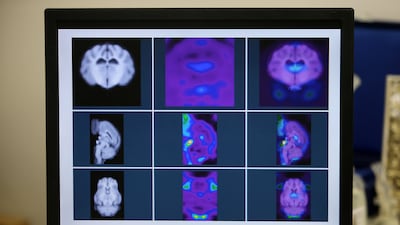
Parkinson's is a degenerative condition that causes nerve cells to die. This prevents signals from travelling to the body, which causes movement and speech problems. Pawan Singh / The National -
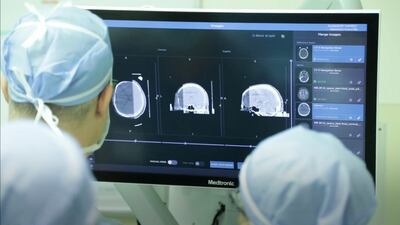
Doctors said they have an array of treatments including surgery, medicines, exercise support and therapy, which can significantly improve quality of life. Courtesy: Cleveland Clinic Abu Dhabi -

Regular exercise and breathing can help patients to improve movement, stay active and overcome anxiety and depression, which is common. Ravindranath K / The National -

Regular exercise and breathing can help patients to improve movement, stay active and overcome anxiety and depression, which is common. AFP


“This work demonstrates the potential for eye data, harnessed by the technology to pick up signs and changes too subtle for humans to see,” Alastair Denniston, consultant ophthalmologist at University Hospitals Birmingham, professor at the University of Birmingham and part of NIHR Moorfields BRC, added.
“We can now detect very early signs of Parkinson’s, opening up new possibilities for treatment.”
Louisa Wickham, Moorfields’ medical director, said using imaging across a wider population could “have a huge impact on public health in the future” with the potential for “predictive analysis”.
“OCT (optical coherence tomography) scans are more scalable, non-invasive, lower cost and quicker than brain scans for this purpose,” she added.
The project involved the National Institute of Health and Social Care, as well as biomedical research centres at Moorfields Eye Hospital, University Hospital Birmingham, Great Ormond Street Hospital, Oxford University Hospital, University College Hospital London and the UCL Great Ormond Street Institute of Child Health.
Its findings have been published in Neurology, the medical journal of the American Academy of Neurology.
“Intervening earlier to stop the loss of precious brain cells is the key to preventing the condition,” Claire Bale, Associate Director of Research at Parkinson’s UK, said.
“Parkinson’s UK and others are already funding clinical trials exploring medications and lifestyle approaches to investigate their potential for stopping, slowing or preventing Parkinson’s.
“This research offers hope that eye scans could be used to identify people at risk of developing Parkinson’s to enable early treatment.
“And because the eye scans analysed in this study are non-invasive, and already in routine use, this could be easily put into practice in the NHS.”

