


A study suggests people with mild Covid are infectious for an average of five days.
Only one in five people who took part in the study were infectious before symptoms started, researchers found.
The study found two thirds of people were still infectious five days after symptoms began, with a quarter still infectious at seven days.
The study, led by Imperial College London and published in The Lancet Respiratory Medicine journal, is the first to reveal how long infectiousness lasts with coronavirus in the community.
Detailed daily tests were conducted from when people were exposed to the virus to see how much of the virus they were shedding throughout their infection.
The findings indicate that lateral flow tests do not reliably detect the start of infectiousness, but can be used to safely shorten isolation.
World leaders with Covid-19 - in pictures
-
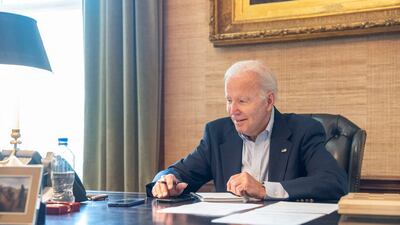
US President Joe Biden tested positive for Covid-19 in July 2022. Reuters -

Former US president Donald Trump gives the thumbs-up after leaving the Walter Reed Medical Centre in Bethesda, Maryland, where he was treated for Covid-19 in October 2020. AFP -

Mr Trump removes his mask after returning to the White House from hospital in October 2020. AFP -

Algerian President Abdelmadjid Tebboune spent a month in Germany in January 2021, where he had surgery after developing complications linked to Covid-19. AFP -

Britain's Queen Elizabeth II had Covid-19 in February 2022, months before her death. AFP -
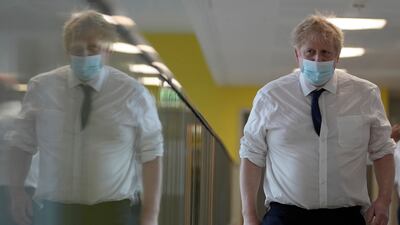
Britain's Prime Minister Boris Johnson caught Covid-19 in March 2020. AFP -
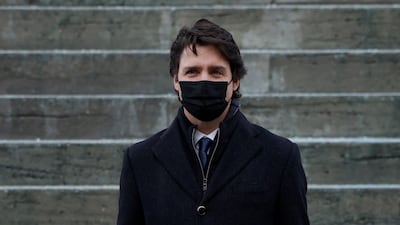
Canadian Prime Minister Justin Trudeau tested positive for Covid-19 a second time in July 2022, six months after he first contracted the virus. Reuters -
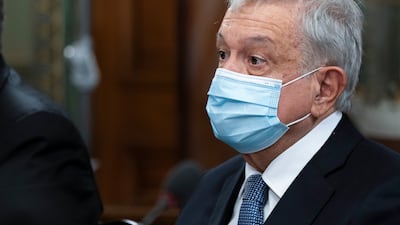
Mexican President Andres Manuel Lopez Obrador tested positive for Covid-19 in January 2022, after having first contracted the coronavirus in early 2021. AP -

Brazil's President Jair Bolsonaro tested positive for Covid-19 in July 2020. Reuters -

Departing Italian Prime Minister Mario Draghi contracted the virus that causes Covid-19 in April 2022. EPA


The researchers recommend people with Covid-19 isolate for five days after symptoms begin and have lateral flow tests from the sixth day.
If tests are negative two days in a row, it is safe to leave isolation, they say.
But if someone continues to test positive, they should isolate but may leave quarantine 10 days after their symptoms began.
UK National Health Service guidance suggests that people should try to stay at home and avoid contact with others for five days.
“Before this study we were missing half of the picture about infectiousness, because it’s hard to know when people are first exposed to Sars-CoV-2 and when they first become infectious," said study author Prof Ajit Lalvani, director of the NIHR health protection research unit for respiratory infections at Imperial.
“By using special daily tests to measure infectious virus [not just PCR] and daily symptom records, we were able to define the window in which people are infectious.
“This is fundamental to controlling any pandemic and has not been previously defined for any respiratory infection in the community.
“Combining our results with what we know about the dynamics of Omicron infections, we believe that the duration of infectiousness we’ve observed is broadly generalisable to current Sars-CoV-2 variants, though their infectious window may be a bit shorter.
“Our evidence can be used to inform infection control policies and self-isolation guidance to help reduce the transmission of Sars-CoV-2.”
Coronavirus pandemic around the world - in pictures
-

A young woman receives a Pfizer jab in Diepsloot Township near Johannesburg, South Africa. AP Photo -

A girl wearing a face mask rides on a merry-go-round at the Christmas market in Frankfurt, Germany. AP Photo -

People travel on a London underground tube train on the Jubilee Line, in London, during the pandemic. AP Photo -

People wait for the tram in Vienna, Austria, amid the crisis. AP Photo -

A woman passes by an empty terrace in the Marrolles quarter in Brussels, Belgium. AP Photo -
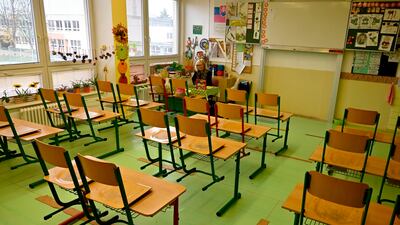
A teacher gives online lessons via webcam at the temporarily closed elementary school in the town of Trebisov, eastern Slovakia. TASR via AP -
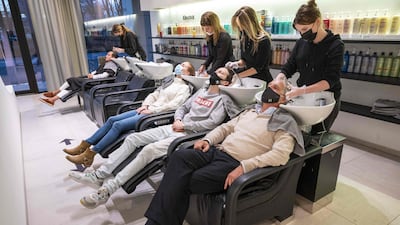
Hairdressers and clients wear masks in Amsterdam, Netherlands. AFP -

A man disinfects seats for tourists at a beach in Kuta, Bali, Indonesia. EPA -
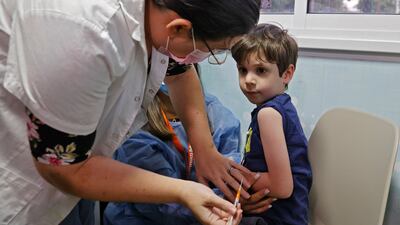
Israeli boy Itamar, 5, receives a dose of the Pfizer/BioNTech Covid-19 vaccine at the Meuhedet Healthcare Services Organisation in Tel Aviv. AFP -

A patient suffering from Covid-19 is admitted in the intensive care unit of the Basaksehir Cam and Sakura City Hospital in Istanbul, Turkey. Reuters -
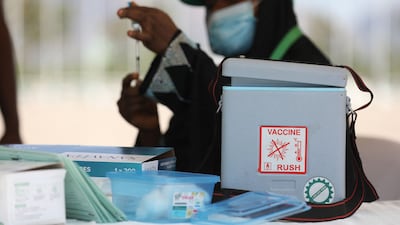
A health worker prepares to administer the AstraZeneca jab in Abuja, Nigeria. AFP


The study followed people who were exposed to someone with PCR-confirmed Covid in their home between September 2020 and March 2021, and May to October 2021, including vaccinated and unvaccinated people.
Samples from 57 people were used, but the duration of infectiousness was only measured in 42.
There were 38 people with a confirmed date of when their symptoms started and three were asymptomatic.
“Self-isolation is not necessary by law, but people who want to isolate need clear guidance on what to do," Prof Lalvani said.
“The NHS currently advises that if you test positive for Covid-19 you should try to stay at home and avoid contact with other people for five days.
"But our data suggest that under a crude five-day self-isolation period, two thirds of cases released into the community would still be infectious – although their level of infectiousness would have substantially reduced compared to earlier in the course of their infection.”
“Our study finds that infectiousness usually begins soon after you develop Covid-19 symptoms," he continued.
“We recommend that anyone who has been exposed to the virus and has symptoms isolates for five days, then uses daily lateral flow tests to safely leave isolation when two consecutive daily tests are negative.”
Covid booster against variants to be available in UK from September
Meanwhile, the NHS announced plans to start introducing the new variant-effective Covid-19 vaccine in the first full week of September as part of the autumn booster programme.
NHS England said care-home residents and people who are housebound will be among the first to be vaccinated from September 5. A wider introduction is due to start on September 12.
The UK became the first country in the world to approve Moderna’s bivalent vaccine, which is effective against the original strain of the virus and the Omicron variant.
But it was reported that the country does not have enough doses to offer the new shot to all people eligible for the booster.
However, ministers said the 26 million people across England who are eligible for an autumn booster will have access to one of the next-generation shots in line with guidance set out by the Joint Committee on Vaccination and Immunisation on Monday.
UK approves world's first variant-adapted Covid vaccine - video
NHS England said people would be offered the next-generation bivalent vaccine where appropriate and subject to supply.
As with previous campaigns, the oldest and most vulnerable will be called first, with people able to book online or through 119 as long as it has been three months since their most recent dose.
Up to 3,000 sites are expected to be part of the introduction, including GP practices and community pharmacies, and new venues may be added.
“The NHS was the first healthcare system in the world to deliver a Covid-19 vaccine outside of clinical trials, and will now be the first to deliver the new, variant-busting vaccine when the rollout begins at the start of September,” NHS chief executive Amanda Pritchard said.
More than 126 million Covid vaccines have been administered by NHS staff and volunteers since the first shot was delivered, outside of clinical trials, to Maggie Keenan in Coventry in December 2020.
“Our fantastic NHS staff have worked incredibly hard to deliver 126 million doses to date and behind the scenes they have once again been preparing to deliver the latest phase with the same speed and precision as we have had throughout the rollout,” Ms Pritchard said.
She urged anyone who was invited to have an autumn booster and flu vaccination “to do so as quickly as possible. It will give you maximum protection this winter”.
The NHS will also be introducing the flu vaccine and encouraging eligible people to have it from the first of the month where possible.
It means that some people may be offered approved doses of the flu and Covid shots, which can be given at the same time.
WHO estimates nearly 15 million deaths associated with Covid-19 - video
“This winter will be the first time we see the real effects of both Covid and flu in full circulation as we go about life as normal," said Steve Russell, NHS director for vaccinations and screening.
"And so it is vital that those most susceptible to serious illness from these viruses come forward for the latest jab in order to protect themselves.
“We know that our GPs and community pharmacies have been integral to the success of the NHS vaccination programme due to their locations and relationships with local communities, and so it is fantastic that so many have opted to be part of the latest phase of the campaign.”
The National Booking Service is set to open during the week of September 5. The NHS invite those who are most susceptible to serious illness from Covid-19 and those aged 75 and over to book an appointment from that week.
Mr Russell said the NHS would contact people when it was their turn to get an autumn booster, and would be inviting the first people outside of care homes to book before the formal introduction.
The NHS will continue to advise local sites to allow immuno-suppressed patients to attend walk-ins to make getting the extra protection as easy as possible.
Health and social care staff will also be able to get the autumn booster.
All providers are being asked to ensure their staff are offered the autumn shot, potentially alongside the flu inoculation.
The JCVI and the Medicines and Healthcare products Regulatory Agency have said the original vaccines continue to provide good protection and people should come forward regardless of the vaccine offered.
The autumn booster campaign is among a package of NHS measures to prepare for winter, including increasing bed capacity and the number of 999 and NHS 111 staff to deal with any more pressure.
“While our world-leading Covid vaccination programme has saved countless lives and enabled us to live with this virus, we cannot be complacent about the threat it poses this winter,” Health and Social Care Secretary Steve Barclay said.
“Vaccines offer the best defence against the virus and will help relieve pressure on the NHS at its most difficult time of year.
"So I encourage all those eligible to come forward as soon as they are contacted by the NHS."

