


Drinking moderate amounts of sweetened or unsweetened coffee, between 1.5 and 3.5 cups a day, could help you to live longer, a study has found.
Researchers from Southern Medical University in Guangzhou, China, used data from the UK Biobank health questionnaire to evaluate the associations of sugar-sweetened, artificially sweetened, and unsweetened coffee with all-cause and cause-specific deaths.
Their findings are featured in Annals of Internal Medicine.
More than 171,000 participants from the UK without known heart disease or cancer were asked dietary and behaviour questions to determine their coffee habits.
Those who drank any amount of unsweetened coffee were 16 to 21 per cent less likely to die in the following seven years than participants who did not drink coffee, the authors found.
They also found that participants who drank 1.5 to 3.5 daily cups of coffee sweetened with sugar were 29 to 31 per cent less likely to die than those who did not drink coffee.
Adults who drank sugar-sweetened coffee added only about 1 teaspoon of sugar for each cup of coffee on average.
The results for those who used artificial sweeteners were less clear, the study’s authors said.
Previous studies have found that drinking consumption is associated with a lower risk of death, but did not distinguish between unsweetened coffee and coffee with sugar or artificial sweeteners.
-
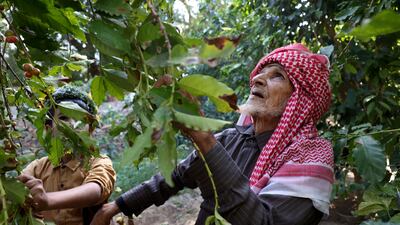
Farah Al Malki, 90, and his grandson Mansour, 11, harvest Khawlani coffee beans at their farm in Saudi Arabia's south-western region of Jizan. All photos: AFP -

Mr Al Malki has a long history with coffee, which spread from Ethiopia to Yemen and then to the rest of the Middle East around the 15th century. "My father inherited it from his grandfathers, and I took over and passed it down to my sons and then on to my grandchildren," he says. -
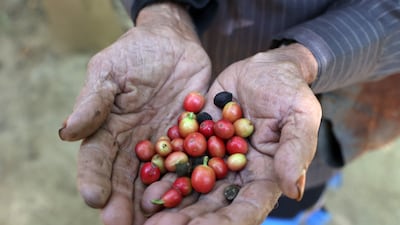
Jizan is known for its red Khawlani coffee beans, often blended with cardamom and saffron to give a yellowish hue of coffee — locally known as ghawa — and a taste markedly different from the bitter black liquid drunk elsewhere in the Middle East and in the West. It remains an integral part of Saudi culture, so much so that the government has designated 2022 as 'The Year of Saudi Coffee'. -

"The biggest issues we used to have were the lack of water and support," says Mr Malki. But with the kingdom's desire to diversify its economy away from oil, alongside a social shift to transform the country's ultra-conservative image and open up to visitors and investors, the government last month began a campaign to promote its coffee. It instructed all restaurants and cafes to use the term "Saudi coffee" instead of Arabic coffee. -
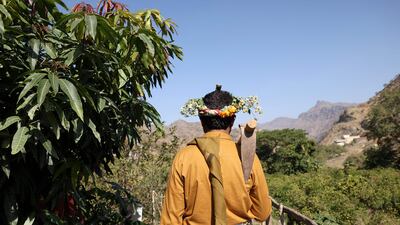
Saudi Aramco, the largely state-owned oil company, announced plans to establish a coffee centre in Jizan using "advanced irrigation techniques to improve agricultural capacity". By the end of 2021, the kingdom had 400,000 coffee trees on 600 farms across the country, producing about 800 tonnes of coffee a year. That is a fraction of what Ethiopia produces, but Saudi Arabia plans to plant 1.2 million Khawlani trees by 2025. -
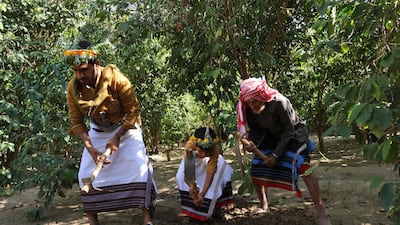
Mr Malki has nine sons, all of whom take part in the coffee industry, ranging from agriculture and packaging to transportation and marketing. On the field every day is his son Ahmed, 42, left, who like his father is dressed in traditional farmer's clothing. He says he has an intimate knowledge of Khawlani coffee beans, explaining: "All farms are organic and free of chemicals." -
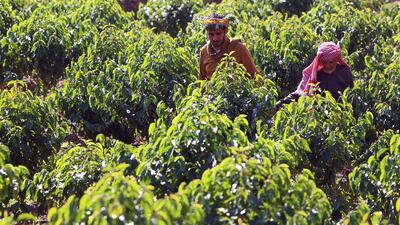
They produce about 2.5 tonnes of coffee beans a year, selling for between $27-$40 a kilogram. -
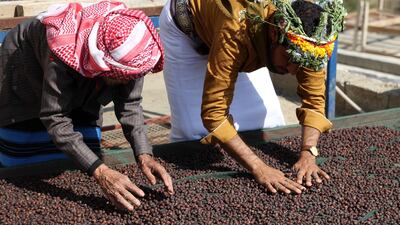
Saudi Arabia has sought to include its cultivation of Khawlani coffee on the list of "intangible cultural heritage of humanity" maintained by the UN cultural agency, Unesco. This, Ahmed says, would be a dream come true. -
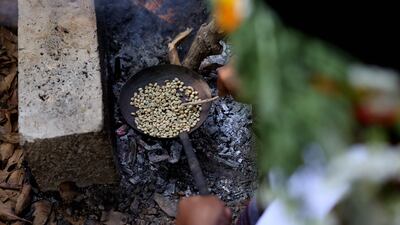
"It will help in supporting farmers and preserving coffee trees as well as attracting foreign investors to the region," he says. "I hope to pass this on to my sons and their sons, and pray it be a source of livelihood for them."


Researchers have said that there are a number of variables to consider when looking at the headline findings.
They said, for example, that while coffee has qualities that could be beneficial to health, it was difficult to measure differences in socioeconomic status, diet and other lifestyle factors that may affect findings.
Also, the data is collected from a country where tea is a similarly popular beverage.
They also caution that the average amount of daily sugar for each cup of coffee recorded in the study is much lower than drinks bought at popular coffee chains.

