Worshippers pray at the Grand Mosque during Hajj in Makkah, Saudi Arabia, in 2019. Reuters

Hajj 2022: dates, packages, Covid rules and all you need to know


  • English
  • Arabic

Since the introduction of mass vaccinations, relaxed social distancing and travel laws, authorities are eager to welcome people from abroad to perform Hajj in June, to pre-Covid levels.

Two years ago, the kingdom closed its borders to contain the spread of Covid-19 and Hajj was restricted to 1,000 domestic pilgrims. Last year, numbers were limited to 60,000 because of the health threat posed by the Covid-19 pandemic.

Saudi Arabia said those wishing to perform Hajj have to apply online.

Hajj attracts nearly two million Muslims and generates about $12 billion in revenue for Saudi Arabia every year.

Deputy Minister of Hajj and Umrah Abdul Fattah Mashat said Hajj, as well as Umrah, a shorter pilgrimage that can be performed at any time of the year, are major components of the Saudi Vision 2030.

One of the programme's aims is to boost the religious tourism sector and host 30 million Umrah pilgrims annually by 2030.

What is Hajj?

Hajj, the Arabic word for pilgrimage, is one of the five pillars of Islam and a once-in-a-lifetime obligation for every Muslim, if they are able.

Millions of faithful make the pilgrimage to holiest sites of Islam in the cities of Makkah and Madinah, beginning on the eighth day of Dhu Al Hijja, the last month of the Islamic calendar.

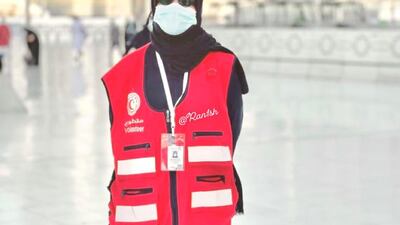
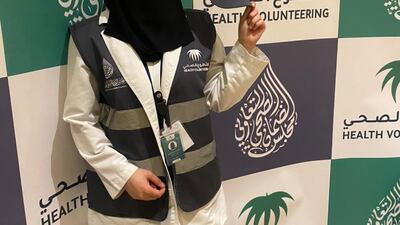
  • Rania Shuaib, a Hajj volunteer in Makkah.
    Rania Shuaib, a Hajj volunteer in Makkah.
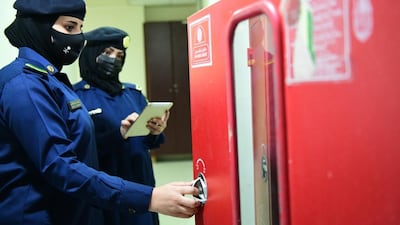
  • Solider Abeer Al Rashid who conducted Saudi Arabia's first female-led security forces briefing for Hajj last week.
    Solider Abeer Al Rashid who conducted Saudi Arabia's first female-led security forces briefing for Hajj last week.
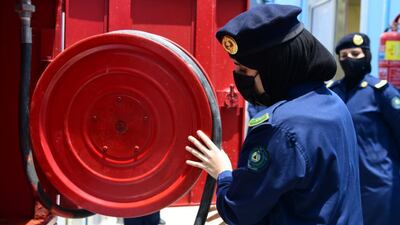
  • Civil defence soliders checking holy sites.
    Civil defence soliders checking holy sites.
  • Amal AabdulRahman is in her fourth year as a Hajj camp supervisor.
    Amal AabdulRahman is in her fourth year as a Hajj camp supervisor.
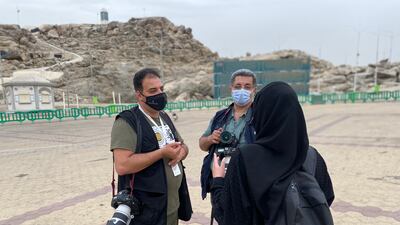
  • Reem Khalid, 25, talking to reporters in her role as a media co-ordinator.
    Reem Khalid, 25, talking to reporters in her role as a media co-ordinator.
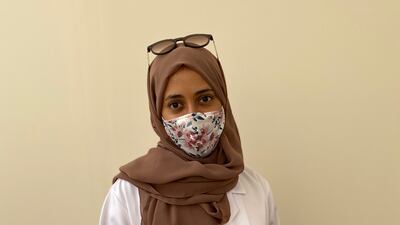
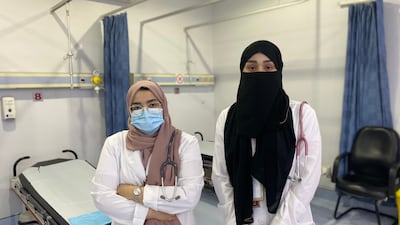
  • Dr Zahra Al Srori and her friend Dr Tasneem Eid both decided to work this Hajj.
    Dr Zahra Al Srori and her friend Dr Tasneem Eid both decided to work this Hajj.
  • Nurse Sara Al Shamari is working at the Grand Mosque of Makkah, her second placement as a volunteer.
    Nurse Sara Al Shamari is working at the Grand Mosque of Makkah, her second placement as a volunteer.
  • Civil defence soliders checking holy sites.
    Civil defence soliders checking holy sites.
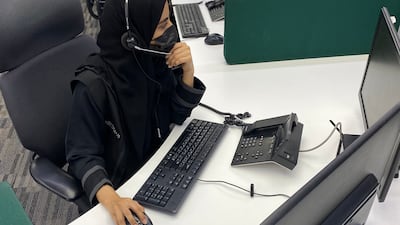
  • The 911 call centre in Makkah has a designated women’s section, covering all sorts of emergencies.
    The 911 call centre in Makkah has a designated women’s section, covering all sorts of emergencies.
  • Civil defence soliders checking holy sites.
    Civil defence soliders checking holy sites.

What is special about Hajj?

Hajj is the most revered spiritual experience for devout Muslims — considered a chance to start afresh and celebrate the spirit of unity in Islam. Pilgrims are all required to perform the same rituals taught by the Prophet Mohammed, to remind them that they are all equal before God.

When does Hajj begin this year? How long does it take?

This year, Hajj is expected to begin on July 26. The pilgrimage takes three days, but most pilgrims extend their stay by a week to pray in the holy cities of Makkah and Madinah.

What are the Covid-19 rules performing Hajj this year?

Authorities have set out health requirements that Hajj pilgrims from outside the kingdom have to meet before landing in the country.

Pilgrims who wish to perform Hajj must be vaccinated against Covid-19.

The vaccination deadline is 10 days before the Hajj season begins, according to the Ministry of Hajj and Umrah, who said that pilgrims must have all three doses of a Covid-19 vaccine for them to obtain the Hajj permit.

The ministry also said vaccinations against seasonal flu and meningococcal meningitis must be taken and for those coming from outside Saudi Arabia vaccinations against yellow fever and polio are mandatory.

What do pilgrims wear during Hajj?

During Hajj, as with Umrah, men wear two sheets of plain white cloth, to cover the upper and lower body. Women must wear modest clothes that cover their bodies to the ankle and scarves to cover their hair. The clothes are usually white, although there is no restriction on colour.

What happens during Hajj?

On the first day, Muslims perform Umrah, which includes Tawaf and Sa'i. The first involves circumambulating the Kaaba, the holiest site in Islam, built by the Prophet Ibrahim and his son Ismail, at the Grand Mosque in Makkah. During Sa'i, pilgrims walk seven times between two hills, called Safa and Marwa, in the mosque complex.

After Umrah, Muslims travel to Mina, a holy site south-east of Makkah, by shuttle and camp there in tents overnight. Mina, also known as the city of tents, can host up to three million people.

On the second day, pilgrims travel to Mount Arafat, five kilometres from Makkah, where the Prophet Mohammed is believed to have delivered his last sermon.

Pilgrims spend the day praying at Arafat until sunset, then walk the seven kilometres to the third holy site, Muzdalifah. There, they perform the sunset and night prayers and spend the night worshipping under the open sky.

On the third morning, the pilgrims gather pebbles and return to Mina for the stoning ceremony. They throw seven pebbles each at Jamrat Al Aqabah, a stone monument that signifies the temptations of Satan, between sunrise and sunset.

The pilgrims’ three concluding acts include sacrificing an animal to feed people in need, which can be done by purchasing a voucher, and cutting or shaving their hair, then returning to Makkah for another Umrah. Most women cut a few strands of hair while men prefer to shave it all off.

Will Hajj be open to international pilgrims?

The ministry opened registration for Hajj 2023 in February for international pilgrims and to give those who had performed Hajj more than five years ago another chance to apply for a permit.

Most pilgrims arrive at the airport in Jeddah, which is the major city closest to Makkah.

What are the Hajj packages available this year?

The Hajj and Umrah ministry has announced three Hajj packages.

Packages start from SAR 3,984 ($1,060) and can be paid in three instalments for domestic pilgrims.

What are the health rules at the holy sites?

Authorities have outlined procedures that must be followed at entry points within and before entering the country. These include verification of all health documents, including vaccination certificates, and screening in person.

Pilgrims will be divided into groups for transport to holy sites.

Saudi health authorities said they will continue to assess and update the precautions as needed.

What is the 'Smart Pilgrim' app? How does it work?

The Ministry of Hajj has introduced smart technology to assist in carrying out Hajj rituals.

“A pilgrim can download the Smart Pilgrim app, which has many services, to his or her smartphone and chat with their Hajj service provider to report any violation or file a complaint,” said Hisham Saeed, assistant undersecretary of the Ministry of Hajj and Umrah.

He said there will be an expansion in the coming weeks in smart services, including three new apps to better serve pilgrims.

The purpose of the Smart Pilgrim app is to resolve any complaints or issues in a timely manner.

“The Hajj and Umrah Ministry has a call centre that receives the pilgrims’ inquiries, complaints, and suggestions round the clock. In addition, a pilgrim can download the smart pilgrim app, which has many services, to his or her smartphone and chat with their Hajj service provider,” he said.

The forum, held annually, gathers specialists, scientists and stakeholders working in the Hajj and Umrah ecosystem to discuss "scientific issues, solutions and technology advancements" that can enhance Hajj services and operations.


Switching%20sides
%3Cp%3EMahika%20Gaur%20is%20the%20latest%20Dubai-raised%20athlete%20to%20attain%20top%20honours%20with%20another%20country.%0D%3C%2Fp%3E%0A%3Cp%3E%3Cstrong%3EVelimir%20Stjepanovic%20(Serbia%2C%20swimming)%20%3C%2Fstrong%3E%0D%3Cbr%3EBorn%20in%20Abu%20Dhabi%20and%20raised%20in%20Dubai%2C%20he%20finished%20sixth%20in%20the%20final%20of%20the%202012%20Olympic%20Games%20in%20London%20in%20the%20200m%20butterfly%20final.%20%0D%3C%2Fp%3E%0A%3Cp%3E%3Cstrong%3EJonny%20Macdonald%20(Scotland%2C%20rugby%20union)%20%3C%2Fstrong%3E%0D%3Cbr%3EBrought%20up%20in%20Abu%20Dhabi%20and%20represented%20the%20region%20in%20international%20rugby.%20When%20the%20Arabian%20Gulf%20team%20was%20broken%20up%20into%20its%20constituent%20nations%2C%20he%20opted%20to%20play%20for%20Scotland%20instead%2C%20and%20went%20to%20the%20Hong%20Kong%20Sevens.%20%0D%3C%2Fp%3E%0A%3Cp%3E%3Cstrong%3ESophie%20Shams%20(England%2C%20rugby%20union)%20%3C%2Fstrong%3E%0D%3Cbr%3EThe%20daughter%20of%20an%20English%20mother%20and%20Emirati%20father%2C%20Shams%20excelled%20at%20rugby%20in%20Dubai%2C%20then%20after%20attending%20university%20in%20the%20UK%20played%20for%20England%20at%20sevens.%20%0D%3C%2Fp%3E%0A

Mercer, the investment consulting arm of US services company Marsh & McLennan, expects its wealth division to at least double its assets under management (AUM) in the Middle East as wealth in the region continues to grow despite economic headwinds, a company official said.

Mercer Wealth, which globally has $160 billion in AUM, plans to boost its AUM in the region to $2-$3bn in the next 2-3 years from the present $1bn, said Yasir AbuShaban, a Dubai-based principal with Mercer Wealth.

Within the next two to three years, we are looking at reaching $2 to $3 billion as a conservative estimate and we do see an opportunity to do so,” said Mr AbuShaban.

Mercer does not directly make investments, but allocates clients’ money they have discretion to, to professional asset managers. They also provide advice to clients.

“We have buying power. We can negotiate on their (client’s) behalf with asset managers to provide them lower fees than they otherwise would have to get on their own,” he added.

Mercer Wealth’s clients include sovereign wealth funds, family offices, and insurance companies among others.

From its office in Dubai, Mercer also looks after Africa, India and Turkey, where they also see opportunity for growth.

Wealth creation in Middle East and Africa (MEA) grew 8.5 per cent to $8.1 trillion last year from $7.5tn in 2015, higher than last year’s global average of 6 per cent and the second-highest growth in a region after Asia-Pacific which grew 9.9 per cent, according to consultancy Boston Consulting Group (BCG). In the region, where wealth grew just 1.9 per cent in 2015 compared with 2014, a pickup in oil prices has helped in wealth generation.

BCG is forecasting MEA wealth will rise to $12tn by 2021, growing at an annual average of 8 per cent.

Drivers of wealth generation in the region will be split evenly between new wealth creation and growth of performance of existing assets, according to BCG.

Another general trend in the region is clients’ looking for a comprehensive approach to investing, according to Mr AbuShaban.

“Institutional investors or some of the families are seeing a slowdown in the available capital they have to invest and in that sense they are looking at optimizing the way they manage their portfolios and making sure they are not investing haphazardly and different parts of their investment are working together,” said Mr AbuShaban.

Some clients also have a higher appetite for risk, given the low interest-rate environment that does not provide enough yield for some institutional investors. These clients are keen to invest in illiquid assets, such as private equity and infrastructure.

“What we have seen is a desire for higher returns in what has been a low-return environment specifically in various fixed income or bonds,” he said.

“In this environment, we have seen a de facto increase in the risk that clients are taking in things like illiquid investments, private equity investments, infrastructure and private debt, those kind of investments were higher illiquidity results in incrementally higher returns.”

The Abu Dhabi Investment Authority, one of the largest sovereign wealth funds, said in its 2016 report that has gradually increased its exposure in direct private equity and private credit transactions, mainly in Asian markets and especially in China and India. The authority’s private equity department focused on structured equities owing to “their defensive characteristics.”

At Eternity’s Gate

Director: Julian Schnabel

Starring: Willem Dafoe, Oscar Isaacs, Mads Mikkelsen

Three stars

Avatar: Fire and Ash

Director: James Cameron

Starring: Sam Worthington, Sigourney Weaver, Zoe Saldana

Rating: 4.5/5

Groom and Two Brides

Director: Elie Semaan

Starring: Abdullah Boushehri, Laila Abdallah, Lulwa Almulla

Rating: 3/5

Gulf Under 19s final

Dubai College A 50-12 Dubai College B

Director: Laxman Utekar

Cast: Vicky Kaushal, Akshaye Khanna, Diana Penty, Vineet Kumar Singh, Rashmika Mandanna

Rating: 1/5

The drill

Recharge as needed, says Mat Dryden: “We try to make it a rule that every two to three months, even if it’s for four days, we get away, get some time together, recharge, refresh.” The couple take an hour a day to check into their businesses and that’s it.

Stick to the schedule, says Mike Addo: “We have an entire wall known as ‘The Lab,’ covered with colour-coded Post-it notes dedicated to our joint weekly planner, content board, marketing strategy, trends, ideas and upcoming meetings.”

Be a team, suggests Addo: “When training together, you have to trust in each other’s abilities. Otherwise working out together very quickly becomes one person training the other.”

Pull your weight, says Thuymi Do: “To do what we do, there definitely can be no lazy member of the team.” 

US tops drug cost charts

The study of 13 essential drugs showed costs in the United States were about 300 per cent higher than the global average, followed by Germany at 126 per cent and 122 per cent in the UAE.

Thailand, Kenya and Malaysia were rated as nations with the lowest costs, about 90 per cent cheaper.

In the case of insulin, diabetic patients in the US paid five and a half times the global average, while in the UAE the costs are about 50 per cent higher than the median price of branded and generic drugs.

Some of the costliest drugs worldwide include Lipitor for high cholesterol. 

The study’s price index placed the US at an exorbitant 2,170 per cent higher for Lipitor than the average global price and the UAE at the eighth spot globally with costs 252 per cent higher.

High blood pressure medication Zestril was also more than 2,680 per cent higher in the US and the UAE price was 187 per cent higher than the global price.