
Saudi Arabia's Heritage Commission announced on Wednesday that an Umayyad coin dating to the year 85 AH has been discovered in the Halit archaeological site in Dawadimi Province in Riyadh.
The Heritage Commission said the recent discoveries confirm the importance of the site as one of the most important mining settlements, which was of high importance in the early Islamic era.
The coin was discovered during the excavation project for the Halit archaeological site in Dawadimi Province, among several other important discoveries.
During the excavation, finds included a mithqal, used for measuring precious metals, early Arabic writing and a “settlement market”, featuring adjoining rooms with side entrances next to a mosque, which was also recently discovered.
-

French archaeologists in AlUla, Saudi Arabia, clean pottery to examine findings from the Dadan and Lihyan civilisation dating back to the second half of the first millennium BC. Reuters -
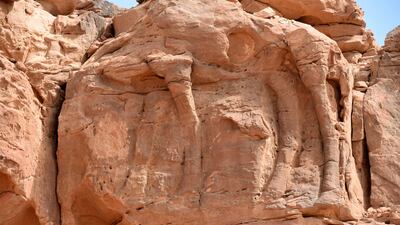
This carved camel's body can be seen eight kilometres north of the city of Sakaka in Saudi Arabia's northwestern Al Jouf province. AFP -
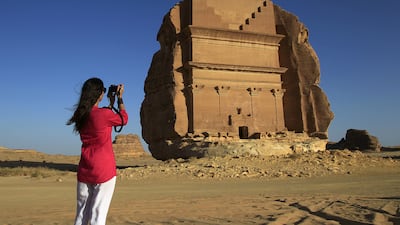
A foreign tourist visits Abu Lawha, the largest Nabataean tomb at the desert archaeological site of Madain Saleh, north-west of Riyadh, Saudi Arabia. AP Photo -

Carvings of camels and horses hewn into rock faces in Saudi Arabia could be around 7,000 years old. AFP -
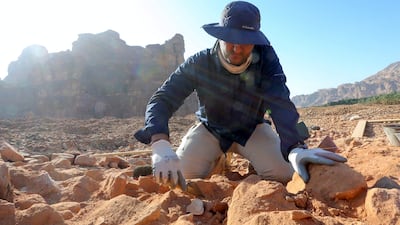
A Saudi archaeologist carefully cleans pottery. Reuters -
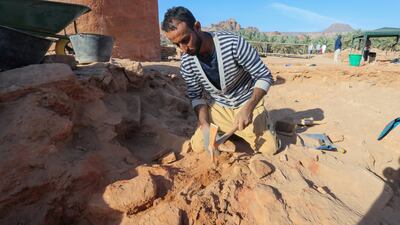
Much care must be taken when examining the findings. Reuters -
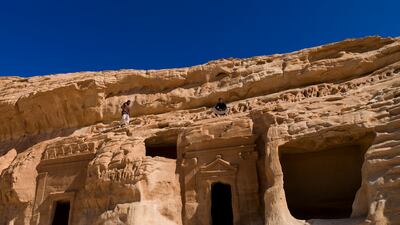
A Nabataean tomb in Madain Saleh archaeological site, Al Madinah Province, AlUla, Saudi Arabia. Getty Images


The Halit archaeological site highlights the role of the Arabian Peninsula during the Umayyad period and has an integrated structure.
The site was earlier called Maadan Al Najadi and belonged to the sons of Najad bin Musa bin Saad bin Abi Waqqas.

