

Central to efforts to bring back the Arabian leopard is the work of the Royal Commission for AlUla, and February 10 has been designated Arabian Leopard day.
The commission, which has national responsibility for bringing back the leopard, has created a fund with a $25 million endowment to promote conservation efforts and signed a 10-year, $20 million agreement with a US organisation called Panthera, which is supporting its efforts.
It’s all part of an initiative for the protection and conservation of the critically-endangered species.
Arabian Leopard Day was marked last year with classroom education, as well as social media outreach with the hashtag #ArabianLeopardDay.
Dr Stephen Browne, the commission's Wildlife and Natural Heritage executive director, said: “There are fewer Arabian Leopards left in the wild — about 200 — than there are spots on one leopard's coat — about 800. Regional co-operation is essential as we restore habitat, return native species to the wild and operate conservation-breeding programmes.”
“The second annual Arabian Leopard Day builds awareness today to influence actions tomorrow,” he added.
Whether the Arabian Leopard still exists at all in the wild in Saudi Arabia is uncertain. Previous estimates put the population in the country at about 50, but recent camera-trap surveys have failed to detect any.
The International Union for Conservation of Nature Red List of Threatened Species, also known as the IUCN Red List or Red Data Book, has assessed the Arabian Leopard as critically endangered since 2008, with current estimates that there are probably fewer than 200 adults in the wild.
“The Royal Commission for AlUla’s species conservation and habitat restoration initiatives are unleashing the power of nature's balance in north-west Saudi Arabia,” Dr Browne said.
Known in Arabic as Al Nimr Al Arabi, the Arabian Leopard has long represented beauty, tranquillity, physical strength and fearlessness in the kingdom. However, while they once roamed freely through the Arabian Peninsula, their population has now dwindled to small, scattered groups across Saudi Arabia, Oman and Yemen.
Dr Browne said the reintroduction of the Arabian Leopard, an apex predator, would be the crowning achievement of the regeneration project. It is planned for 2030.
Here are some fun facts about the Arabian leopard:
The Arabian Leopard is the smallest member of the leopard family. Its top weight of about 30kg is half that of its African cousin.

It arrived in Arabia almost 500,000 years ago when it emerged out of Africa, journeying via the Great Rift Valley to reach the mountains of northern Arabia where it made the land its home.
Originally it was a mountain animal but as desertification spread over a period of centuries, it became the only true desert leopard.

Historically its diet included the Nubian ibex, a type of mountain goat; the Arabian tahr, also a goat-like creature; the diminutive rock hyrax; and when these were not to be found it would eat partridges, hares, hedgehogs, beetles and even porcupines.
Unlike the cheetah that relies on speed, the leopard is a stalk-and-pounce predator. Its slender build with elongated body, short but powerful legs and very long tail, used for balance, make it the perfect hunter in the mountains where it stalks to within a few metres of its quarry before pouncing.
The black rosettes of its coat serve as camouflage, melting into the shadows as it pads along.

One of the earliest depictions of the leopard (500 BCE), in alabaster, is from the ancient Sabaean Kingdom, believed to be the biblical land of Sheba. It showed a leopard jumping down from rocks on to the back of an ibex.
Leopards from northern Arabia, or Arabia Petraea, caught the Romans’ attention and were among the first exotic animals brought to Ancient Rome to fight the bestiarii — gladiators trained in fighting wild beasts.
-
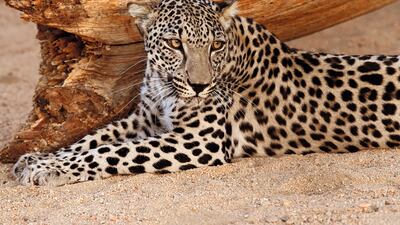
An Arabian leopard at a breeding centre in Taif, Saudi Arabia. Photo: Aline Coquelle -

A programme aims to introduce more of the endangered species into the north-west of the kingdom. Photo: Aline Coquelle -
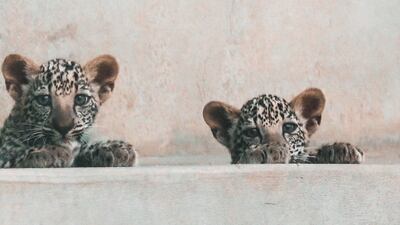
Two cubs born at the centre this year. Photo: Royal Commission for AlUla -
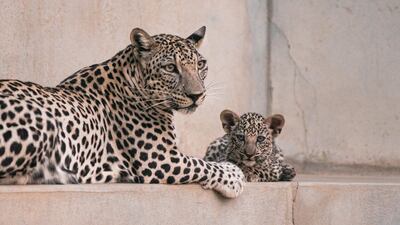
The birth of two females followed the arrival of another cub at the centre a year earlier. Photo: Aline Coquelle -
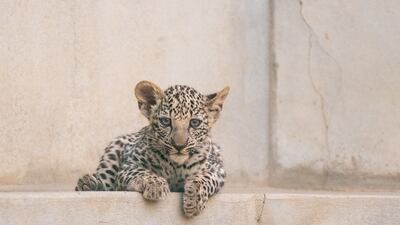
The cubs' birth is a major boost. It is estimated that there are fewer than 200 Arabian leopards left in the wild between Oman, Yemen and Saudi Arabia. -
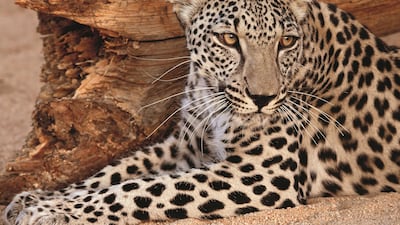
The IUCN Red List of Threatened Species has assessed the animal as critically endangered since 2008. Photo: Aline Coquelle -

Leopards are sought after by trophy hunters and bushmeat poachers. Photo: Aline Coquelle -

This five-month old cub is one of 16 leopards at the centre in AlUla. -
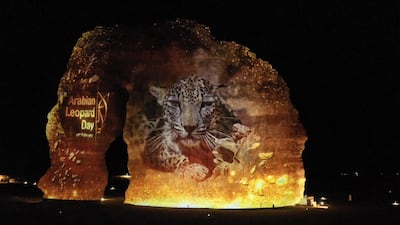
Each February, Middle East landmarks light up for Arabian Leopard Day



