

Saudi Arabia has announced the registration of 67 new archaeological and historical sites.
They have been added to the kingdom's National Antiquities Register, bringing the number of registered archaeological sites to 8,531, it was reported on Sunday.
Fifteen of the newly added sites are in the north. Thirteen are in Tabuk, 10 in Hail, five in Qasim, nine in Jouf, four sites each in Riyadh and Asir, three sites each in Madinah and Baha, and one site in Makkah.
The country's Heritage Commission registered 101 and 253 new archaeological and historical sites in October and April respectively.
The commission aims to build a special database for registered archaeological sites and has been calling on the public to report any finds through the Balagh online platform.
Last year, the body revealed that 14 archaeological sites of significant historical heritage had been registered in the second quarter of 2021 alone.
Under the Ministry of Culture, the commission set up a nationwide conservation strategy covering four categories: antiquities, urban heritage, handicrafts and intangible cultural heritage.
-

Saudi Arabia's Royal Commission for AlUla is comprehensively regenerating the area as a leading global destination for cultural and natural heritage. One of the centrepieces by 2035 will be the Cultural Oasis, shown here. Photo: Royal Commission for AlUla -

An ancient ‘kite’ hunting trap in the sandstone of AlUla. Photo: Royal Commission for AlUla -

Rebecca Repper and David Kennedy, both of the University of Western Australia, survey the Al Hamra region in eastern AlUla County for kites. Photo: Royal Commission for AlUla -

The variety of kite forms recorded on the Harrat 'Uwayrid volcanic lava field in AlUla. Photo: Rebecca Repper / Google Earth -

Stylised diagram of kites showing their key components. Photo: drawn by Rebecca Repper -

Aerial view of a kite in the Khaybar area of north-west Saudi Arabia. Photo: Royal Commission for AlUla -

Another kite in the Khaybar area. Photo: Royal Commission for AlUla -

Diagram of a ‘hatchet’ kite at Harrat 'Uwayrid shows the typical lopsided enclosure shape that extends alongside the apex of the guide walls, in this case, attached to the guide wall, ending in a single cell trap. Photo: drawn by Rebecca Repper -
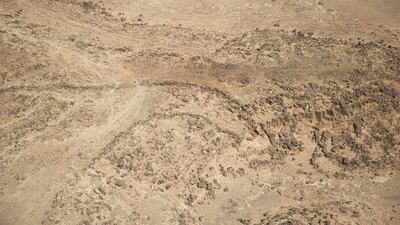
Aerial view of a V-shaped kite on the eroded eastern edge of the Harrat ’Uwayrid. The guide walls of this kite curve and converge towards a cliff edge, at the bottom of which a collapsed enclosure can be seen which may have assisted in trapping the target prey. Photo: Royal Commission for AlUla -
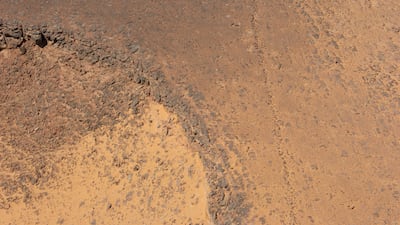
Another ancient kite hunting trap in AlUla. Photo: Royal Commission for AlUla



