
Oman's Sultan Haitham on Thursday issued pardons to 175 prisoners.
A source at the Royal Oman Police said 65 of the inmates were foreign citizens.
The pardons coincide with Oman's 52nd National Day, which the sultanate will celebrate on Friday.
The directive is in line with humanitarian efforts to ease the burden on their families.
Arab leaders free thousands of prisoners each year in a show of compassion to mark public holidays and festivals including Ramadan and Eid Al Fitr.
Oman has announced that November 30 and December 1 will be holidays for employees in the public and private sectors to mark National Day.
Celebrations began on Wednesday in the southern Dhofar governorate, with officials attending a march.
Sultan Haitham is expected to attend a military parade in the governorate on Friday, Oman's state news agency reported.
-
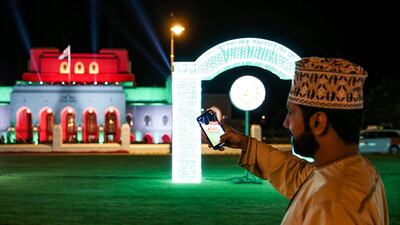
An Omani uses his phone to take a picture as he stands on the lawn before the Royal Opera House Muscat in Oman's capital, lit up with the national colours on the occasion of the Omani national day. AFP -
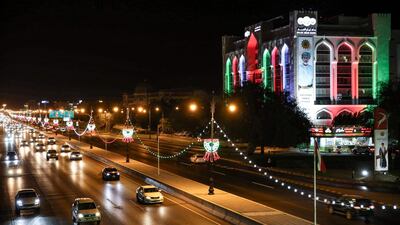
Vehicles drive along a main road past a building of the Oman Arab Bank, lit up with the national colours on the occasion of the Omani national day AFP -

An Omani child wearing a scarf showing the faces of Oman's Sultan Haitham bin Tariq (R) and his predecessor the late Qaboos bin Said (L) as he waves a national flag while standing on the lawn before the Royal Opera House Muscat in the capital, lit up with the national colours on the occasion of the national day. AFP -
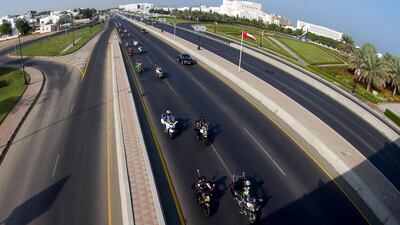
Bikers drive down a street in the Omani capital Muscat, on November 14, 2020, as part of the 50th National Day celebrations. AFP -

Bikers drive down a street in the Omani capital Muscat, on November 14, 2020, as part of the 50th National Day celebrations. AFP -
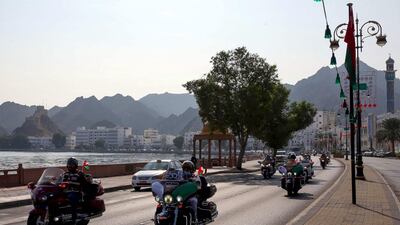
Bikers drive down a street in the Omani capital Muscat, on November 14, 2020, as part of the 50th National Day celebrations. AFP -
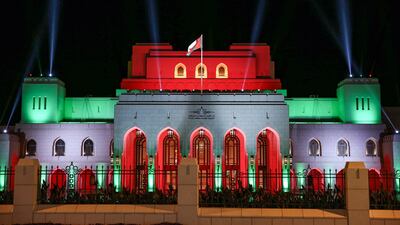
A view of the Royal Opera House Muscat in Oman's capital, lit up with the national colours on the occasion of the Omani national day. AFP -

Indian residents of Oman pose for a picture on the lawn before the Royal Opera House Muscat in Oman's capital, lit up with the national colours on the occasion of the Omani national day. AFP
Classification of skills
A worker is categorised as skilled by the MOHRE based on nine levels given in the International Standard Classification of Occupations (ISCO) issued by the International Labour Organisation.
A skilled worker would be someone at a professional level (levels 1 – 5) which includes managers, professionals, technicians and associate professionals, clerical support workers, and service and sales workers.
The worker must also have an attested educational certificate higher than secondary or an equivalent certification, and earn a monthly salary of at least Dh4,000.
German intelligence warnings
- 2002: "Hezbollah supporters feared becoming a target of security services because of the effects of [9/11] ... discussions on Hezbollah policy moved from mosques into smaller circles in private homes." Supporters in Germany: 800
- 2013: "Financial and logistical support from Germany for Hezbollah in Lebanon supports the armed struggle against Israel ... Hezbollah supporters in Germany hold back from actions that would gain publicity." Supporters in Germany: 950
- 2023: "It must be reckoned with that Hezbollah will continue to plan terrorist actions outside the Middle East against Israel or Israeli interests." Supporters in Germany: 1,250
Source: Federal Office for the Protection of the Constitution
While you're here
National Editorial: What 'Fight Island' means for Abu Dhabi and the world
National Editorial: The UAE looks to cycling for exercise and for the planet
Gareth Cox: Sporting week in pictures, as Covid-19 makes its presence felt
First Person
Richard Flanagan
Chatto & Windus
While you're here
While you're here
Gavin Esler: The Good Friday Agreement teaches us some important lessons
Damien McElroy: Boris must listen to Churchill's comments on Irish divisions
Janine di Giovanni: Track 2 diplomacy key to lasting peace in 21st century
Mercer, the investment consulting arm of US services company Marsh & McLennan, expects its wealth division to at least double its assets under management (AUM) in the Middle East as wealth in the region continues to grow despite economic headwinds, a company official said.
Mercer Wealth, which globally has $160 billion in AUM, plans to boost its AUM in the region to $2-$3bn in the next 2-3 years from the present $1bn, said Yasir AbuShaban, a Dubai-based principal with Mercer Wealth.
“Within the next two to three years, we are looking at reaching $2 to $3 billion as a conservative estimate and we do see an opportunity to do so,” said Mr AbuShaban.
Mercer does not directly make investments, but allocates clients’ money they have discretion to, to professional asset managers. They also provide advice to clients.
“We have buying power. We can negotiate on their (client’s) behalf with asset managers to provide them lower fees than they otherwise would have to get on their own,” he added.
Mercer Wealth’s clients include sovereign wealth funds, family offices, and insurance companies among others.
From its office in Dubai, Mercer also looks after Africa, India and Turkey, where they also see opportunity for growth.
Wealth creation in Middle East and Africa (MEA) grew 8.5 per cent to $8.1 trillion last year from $7.5tn in 2015, higher than last year’s global average of 6 per cent and the second-highest growth in a region after Asia-Pacific which grew 9.9 per cent, according to consultancy Boston Consulting Group (BCG). In the region, where wealth grew just 1.9 per cent in 2015 compared with 2014, a pickup in oil prices has helped in wealth generation.
BCG is forecasting MEA wealth will rise to $12tn by 2021, growing at an annual average of 8 per cent.
Drivers of wealth generation in the region will be split evenly between new wealth creation and growth of performance of existing assets, according to BCG.
Another general trend in the region is clients’ looking for a comprehensive approach to investing, according to Mr AbuShaban.
“Institutional investors or some of the families are seeing a slowdown in the available capital they have to invest and in that sense they are looking at optimizing the way they manage their portfolios and making sure they are not investing haphazardly and different parts of their investment are working together,” said Mr AbuShaban.
Some clients also have a higher appetite for risk, given the low interest-rate environment that does not provide enough yield for some institutional investors. These clients are keen to invest in illiquid assets, such as private equity and infrastructure.
“What we have seen is a desire for higher returns in what has been a low-return environment specifically in various fixed income or bonds,” he said.
“In this environment, we have seen a de facto increase in the risk that clients are taking in things like illiquid investments, private equity investments, infrastructure and private debt, those kind of investments were higher illiquidity results in incrementally higher returns.”
The Abu Dhabi Investment Authority, one of the largest sovereign wealth funds, said in its 2016 report that has gradually increased its exposure in direct private equity and private credit transactions, mainly in Asian markets and especially in China and India. The authority’s private equity department focused on structured equities owing to “their defensive characteristics.”
While you're here
Mina Al-Oraibi: Beirut's suffering is a direct result of a failed political system
Michael Young: From one crisis to the next, where is Lebanon headed?
Joyce Karam: US delegation to push for independent government
Dubai Bling season three
Cast: Loujain Adada, Zeina Khoury, Farhana Bodi, Ebraheem Al Samadi, Mona Kattan, and couples Safa & Fahad Siddiqui and DJ Bliss & Danya Mohammed
Rating: 1/5
You might also like:
Crazy Rich Asians
Director: Jon M Chu
Starring: Constance Wu, Henry Golding, Michelle Yeon, Gemma Chan
Four stars



