Wheat grain loaded on to a cargo vessel in Ukraine, from where Yemen will receive its first shipment in months. Reuters

Yemen set for first shipment of grain from Ukraine


  • English
  • Arabic

The first shipment of grain from Ukraine bound for Yemen is now en route, the UN said on Tuesday.

Seventeen million people in Yemen are going hungry after years of conflict, exacerbated by climate change and the occupation of key ports by Houthi rebels, has ruined harvests and blocked vital food imports.

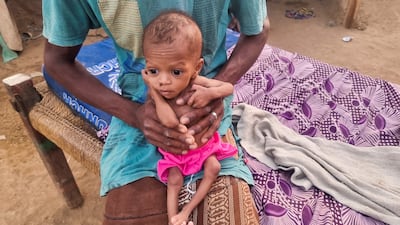
  • The father of malnourished boy Jiad Muhammad Jalal, 1, holds him at a camp for internally displaced people in Hajjah, Yemen. All photos: Reuters
    The father of malnourished boy Jiad Muhammad Jalal, 1, holds him at a camp for internally displaced people in Hajjah, Yemen. All photos: Reuters
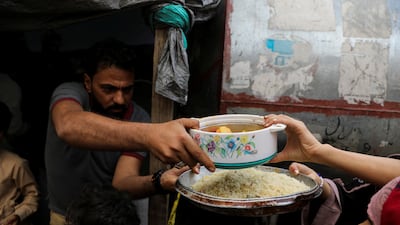
  • A volunteer gives a meal to a woman at a charity kitchen in Sanaa.
    A volunteer gives a meal to a woman at a charity kitchen in Sanaa.
  • About 17.4 million people need food aid as funding dries up, the UN has said.
    About 17.4 million people need food aid as funding dries up, the UN has said.
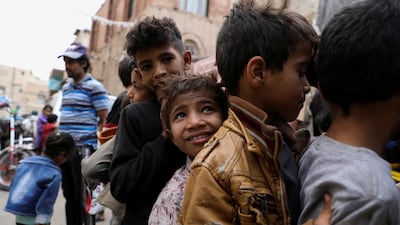
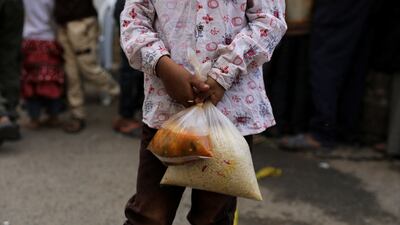
  • Boys stand in line as they wait to receive meals from a charity kitchen in Sanaa.
    Boys stand in line as they wait to receive meals from a charity kitchen in Sanaa.
  • Children have been particularly affected by the conflict in Yemen, UN figures show, with 2.2 million youngsters acutely malnourished.
    Children have been particularly affected by the conflict in Yemen, UN figures show, with 2.2 million youngsters acutely malnourished.
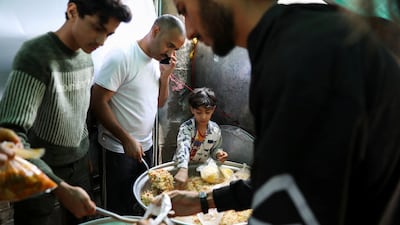
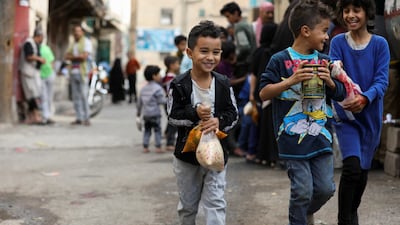
  • Boys leave after receiving meals from a charity kitchen in Sanaa.
    Boys leave after receiving meals from a charity kitchen in Sanaa.
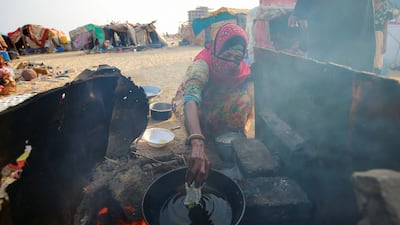
  • A woman cooks a meal at a camp for displaced people in Al Ghaidha.
    A woman cooks a meal at a camp for displaced people in Al Ghaidha.
  • A girl picks food prepared by her mother at a camp for displaced people in Al Ghaidha.
    A girl picks food prepared by her mother at a camp for displaced people in Al Ghaidha.
  • UN Secretary General Antonio Guterres has said Yemen and other vulnerable nations are being hit hard by the economic fallout from Russia’s invasion of Ukraine.
    UN Secretary General Antonio Guterres has said Yemen and other vulnerable nations are being hit hard by the economic fallout from Russia’s invasion of Ukraine.
  • Internally displaced people collect food aid distributed by a charity in Taez.
    Internally displaced people collect food aid distributed by a charity in Taez.

Ukraine and Russia together accounted for about 20 per cent of global wheat exports, a proportion that was vital for net importers, particularly in the Middle East.

The vast majority of the world's grain is consumed domestically and disruption to exports can have dangerous consequences for fragile importers such as Yemen, because prices rise while competition to secure supply stiffens.

The World Food Programme says one of its largest aid operations is focused on the Yemen but efforts are amounting to a race against time, as deteriorating conditions could raise the number of hungry people who require assistance to nearly 20 million by 2023.

The WFP said the MV Karteria, with 37,000 tonnes of wheat grain on board, had left the Ukrainian port of Yuzhny.

The WFP-chartered ship will stop in Turkey, where the grain will be milled into flour before sailing to Yemen.

“The war in Ukraine has been the last straw in Yemen against a backdrop of prolonged conflict. It is paramount to get commodities flowing back into the country and especially grain — for humanitarian and commercial purposes,” said Richard Ragan, WFP’s representative in Yemen.

The UN agency said the grain shipment would provide a 50-kilogram bag of wheat flour to nearly 4 million people that would last them for about a month, helping the WFP to address immediate aid gaps.

The Russian war in Ukraine, which started in February, has been deeply felt in Yemen, where a long-running conflict created one of the world’s worst humanitarian crises and pushed millions of Yemenis to the brink of famine.

Yemen, the poorest Arab country, depends on direct imports of wheat flour — a key staple in Yemenis’ diet — from Russia and Ukraine. The WFP estimates that 46 per cent of Yemen’s wheat imports last year came from Ukraine and Russia.

What turned into a highly destructive civil war in Yemen broke out in 2014, when Iran-backed Houthi rebels seized the capital of Sanaa, as well as much of the north, forcing the government into exile. A coalition led by Saudi Arabia entered the fray early the next year to try to restore the internationally recognised government to power.

More than 150,000 people have been killed, including at least 14,500 civilians, in the conflict that turned into a regional proxy war between rivals Saudi Arabia and Iran.


Infiniti QX80 specs

Engine: twin-turbocharged 3.5-liter V6

Power: 450hp

Torque: 700Nm

Price: From Dh450,000, Autograph model from Dh510,000

Available: Now

Mercer, the investment consulting arm of US services company Marsh & McLennan, expects its wealth division to at least double its assets under management (AUM) in the Middle East as wealth in the region continues to grow despite economic headwinds, a company official said.

Mercer Wealth, which globally has $160 billion in AUM, plans to boost its AUM in the region to $2-$3bn in the next 2-3 years from the present $1bn, said Yasir AbuShaban, a Dubai-based principal with Mercer Wealth.

Within the next two to three years, we are looking at reaching $2 to $3 billion as a conservative estimate and we do see an opportunity to do so,” said Mr AbuShaban.

Mercer does not directly make investments, but allocates clients’ money they have discretion to, to professional asset managers. They also provide advice to clients.

“We have buying power. We can negotiate on their (client’s) behalf with asset managers to provide them lower fees than they otherwise would have to get on their own,” he added.

Mercer Wealth’s clients include sovereign wealth funds, family offices, and insurance companies among others.

From its office in Dubai, Mercer also looks after Africa, India and Turkey, where they also see opportunity for growth.

Wealth creation in Middle East and Africa (MEA) grew 8.5 per cent to $8.1 trillion last year from $7.5tn in 2015, higher than last year’s global average of 6 per cent and the second-highest growth in a region after Asia-Pacific which grew 9.9 per cent, according to consultancy Boston Consulting Group (BCG). In the region, where wealth grew just 1.9 per cent in 2015 compared with 2014, a pickup in oil prices has helped in wealth generation.

BCG is forecasting MEA wealth will rise to $12tn by 2021, growing at an annual average of 8 per cent.

Drivers of wealth generation in the region will be split evenly between new wealth creation and growth of performance of existing assets, according to BCG.

Another general trend in the region is clients’ looking for a comprehensive approach to investing, according to Mr AbuShaban.

“Institutional investors or some of the families are seeing a slowdown in the available capital they have to invest and in that sense they are looking at optimizing the way they manage their portfolios and making sure they are not investing haphazardly and different parts of their investment are working together,” said Mr AbuShaban.

Some clients also have a higher appetite for risk, given the low interest-rate environment that does not provide enough yield for some institutional investors. These clients are keen to invest in illiquid assets, such as private equity and infrastructure.

“What we have seen is a desire for higher returns in what has been a low-return environment specifically in various fixed income or bonds,” he said.

“In this environment, we have seen a de facto increase in the risk that clients are taking in things like illiquid investments, private equity investments, infrastructure and private debt, those kind of investments were higher illiquidity results in incrementally higher returns.”

The Abu Dhabi Investment Authority, one of the largest sovereign wealth funds, said in its 2016 report that has gradually increased its exposure in direct private equity and private credit transactions, mainly in Asian markets and especially in China and India. The authority’s private equity department focused on structured equities owing to “their defensive characteristics.”

In numbers: PKK’s money network in Europe

Germany: PKK collectors typically bring in $18 million in cash a year – amount has trebled since 2010

Revolutionary tax: Investigators say about $2 million a year raised from ‘tax collection’ around Marseille

Extortion: Gunman convicted in 2023 of demanding $10,000 from Kurdish businessman in Stockholm

Drug trade: PKK income claimed by Turkish anti-drugs force in 2024 to be as high as $500 million a year

Denmark: PKK one of two terrorist groups along with Iranian separatists ASMLA to raise “two-digit million amounts”

Contributions: Hundreds of euros expected from typical Kurdish families and thousands from business owners

TV channel: Kurdish Roj TV accounts frozen and went bankrupt after Denmark fined it more than $1 million over PKK links in 2013 

The specs
  • Engine: 3.9-litre twin-turbo V8
  • Power: 640hp
  • Torque: 760nm
  • On sale: 2026
  • Price: Not announced yet
Empires%20of%20the%20Steppes%3A%20A%20History%20of%20the%20Nomadic%20Tribes%20Who%20Shaped%20Civilization
%3Cp%3E%3Cstrong%3EAuthor%3A%20%3C%2Fstrong%3EKenneth%20W%20Harl%3Cstrong%3E%3Cbr%3EPublisher%3A%20%3C%2Fstrong%3EHanover%20Square%20Press%3Cstrong%3E%3Cbr%3EPages%3A%20%3C%2Fstrong%3E576%3C%2Fp%3E%0A
Real estate tokenisation project

Dubai launched the pilot phase of its real estate tokenisation project last month.

The initiative focuses on converting real estate assets into digital tokens recorded on blockchain technology and helps in streamlining the process of buying, selling and investing, the Dubai Land Department said.

Dubai’s real estate tokenisation market is projected to reach Dh60 billion ($16.33 billion) by 2033, representing 7 per cent of the emirate’s total property transactions, according to the DLD.

Updated: August 31, 2022, 11:14 AM