
Barricades that had surrounded the Kaaba for two years were lifted on Wednesday in line with a decree issued by King Salman.
Sheikh Abdul Rahman Al Sudais, head of the General Presidency of the Two Holy Mosques, on Tuesday announced that the barriers would be removed.
They had prevented pilgrims from getting too close to the Kaaba or touching the black silk covering known as the kiswah. Pilgrims were also unable to touch the Hajar Al Aswad (Black Stone), the ancient rock set into the corner of the Kaaba in Makkah.
The Black Stone was placed by the Prophet Mohammed in the Kaaba in 605 CE.
It is the point from which the circumambulation begins and ends for Tawaf, the ritual where worshippers circle the Kaaba seven times anticlockwise to complete their Hajj or Umrah pilgrimage.
The barriers were placed around the Kaaba on July 1, 2020, after the outbreak of the Covid-19 pandemic in 2020, to help contain the spread of the virus.
-
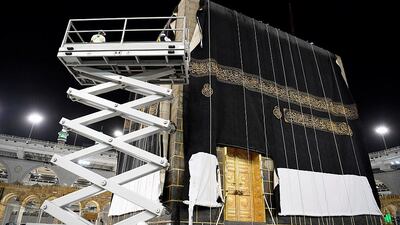
In Makkah, the customary changing of the kiswah, the covering of the Kaaba at the heart of the Grand Mosque that has become familiar to millions of pilgrims, takes place. All photos SPA -
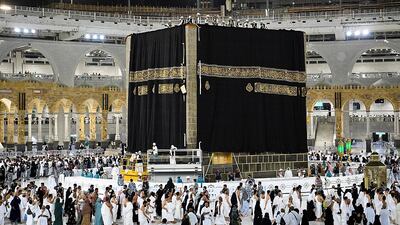
The responsibility for the renewal of the embroidered kiswah belongs to Saudi Arabia’s General Presidency for the Affairs of the Grand Mosque and the Prophet’s Mosque. Tradition has it that the old kiswah is taken down, cut up and parts are gifted to people and organisations. -

The work is done under the supervision of Sheikh Abdulrahman Al Sudais and carried out by a team from the King Abdulaziz Complex. -
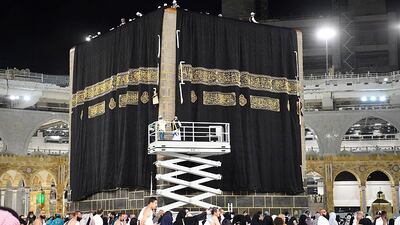
The creation of a kiswah each year involves more than 200 specialist fabric workers and hundreds of kilograms of black silk. Gold thread adorns the black silk, spelling out Quranic passages as well as phrases such as 'no god but Allah', and 'glory to God'.


Sheikh Al Sudais said the barricades were being removed for the beginning of the new Umrah season.
“The presidency is working with all the sectors operating at the Grand Mosque to receive pilgrims and provide them with all services and facilities," he said.
The kiswah at the Grand Mosque in Makkah was replaced on Saturday morning to mark the Islamic (Hijri) New Year.
It used to be changed each year on the ninth or 10th day of Dhu Al Hijjah, the last month of the Islamic calendar, but was moved to the first day of Muharram this year.

