
The Kaaba is adorned with a new kiswah, a covering, annually to mark the occasion of the first day of Eid Al Adha.
The kiswah is usually put in place on the ninth or 10th day of Dhu Al Hijjah, the last month of the Islamic calendar.
Abdulhamid bin Said Al Maliki, the deputy general president for affairs at the King Abdulaziz Complex for Manufacturing the Kiswah al Kaaba, said the new covering would be draped over the Kaaba on the first day of Muharram instead of the ninth day of Dhu Al Hijjah, marking the beginning of the new Islamic year.
The covering, made of black silk and embroidered with gold patterns, weighs 670 kilograms and measures 658 square metres. It covers the Kaaba, the stone structure in the centre of the Grand Mosque of Makkah that millions of pilgrims circumambulate as part of Hajj.
The draping of the kiswah over the Kaaba predates Islam by about two centuries, but the tradition continued during the Prophet Mohammed's lifetime and to this day as a way of protecting the holy building and honouring the site.
From the 12th century, the kiswah was produced in Egypt using materials from around the Muslim world before being transported to Makkah. In 1927, manufacture begun to be transferred to Makkah and by 1962 it was being produced solely at the city's Kiswah Al Kaaba factory.
Owned and run by the Saudi Arabian government, the factory takes the whole year to produce the cover, of which six to eight months is taken up by the embroidery alone. The creation of a new kiswah involves more than 200 specialist fabric workers. It comprises 47 pieces of natural silk, each 98 centimetres by 14 metres. The outer layer is made from 670kg of raw silk. The inside of the covering is a strong cotton lining, which helps to preserve the silk on top.
Gold thread adorns the black silk, spelling out Quranic passages as well as phrases such as “no God but Allah", and "glory to God" in the Al Thuluth style of calligraphy.
Before it is sewed on to the Kaaba, it is heavily perfumed with oud.
Doors to the Kaaba open only twice a year for cleaning: 30 days before Ramadan and again 30 days before Hajj.
Once the Hajj season is over, the kiswah is removed and cut into small pieces for distribution among selected people and organisations.
How the kiswah is made
-

The belt of the kiswah being embroidered. -

Sewing bobbins are prepared after the silk threads are dyed. -
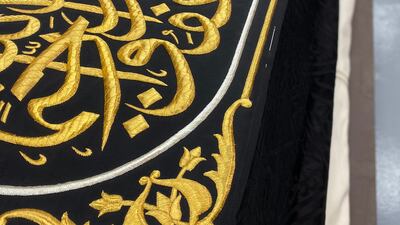
Part of the belt of the kiswah. -

The machine attaches the belt of the kiswah to the remaining parts. -

The machine attaches the belt of the Kiswa to the remaining parts. -
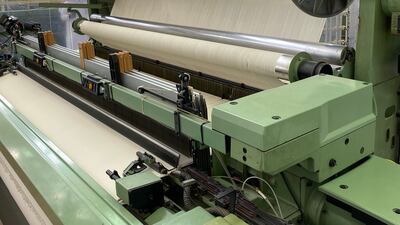
The machine produces cotton textiles in two kinds. The first will be used in the inner lining of the kiswah, and the other, which is white, is used to cover the Kaaba during the Hajj season when the kiswah is pulled up. -
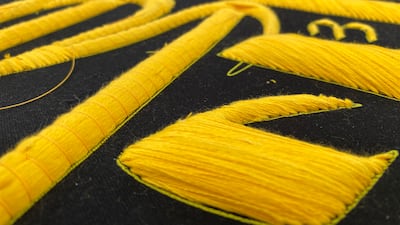
The belt of the holy Kaaba is embroidered. -
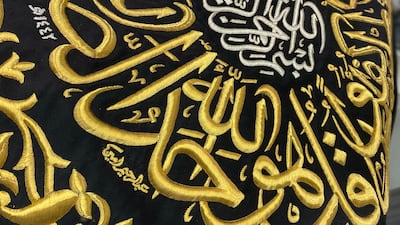
The corner of the kiswah has a verse of the Quran. It also has the place of where it is made and the year. -
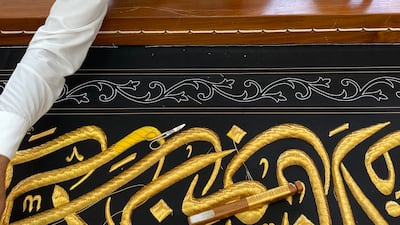
Workers attend to the embroidery and 114 people work on this step for the 16 parts of the belt. -
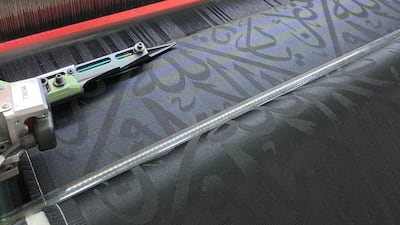
The embroidered textile is prepared with phrases such as 'no God but Allah' and 'glory to God'. -
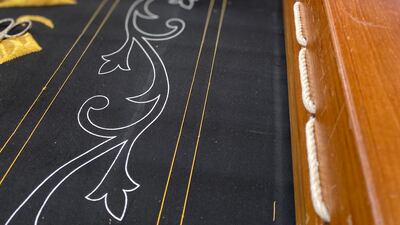
Writings, decoration and calligraphy are first printed on the plain black cloth. -
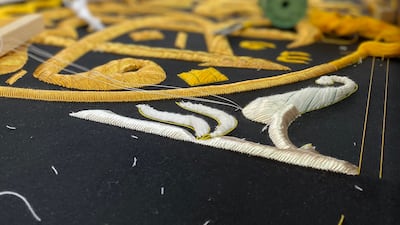
A worker prepares the golden threads. -
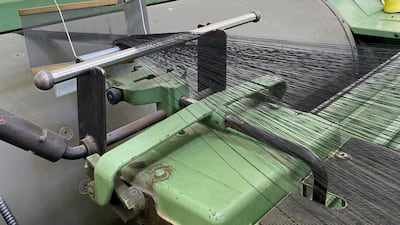
Threads are prepared to make the black silk cloth for the kiswah.



