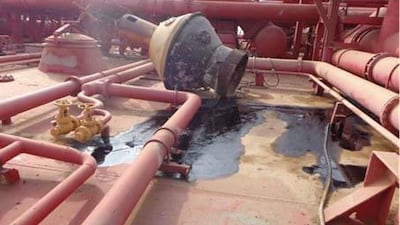
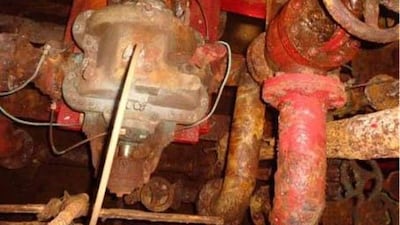
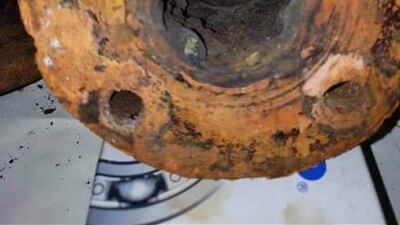
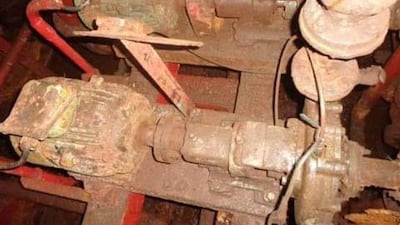
The UN has discussed with the Houthis the prospect of creating an escrow account for the sale of 1.1 million barrels of oil aboard the decaying FSO Safer supertanker, Humanitarian Co-ordinator for Yemen David Gressly told The National on Sunday.
In an exclusive interview on the sidelines of the first Yemen International Forum in Stockholm, Mr Gressly said the Houthis “were not opposed to the concept, but were not ready to act on it yet”.
The event was organised by the Sanaa Centre for Strategic studies in collaboration with the government of Sweden.
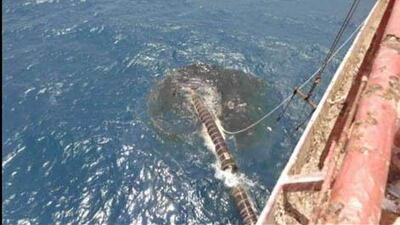
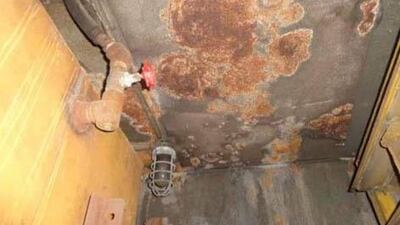
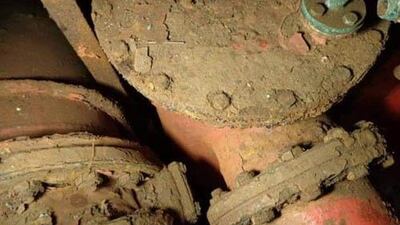
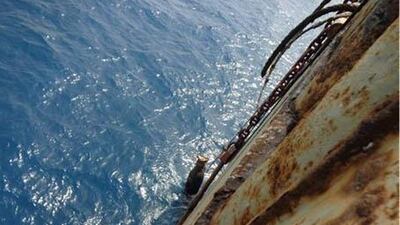
The FSO Safer is a vessel connected via pipeline to the oil-rich city of Marib, and is moored off the coast of Ras Issa in the Red Sea. At the mercy of the elements, the corroding ship has been unmaintained since at least 2016 and poses a grave environmental threat to Yemen and other countries such as Saudi Arabia, Eritrea, Djibouti and others, if the oil leaks or the vessel explodes.
The UN has signed a Memorandum of Understanding with the Houthis to offload the oil on to a temporary vessel in an emergency operation. After that is done, the plan is to replace the Safer with a permanent vessel. The Houthis said they will not make financial contributions to this plan.
Ownership versus control
“My engagement in Sanaa tells me clearly that the Houthis are concerned about the oil spilling, so they have an interest in securing it. If we could sell the oil, we would have sold it, but because of complications of control versus ownership, it’s not possible right now,” Mr Gressly said.
Technically, the oil belongs to Yemen’s national SAFER Exploration and Production Operations Company. But since the Houthis possess control of the area where the ship is located, they have been monopolising access to the vessel sought by the UN and technical inspectors for years.
Sea mines also surround the area where the Safer is moored. Mr Gressly hopes a peace settlement could be reached through the continuing UN-brokered talks in Amman between the warring sides.
“The political process might assist in figuring out the oil situation. If there’s a settlement, one would expect this issue would be resolved at the same time. So we have to see how the future plays out,” he said.
Mr Gressly’s main focus for now is to raise the $20 million remaining to cover the emergency operation’s cost of $80m, which he was hoping to do by the end of this June.
Earlier this month, the UN set up a crowdfund to raise $5m towards that goal.
“We don’t expect the crowdfunding to bridge the $20 million gap — even $5 million will be a bit of a stretch as well but it’s a way not only to get contributions but to also raise global awareness of the problem.”
“Most of the systems aboard the ship have broken down. This includes a key system to pump inert gas into the oil chambers. Atmospheric oxygen is now in those chambers and so a small flame could set off an explosion.”
Time is of the essence in this operation because as the currents and winds get stronger and more turbulent in winter, the chances that the Safer breaks up or suffers from an oil spill become higher, Mr Gressly said.

Zayed Sustainability Prize
Skoda Superb Specs
Engine: 2-litre TSI petrol
Power: 190hp
Torque: 320Nm
Price: From Dh147,000
Available: Now
Mercer, the investment consulting arm of US services company Marsh & McLennan, expects its wealth division to at least double its assets under management (AUM) in the Middle East as wealth in the region continues to grow despite economic headwinds, a company official said.
Mercer Wealth, which globally has $160 billion in AUM, plans to boost its AUM in the region to $2-$3bn in the next 2-3 years from the present $1bn, said Yasir AbuShaban, a Dubai-based principal with Mercer Wealth.
“Within the next two to three years, we are looking at reaching $2 to $3 billion as a conservative estimate and we do see an opportunity to do so,” said Mr AbuShaban.
Mercer does not directly make investments, but allocates clients’ money they have discretion to, to professional asset managers. They also provide advice to clients.
“We have buying power. We can negotiate on their (client’s) behalf with asset managers to provide them lower fees than they otherwise would have to get on their own,” he added.
Mercer Wealth’s clients include sovereign wealth funds, family offices, and insurance companies among others.
From its office in Dubai, Mercer also looks after Africa, India and Turkey, where they also see opportunity for growth.
Wealth creation in Middle East and Africa (MEA) grew 8.5 per cent to $8.1 trillion last year from $7.5tn in 2015, higher than last year’s global average of 6 per cent and the second-highest growth in a region after Asia-Pacific which grew 9.9 per cent, according to consultancy Boston Consulting Group (BCG). In the region, where wealth grew just 1.9 per cent in 2015 compared with 2014, a pickup in oil prices has helped in wealth generation.
BCG is forecasting MEA wealth will rise to $12tn by 2021, growing at an annual average of 8 per cent.
Drivers of wealth generation in the region will be split evenly between new wealth creation and growth of performance of existing assets, according to BCG.
Another general trend in the region is clients’ looking for a comprehensive approach to investing, according to Mr AbuShaban.
“Institutional investors or some of the families are seeing a slowdown in the available capital they have to invest and in that sense they are looking at optimizing the way they manage their portfolios and making sure they are not investing haphazardly and different parts of their investment are working together,” said Mr AbuShaban.
Some clients also have a higher appetite for risk, given the low interest-rate environment that does not provide enough yield for some institutional investors. These clients are keen to invest in illiquid assets, such as private equity and infrastructure.
“What we have seen is a desire for higher returns in what has been a low-return environment specifically in various fixed income or bonds,” he said.
“In this environment, we have seen a de facto increase in the risk that clients are taking in things like illiquid investments, private equity investments, infrastructure and private debt, those kind of investments were higher illiquidity results in incrementally higher returns.”
The Abu Dhabi Investment Authority, one of the largest sovereign wealth funds, said in its 2016 report that has gradually increased its exposure in direct private equity and private credit transactions, mainly in Asian markets and especially in China and India. The authority’s private equity department focused on structured equities owing to “their defensive characteristics.”
Look%20Both%20Ways
%3Cp%3EDirector%3A%20Wanuri%20Kahiu%3Cbr%3EStars%3A%20Lili%20Reinhart%2C%20Danny%20Ramirez%2C%20David%20Corenswet%2C%20Luke%20Wilson%2C%20Nia%20Long%3Cbr%3ERating%3A%203%2F5%3Cbr%3E%3C%2Fp%3E%0A
UAE%20SQUAD
%3Cp%3E%0D%3Cstrong%3EMen%3A%3C%2Fstrong%3E%20Saif%20Al%20Zaabi%2C%20Salem%20Al%20Marzooqi%2C%20Zayed%20Al%20Ansaari%2C%20Saud%20Abdulaziz%20Rahmatalla%2C%20Adel%20Shanbih%2C%20Ahmed%20Khamis%20Al%20Blooshi%2C%20Abdalla%20Al%20Naqbi%2C%20Khaled%20Al%20Hammadi%2C%20Mohammed%20Khamis%20Khalaf%2C%20Mohammad%20Fahad%2C%20Abdulla%20Al%20Arimi.%0D%3Cbr%3E%3Cstrong%3EWomen%3A%3C%2Fstrong%3E%20Mozah%20Al%20Zeyoudi%2C%20Haifa%20Al%20Naqbi%2C%20Ayesha%20Al%20Mutaiwei.%3C%2Fp%3E%0A
The President's Cake
Director: Hasan Hadi
Starring: Baneen Ahmad Nayyef, Waheed Thabet Khreibat, Sajad Mohamad Qasem
Rating: 4/5
What can victims do?
Always use only regulated platforms
Stop all transactions and communication on suspicion
Save all evidence (screenshots, chat logs, transaction IDs)
Report to local authorities
Warn others to prevent further harm
Courtesy: Crystal Intelligence