


Yemen’s armed groups should be integrated into a national army in order to rebuild the country’s security apparatus, the adviser to the head of the country's presidential council told The National.
”A state cannot be created while militia roam free. Militias do not build nations,” Yaseen Makkawi said in an exclusive interview on the sidelines of the first Yemen International Forum in Stockholm.

The three-day event organised by the Sanaa Centre for Strategic Studies and the Swedish government is being attended by Yemeni politicians, legal experts and prominent members of civil society as well as the UN and US special envoys and a number of representatives from the international community and finance officials linked to the Houthi rebels.
The meeting is being held amid the longest nationwide truce since civil war broke out in late 2014 when the Iran-backed rebels overran the capital, Sanaa, forcing the government to flee south and later into exile in Saudi Arabia.
Nearly eight years later, the rebels control most of the north, while the government, backed by the army and an array of militias, holds the south.
The conflict has forced millions of Yemenis to leave their homes and left 70 per cent of the population reliant on aid to survive in what the UN has called the world's biggest humanitarian crisis.
Mr Makkawi said the eight-member presidential council, which replaced former president Abdrabu Mansur Hadi in April following intra-Yemeni talks hosted by Saudi Arabia, is up against “complex challenges”. These include creating a military front that prioritises national interests “in the north and in the south”, he said.
“The security situation in Yemen should be rooted in its national identity through power-sharing,” said Mr Makkawi, who was also adviser to Mr Hadi
“We need a true and genuine national army that has loyalty to all the country’s governorates — without militias — within a decentralised, Federal system,“ he said.
The Houthis‘ presence in Sanaa as an armed group and their position of power present “a real dilemma“, Mr Makkawi said.
He conceded that the group could play a political role, “so long as they do not possess weapons”, adding that he feared the emergence of a government like Lebanon's in which the Iran-backed Hezbollah movement, the country's only armed group outside the military, holds considerable sway over politics.
-

Yemen has been swamped by severe humanitarian problems, which have been made worse by dangers of landmines. All photos: Masam -

The country has already been ravaged by poverty, war and economic collapse and to compound matters, landmines have been laid across much of the nation in a series of conflicts and uprisings. -

The explosives have been used extensively by the Iranian-backed Houthi rebels as part of the civil war that began in 2014. -

But efforts are under way to demine Yemen, including by the Yemeni authorities and the Saudi Project for Landmine Clearance (Masam). -

The demining campaign was launched by the King Salman Humanitarian Aid and Relief Centre. -

Since 2018, Masam has been removing mines, improvised explosive devices and unexploded ordnance. -

Ousama Algosaibi, Masam’s managing director, says the task is mammoth because the number of explosive devices laid in Yemen is 'mind-boggling'. -
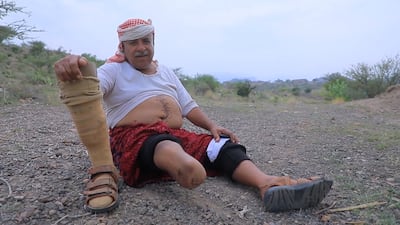
Mr Algosaibi says landmines have been found in villages, on agricultural land, in children’s schools and on roads leading to villages. -

Mr Algosaibi says: ‘These are all civilian areas that are now very far from any active front. I don’t understand the reason they have planted those areas with mines and IEDs.’ -

'What is the use of planting IEDs under the floor of a children’s school?' he says. 'It just doesn’t make sense.' -

'Houthis want to use that as ... a terror tool against the local population, against the local civilians' Mr Algosaibi suggests. -

The demining is carried out by 32 teams of Yemenis, who have been through comprehensive training. -

Residents may pinpoint a location where a mine cost a relative a leg or killed an animal, and operatives can often then work out the line in which others were laid. -

Metal detectors highlight the precise location of devices, which are typically collected and destroyed, hundreds at a time, in controlled explosions. -

Masam and other entities carrying out demining in Yemen are doing so while conflict continues to rage. -

Masam has cleared more than 32 million square metres and destroyed more than 335,000 explosives to date. -

Operating in a war zone magnifies the dangers to the staff and Masam has lost 28 personnel in 16 incidents. -

Half of these incidents happened during demining, such as when a mine or other device suddenly exploded or was booby trapped. -

The other eight were caused directly by the civil war, such as when drones targeted vehicles or camps.


”What is preventing Lebanon from returning to its former glory? It’s the weaponisation of decision-making, and having a veto power through arms,” he said.
In closed sessions at the forum on Saturday, experts discussed ways to integrate fighters into a national security apparatus or civilian life. The presence of child soldiers and the number of armed state and non-state actors, thought to be in the millions, are major challenges to establishing such a programme, they said.
Mr Makkawi believes finding common ground is imperative in this juncture, as the country enters the third month of the UN-brokered truce that has largely held despite reports of violations by the warring sides.
”It is time to talk about the commonalities among Yemenis, and that is the fact that the country is being destroyed and is in the last stages of destruction. It is time to rebuild it by reshuffling our cards on the road to rebuilding institutions," he said.
“Civilians are being starved and killed. The presidential council needs to look to the future - and give Yemenis hope for their own future.”

