Saudi Arabia opens to tourists from around the world. Courtesy of Consulum Balloons flying over the Unesco World Heritage Site of Al Ula.

From renewables to reforms: how Saudi Arabia made strides in 2021


  • English
  • Arabic

In 2021, Saudi Arabia kept up the breakneck speed of reforms that have, in recent years, propelled it to become a dynamic business, tourism and cultural destination.

From education reform and changing women's role in society to investing billions in green energy, every month of 2021 appeared to bring a bold new announcement from Crown Prince Mohammed bin Salman.

Critics might dismiss many of these ideas as being based on slogans more than substance, but this view is increasingly outdated as the effects of reforms from years past are felt, with women's participation in the workforce rising from 13 per cent in 2018 to 20 per cent in 2020 and with construction on major projects — such as the Red Sea tourism development project focused on 90 islands on the country's eastern coastline — well under way.

On the social scene, the kingdom hosted its first F1 race this year. It also held large outdoor festivals and even built a winter wonderland.

Green ambitions

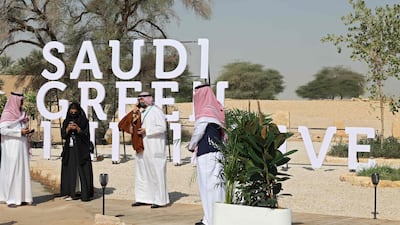
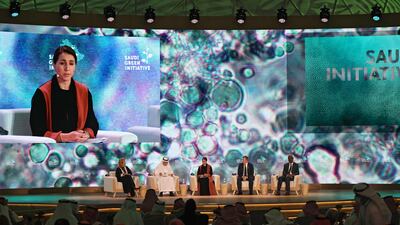
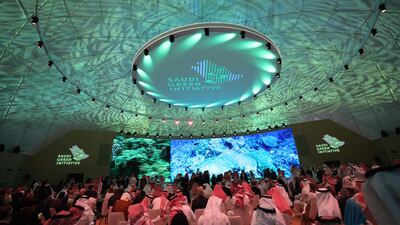
  • Delegates take part in the opening ceremony of the Saudi Green Initiative forum in Riyadh. AFP
    Delegates take part in the opening ceremony of the Saudi Green Initiative forum in Riyadh. AFP
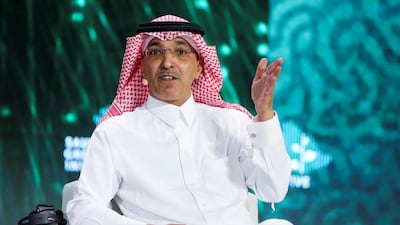
  • Saudi Finance Minister Mohammed Al-Jadaan addresses delegates during one of the sessions at the forum. Reuters
    Saudi Finance Minister Mohammed Al-Jadaan addresses delegates during one of the sessions at the forum. Reuters
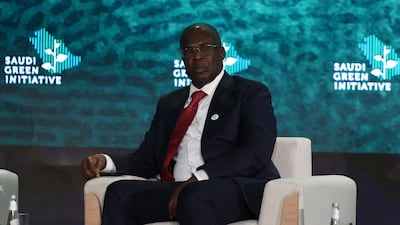
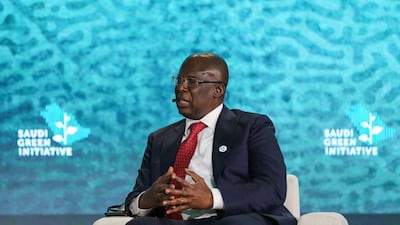
  • Nigeria's Minister of State for Petroleum Resources Timipre Sylva takes part in one of the sessions. AFP
    Nigeria's Minister of State for Petroleum Resources Timipre Sylva takes part in one of the sessions. AFP
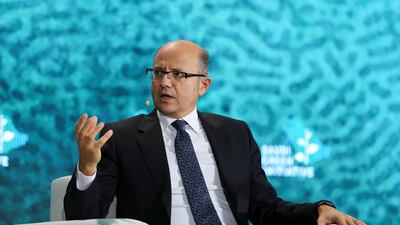
  • Azerbaijan's Minister of Energy Parviz Shahbazov makes a point at the forum. Reuters
    Azerbaijan's Minister of Energy Parviz Shahbazov makes a point at the forum. Reuters
  • Nigeria's Minister of State for Petroleum Resources Timipre Sylva speaks at the forum. Reuters
    Nigeria's Minister of State for Petroleum Resources Timipre Sylva speaks at the forum. Reuters
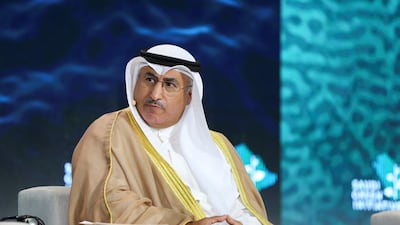
  • Kuwait's Oil Minister Mohammed Al Fares attends the Saudi Green Initiative forum. Reuters
    Kuwait's Oil Minister Mohammed Al Fares attends the Saudi Green Initiative forum. Reuters
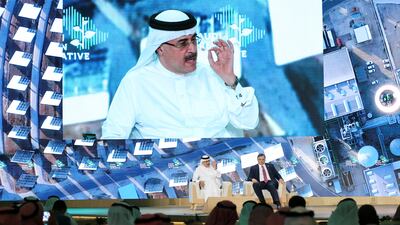
  • Amin Nasser, president and chief executive of Saudi Aramco, speaks during a discussion with TotalEnergies chairman and chief executive Patrick Pouyanne at the forum. Reuters
    Amin Nasser, president and chief executive of Saudi Aramco, speaks during a discussion with TotalEnergies chairman and chief executive Patrick Pouyanne at the forum. Reuters
  • The UAE's Minister of Climate Change and Environment, Mariam Al Mheiri, speaks during the opening ceremony of the forum in Riyadh. AFP
    The UAE's Minister of Climate Change and Environment, Mariam Al Mheiri, speaks during the opening ceremony of the forum in Riyadh. AFP
  • Delegates at the opening ceremony of the forum. AFP
    Delegates at the opening ceremony of the forum. AFP
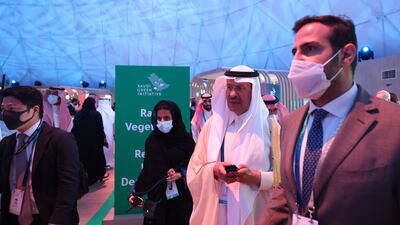
  • Saudi Energy Minister Prince Abdulaziz bin Salman arrives for the opening ceremony. AFP
    Saudi Energy Minister Prince Abdulaziz bin Salman arrives for the opening ceremony. AFP
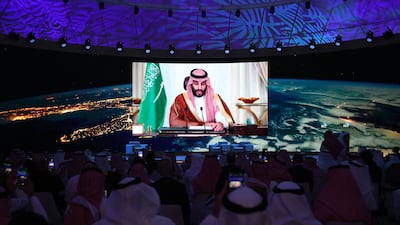
  • Saudi Crown Prince Mohammed bin Salman delivers a speech during the opening ceremony of the forum. AFP
    Saudi Crown Prince Mohammed bin Salman delivers a speech during the opening ceremony of the forum. AFP
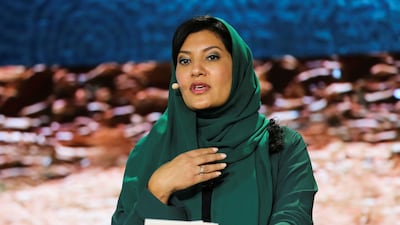
  • Princess Reema bint Bandar, Saudi Arabia's ambassador to the US, addresses delegates at the forum. Reuters
    Princess Reema bint Bandar, Saudi Arabia's ambassador to the US, addresses delegates at the forum. Reuters

In October, Prince Mohammed inaugurated the Middle East Green Initiative summit in Riyadh. It is hoped the initiative will contribute to clean fuel solutions that will affect the lives of more than 750 million people around the world.

As to its own green development, Saudi Arabia has focused on renewable energy. When the country's ambitious solar energy projects are realised, the kingdom will have added 60 gigawatts of solar power to its national grid by 2030. For comparison, the peak electricity demand of New York in winter is close to 25 gigawatts.

The Green Initiative announcement came after the kingdom announced the establishment of a regional centre for sustainable development to further coordinate renewable energy efforts across the Middle East. The Saudi Green Initiative aims to double the kingdom's current targets for reducing carbon emissions.

The world's biggest tourism promotion

Saudi Arabia plans to invest more than $1 trillion in the tourism sector over the next 10 years, Tourism Minister Ahmed Al Khateeb announced in October.

Investment in the sector is one of the pillars of the Vision 2030 transformation initiative that seeks to diversify the economy and reduce its reliance on oil. Saudi Arabia aims to increase the contribution of the tourism sector to its economy to more than 10 per cent of gross domestic product by 2030 from about 3 per cent.

  • A still from 'The Architects of Ancient Arabia' shows Jebel Al Fil (or Elephant Rock), Al Ula. Courtesy Discovery Channel
    A still from 'The Architects of Ancient Arabia' shows Jebel Al Fil (or Elephant Rock), Al Ula. Courtesy Discovery Channel
  • A still from 'The Architects of Ancient Arabia' shows Hegra, Saudi Arabia’s first Unesco World Heritage Site, at Al Ula, Saudi Arabia. Courtesy Discovery Channel
    A still from 'The Architects of Ancient Arabia' shows Hegra, Saudi Arabia’s first Unesco World Heritage Site, at Al Ula, Saudi Arabia. Courtesy Discovery Channel
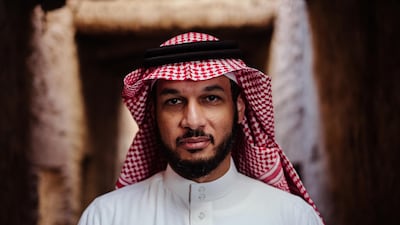
  • Ahmed Aliman, Al Ula historian. Courtesy Discovery Channel
    Ahmed Aliman, Al Ula historian. Courtesy Discovery Channel
  • A still from 'The Architects of Ancient Arabia' shows part of Al Ula's Old Town. Courtesy Discovery Channel
    A still from 'The Architects of Ancient Arabia' shows part of Al Ula's Old Town. Courtesy Discovery Channel
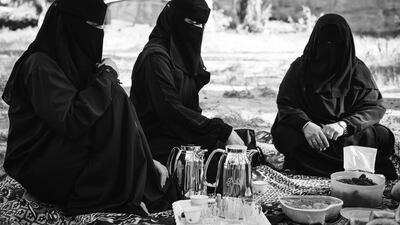
  • A still from 'The Architects of Ancient Arabia' shows three women having Arabic coffee in Al Ula, Saudi Arabia. Courtesy Discovery Channel
    A still from 'The Architects of Ancient Arabia' shows three women having Arabic coffee in Al Ula, Saudi Arabia. Courtesy Discovery Channel
  • Rebecca Foote, director, archaeology and cultural heritage research at Royal Commission for Al Ula. Courtesy Discovery Channel
    Rebecca Foote, director, archaeology and cultural heritage research at Royal Commission for Al Ula. Courtesy Discovery Channel
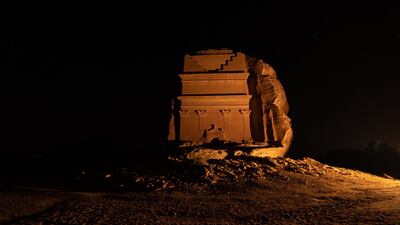
  • A still from 'The Architects of Ancient Arabia' shows the Tomb of Lihyan, son of Kuza at Hegra, Al Ula. Courtesy Discovery Channel
    A still from 'The Architects of Ancient Arabia' shows the Tomb of Lihyan, son of Kuza at Hegra, Al Ula. Courtesy Discovery Channel
  • A still from 'The Architects of Ancient Arabia' shows Hegra, Al Ula, Saudi Arabia. Courtesy Discovery Channel
    A still from 'The Architects of Ancient Arabia' shows Hegra, Al Ula, Saudi Arabia. Courtesy Discovery Channel

Under the Vision 2030 plan, the kingdom seeks to attract 100 million local and international visitors annually by 2030 through making the most of its archaeological sites, bustling cities and pristine beaches.

Promoting Neom

Neom, the completely new, green and “smart” city development north of the Red Sea in Tabuk province, is one of the world's most ambitious megaprojects.

The $500 billion city, with a planned population of one million and a 176-kilometre layout, will have vertical take-off and landing public transport as well as giant “solar domes” to provide desalinated drinking water. The entire development will be dotted with parks and pedestrian areas.

The city will also host Oxagon, the world's largest floating industrial complex, strategically situated near the Suez Canal.

In December, 250 Saudi business leaders gathered at the Discover Neom event in London to promote investment in the project, described by Saudi Arabia's ambassador to the UK, Khalid bin Bandar, as “a global hub for innovation and an accelerator for growth".

Reopening the Grand Mosque in Makkah

Saudi Arabia's Grand Mosque in Makkah started receiving pilgrims at full capacity in October for the first time since the pandemic began in late 2019. The kingdom removed the mask requirement and social distancing rules in open spaces after a decline in coronavirus infections.

Worshippers perform taraweeh prayer at the Kaaba in the Grand Mosque on the first day of Ramadan. Reuters

In November, Saudi Arabia announced a new service for overseas pilgrims, which will issue permits for Umrah and prayers at the Grand Mosque in Makkah as well as for visiting the Prophet’s Mosque in Madinah.

The non-profit city

At present, the world's largest business incubator hub is in France, known as Station F, a sprawling mini-city for brainstorming in Paris that covers 34,000 square metres and has Facebook, Microsoft and Naver as business partners.

Now, Saudi Arabia is planning its own incubator with a twist — one that focuses on projects for the public good.

In November, Prince Mohammed announced a grand plan for a “non-profit city”, comprising a huge network of business incubators, training facilities and facilities for non-profit and non-governmental organisations on an international scale.

He said the Prince Mohammed bin Salman Non-Profit City will "host academies, colleges, ‘Misk schools’, a conference centre, a science museum and a creative centre offering a space to support the ambitions of innovators in sciences and new generation technology such as AI, Internet of Things and robotics".

Sweeping education reform

In September, Prince Mohammed launched a programme to shake up education, teach the values of global citizenship and adapt the kingdom to a changing world.

The Human Capability Development Programme (HCDP) is part of Vision 2030 and the Crown Prince said he hopes the HCDP will give Saudis the skills needed to compete globally in the 21st century, including in areas such as creative thinking, data analysis, technical capabilities, and emotional and social skills.

Saudi schoolgirls standing on the red carpet at the Red Sea Film Festival in Jeddah, Saudi Arabia. Red Sea Film Festival / AFP

It will introduce subjects including digital skills, Islamic studies, national unity and self-defence to school syllabi next year and will add smart-learning tools to its education system. Life and family skills, critical thinking, social studies and English at the primary level will also feature in the new curriculum.

Women in the armed forces

In September, Saudi Arabia's first recruits graduated from the Armed Forces Women's Cadre Training Centre, the first time in the kingdom's history that women will begin serving in front-line roles.

The decision to allow women in the Saudi military came as part of Vision 2030, which focuses on issues such as women's empowerment and gender equality in all fields.

First group of women Saudi soldiers graduate from the Armed Forces Women’s Cadre Training Centre. Photo: Saudi Arabia's Ministry of Defence

Saudi women can now climb the ranks from soldier to officer in the Royal Saudi Air Defence Force, Royal Saudi Navy, Royal Saudi Strategic Missile Force and the Armed Forces Medical Services.


England v South Africa Test series:

First Test: at Lord's, England won by 211 runs

Second Test: at Trent Bridge, South Africa won by 340 runs

Third Test: at The Oval, July 27-31

Fourth Test: at Old Trafford, August 4-8

The specs

Engine: 6.2-litre supercharged V8

Power: 712hp at 6,100rpm

Torque: 881Nm at 4,800rpm

Transmission: 8-speed auto

Fuel consumption: 19.6 l/100km

Price: Dh380,000

On sale: now 

Meydan race card

6pm Dubai Trophy – Conditions(TB) $100,000 (Turf) 1,200m 

6.35Dubai Trophy – Conditions(TB) $100,000 (Turf) 1,200m
1,800m 

7.10pm Jumeirah Derby Trial – Conditions (TB) $60,000 (T)
1,800m ,400m 

7.45pm Al Rashidiya – Group 2 (TB)  $180,000  (T) 1,800m 

8.20pm Al Fahidi Fort – Group 2 (TB) $180,000 (T) 1,400m 

8.55pm Dubawi Stakes – Group 3 (TB) $150,000 (D) 1,200m 

9.30pm Aliyah – Rated Conditions (TB) $80,000 (D) 2,000m  

Mercer, the investment consulting arm of US services company Marsh & McLennan, expects its wealth division to at least double its assets under management (AUM) in the Middle East as wealth in the region continues to grow despite economic headwinds, a company official said.

Mercer Wealth, which globally has $160 billion in AUM, plans to boost its AUM in the region to $2-$3bn in the next 2-3 years from the present $1bn, said Yasir AbuShaban, a Dubai-based principal with Mercer Wealth.

Within the next two to three years, we are looking at reaching $2 to $3 billion as a conservative estimate and we do see an opportunity to do so,” said Mr AbuShaban.

Mercer does not directly make investments, but allocates clients’ money they have discretion to, to professional asset managers. They also provide advice to clients.

“We have buying power. We can negotiate on their (client’s) behalf with asset managers to provide them lower fees than they otherwise would have to get on their own,” he added.

Mercer Wealth’s clients include sovereign wealth funds, family offices, and insurance companies among others.

From its office in Dubai, Mercer also looks after Africa, India and Turkey, where they also see opportunity for growth.

Wealth creation in Middle East and Africa (MEA) grew 8.5 per cent to $8.1 trillion last year from $7.5tn in 2015, higher than last year’s global average of 6 per cent and the second-highest growth in a region after Asia-Pacific which grew 9.9 per cent, according to consultancy Boston Consulting Group (BCG). In the region, where wealth grew just 1.9 per cent in 2015 compared with 2014, a pickup in oil prices has helped in wealth generation.

BCG is forecasting MEA wealth will rise to $12tn by 2021, growing at an annual average of 8 per cent.

Drivers of wealth generation in the region will be split evenly between new wealth creation and growth of performance of existing assets, according to BCG.

Another general trend in the region is clients’ looking for a comprehensive approach to investing, according to Mr AbuShaban.

“Institutional investors or some of the families are seeing a slowdown in the available capital they have to invest and in that sense they are looking at optimizing the way they manage their portfolios and making sure they are not investing haphazardly and different parts of their investment are working together,” said Mr AbuShaban.

Some clients also have a higher appetite for risk, given the low interest-rate environment that does not provide enough yield for some institutional investors. These clients are keen to invest in illiquid assets, such as private equity and infrastructure.

“What we have seen is a desire for higher returns in what has been a low-return environment specifically in various fixed income or bonds,” he said.

“In this environment, we have seen a de facto increase in the risk that clients are taking in things like illiquid investments, private equity investments, infrastructure and private debt, those kind of investments were higher illiquidity results in incrementally higher returns.”

The Abu Dhabi Investment Authority, one of the largest sovereign wealth funds, said in its 2016 report that has gradually increased its exposure in direct private equity and private credit transactions, mainly in Asian markets and especially in China and India. The authority’s private equity department focused on structured equities owing to “their defensive characteristics.”

COMPANY PROFILE
Name: Kumulus Water
 
Started: 2021
 
Founders: Iheb Triki and Mohamed Ali Abid
 
Based: Tunisia 
 
Sector: Water technology 
 
Number of staff: 22 
 
Investment raised: $4 million 
england euro squad

Goalkeepers: Dean Henderson (Man Utd), Sam Johnstone (West Brom), Jordan Pickford (Everton)

Defenders: John Stones (Man City), Luke Shaw (Man Utd), Harry Maguire (Man Utd), Trent Alexander-Arnold (Liverpool), Kyle Walker (Man City), Tyrone Mings (Aston Villa), Reece James (Chelsea), Conor Coady (Wolves), Ben Chilwell (Chelsea), Kieran Trippier (Atletico Madrid)

Midfielders: Mason Mount (Chelsea), Declan Rice (West Ham), Jordan Henderson (Liverpool), Jude Bellingham (Borussia Dortmund), Kalvin Phillips (Leeds)

Forwards: Harry Kane (Tottenham), Marcus Rashford (Man Utd), Raheem Sterling (Man City), Dominic Calvert-Lewin (Everton), Phil Foden (Man City), Jack Grealish (Aston Villa), Jadon Sancho (Borussia Dortmund), Bukayo Saka (Arsenal)

Updated: January 11, 2022, 12:01 PM