
Unmanned speed boats were skimming across in the Arabian Sea on Wednesday, according to the US Fifth Fleet.
The Man-Portable Tactical Autonomous Systems (MANTAS) T-12 was filmed speeding across the waves at up to 45 knots — more than 80 kilometres per hour.
-

This unmanned surface vessel, part of the Strategic Capabilities Office’s Ghost Fleet Overlord programme, recently made a trip from the southern US Gulf coast to the coast of California, almost entirely by travelling autonomously. In December, it took part in exercise Dawn Blitz, in which it also demonstrated its autonomous capabilities. Photo: US Navy -
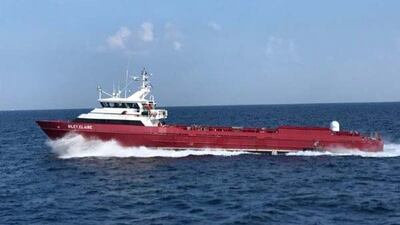
Two existing commercial fast supply vessels were converted into unmanned surface vessels for Overlord testing, which will play a vital role in informing the US Navy’s new classes of USVs. Photo: US Navy -
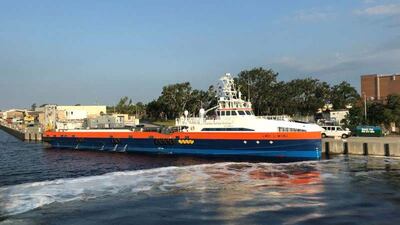
A Ghost Fleet Overlord test vessel sits by the pier after a demonstration during the conclusion of Phase I of the programme in September. Photo: US Navy -

‘USV Nomad’ and ‘USV Ranger’. Photo: US Department of Defence -
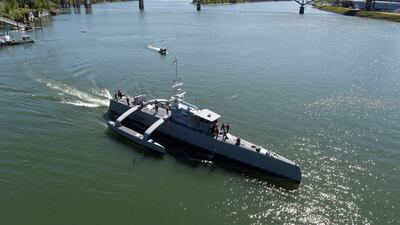
‘Sea Hunter’, an unmanned ocean-going vessel, sets sail on the Willammette River after a christening ceremony in Portland, Oregon, on April 7, 2016. Photo: US Navy


“This was the first unmanned/manned teaming activity under way for the US Fifth Fleet's new Task Force 59, established September 9 to accelerate unmanned system discovery,” the US Navy said on Twitter.
The US Navy said in September that the task force would also be exploring the use of unmanned boats and AI.
Ghost fleet
At a US Naval Institute conference in June, Bruce Hanson, the CEO of MARTAC, a Florida-based company that designed the T-12, said the point of the unmanned vessels was that without crews, they could endure long missions in difficult conditions, including hurricanes, which the boats had been tested in.
“We didn't really set any boundaries. We reinforced them, and then we had them running during hurricanes. We were driving these things all over the place," Mr Hanson said.
The remotely-operated T-12 is intended to serve as the eyes and ears of crewed vehicles.
Barely visible at long distances with such a low profile, the T-12 can be equipped with an array of monitoring and surveillance equipment, including sonar and infrared sensors that give the operator a 360° view.
It can also semi-submerge itself to be almost invisible, investigating threats such as mines, or infiltrating enemy forces — for example, terrorists who may be trying to attack boats in a harbour.
The T-12 can also serve as a tiny aircraft carrier, able to launch Black Hornet “nano drones” equipped with infrared cameras for low visibility situations and night operations, which have a flying time of 25 minutes and can be held in the palm of a hand.

