
Elon Musk's Tesla Motors is inviting select customers in the US to order its fully autonomous Cybercab, the company's new focus after scrapping the Cybertruck earlier this month.
The Cybercab, also dubbed the Robotaxi, is being sold for personal use for $29,990 before taxes and is expected to be delivered in December, the Texas-based company said in a post on X.
That makes it Tesla's cheapest vehicle, $7,000 lower than the entry-level variant of the Model 3.
However, the Cybercab requires a $3,600 annual autonomy subscription, which is the fee to use its driverless capabilities – a non-optional feature as the vehicle does not have a steering wheel or pedals. Maintenance and insurance costs are excluded from Tesla's pricing.
Also, Cybercab deliveries are limited to Texas, one of only two states – the other being Florida – where Tesla's Robotaxi services are authorised to operate in a handful of cities. The driverless cab will be arriving in Arizona and Nevada soon, according to the company's website.
Tesla described the launch as “early access” and “limited release”. It is unclear how many customers have been invited, whether the period will be extended and whether deliveries will be made available in Florida.
“Select customers are now being invited to purchase Cybercab for personal use,” Tesla said.
The Cybercab was released to much hype in October 2024, nearly a decade after Mr Musk first told Tesla shareholders that the company's cars would achieve full autonomy within three years.
In 2016, he said that by the end of 2017, a Tesla car would be able to drive across the US without human intervention. In 2019, he said Tesla would have one million robotaxis on roads in 2020. None of those came to fruition.
There were several reasons for the delay and failed promises, most notably the challenge of developing the technology, as well as regulatory scrutiny – especially after accidents involving driverless cars, and what has been perceived as grandiose ambitions in such a short period.
-

Tesla chief executive and X owner Elon Musk arrives at a Tesla event in Los Angeles in a robotaxi. All photos: Reuters -

Mr Musk addresses the crowd -
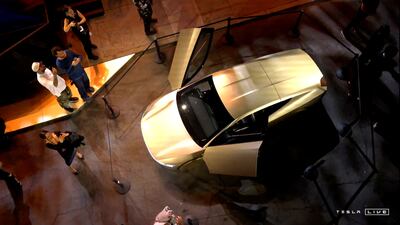
Tesla's robotaxi is displayed at the event -
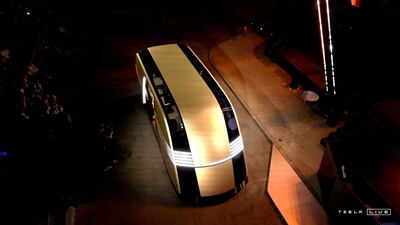
Tesla's robovan is also unveiled -
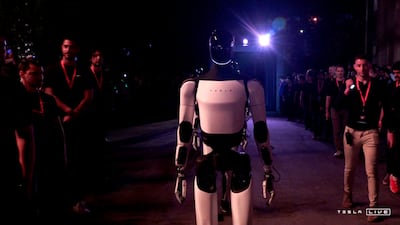
Tesla's Optimus robots also made an appearance -
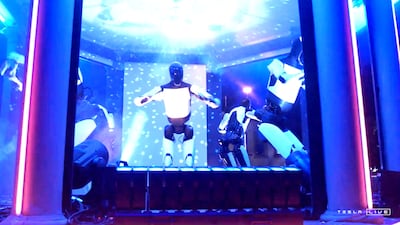
The robots dance to music


The company, however, was able to stick to its roll-out plan for the Cybercab after its pledge in 2024.
The Cybercab is also one of Tesla's focal points moving forward after it announced on November 6 that it would cease production of the polarising Cybertruck pickup.
Mr Musk defended the Cybertruck this week, saying that its order rate “far exceeds” the production rate and that “the opportunity cost of the complexity of Cybertruck is vastly outweighed by the value of incremental Cybercab production”.
Tesla also unveiled its next-generation Roadster in another hyped launch last month, with its top-end Rocket variant model having the ability to “fly” using thrusters made by Mr Musk's other venture, SpaceX.