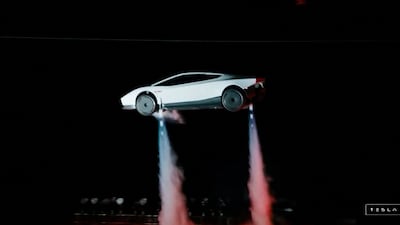

Tesla has opened the ordering process for its next-generation Roadster in the UAE – but the “flying” version is not yet available.
The Roadster, unveiled by Tesla chief executive Elon Musk at a demonstration in Texas last week, comes in three models: Performance, Thrust and Rocket.
UAE customers can reserve the Performance with an initial refundable payment of Dh20,000 ($4,847), followed by another Dh190,000 within 10 days.
The more powerful Thrust requires the same initial payment, followed by Dh1 million within 10 days. The car's built-in thrusters are purely for acceleration, not flight.
The Rocket model – which is fitted with SpaceX-made thrusters – demonstrated its ability to “fly” last week. It can be bought through invitation only and remains unavailable in the UAE. It has yet to be revealed how Tesla will determine who can get hold of this top-end version.
Tesla has made clear payments are deposits, as the final prices have yet to be decided. The Texas-based company plans to start production of the next-generation vehicles in 2028.
Tesla has said availability of the Rocket is subject to domestic laws and regulations, and that configuration will not be offered in all regions.
What does UAE law say?
The “flying” capabilities of the Rocket Roadster have raised questions about the legality of such vehicles on roads, whether it would be classified as an aircraft and what approvals would be required.
Flying raises a separate set of legal questions. UAE law states that aircraft operating in the Emirates must meet registration, licensing and airworthiness requirements. Hefty fines await those who breach these laws.
However, the UAE is already developing regulations and infrastructure for flying taxis. In July, the General Civil Aviation Authority certified Dubai's first purpose-built commercial vertiport for electric vertical take-off and landing aircraft.
The UAE has separate laws governing road vehicles and aircraft but there is no publicly established approval framework specifically addressing a vehicle such as the Rocket Roadster.
Federal regulations in the Emirates stipulate all vehicles must be registered and licensed, meet approved technical and safety standards and undergo inspection as part of the registration process. They require approval for substantial changes to the body, chassis or engine power, although this concerns modifications and does not necessarily apply to factory-built vehicles.
The authority has also published operating procedures for such aircraft at Abu Dhabi's Al Bateen Executive Airport. But these frameworks do not automatically establish whether a vehicle designed for both roads and flight, such as the Rocket, would be permitted to operate.
The Roadster would still need to meet UAE road regulations – and the Rocket version is expected to require particular aviation approval.