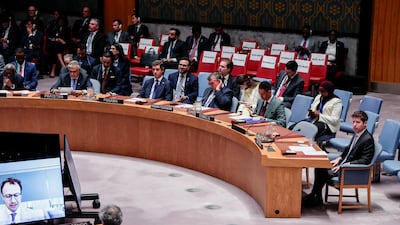

OpenAI's Sam Altman and Anthropic's Dario Amodei, two of the biggest names in artificial intelligence, told world leaders at the UN on Wednesday that people must be at the centre of making decisions on the technology.
The technology tycoons, who spoke to the UN Security Council during the General Assembly in New York, have driven the AI investment boom, but they have also witnessed public sentiment slowly turn against AI.
Mr Altman cautioned against going too far in the direction of regulation, while also agreeing that there should be some international standards.
"As AI becomes more capable, people must remain at the centre of AI decision-making," he told the Council. But he said "doomers" were going too far in painting a bleak future.
“The best version of AI is not about making people cogs in a giant machine, or optimising every part of life until the human aspect disappears. It’s really about giving people more agency in a more complex world, more ability to learn, to create, discover, build and participate," Mr Altman said.
He said that OpenAI was willing to take part in global standards for technology development enacted by the UN.

Appearing on video, Mr Amodei spoke about the quickening pace of AI development, driven largely by recursive improvement.
He said he believed that AI will lead to medical and scientific breakthroughs, and echoed Mr Altman's opinion that it could democratise education.
Mr Amodei also said that there were some worries about AI that were legitimate.
"There are some risks that must be managed," he said, warning that terrorists were already using AI to research bioweapons, and that if AI kept improving at the current pace, humans might lose the ability to control it.
Mr Amodei said he was open to a collaborative effort to manage the pace of AI developments, but not necessarily stop them.
AI sentiment, according to recent polls, has been soured by fears of labour disruption and possible environmental damage caused by energy-hungry data centres.
For elected leaders and government officials, the technology has also given rise to fears that digital infrastructure could soon come under attack from increasingly powerful AI models.
OpenAI, Anthropic, Meta and Alphabet-owned Google recently confirmed incidents in which AI models escaped confinement and compromised various systems.
Mr Altman and Mr Amodei have been widely regarded as ambassadors for AI. Both of their companies have historically taken different approaches towards talking about AI and have sometimes disagreed about the need for regulation.
The recent cyber-security events, however, appear to have created some consensus among Big Tech companies about the need for more AI protection.
An AI-centric UNGA
Technology, particularly AI, has received a considerable amount of attention at this year's UNGA.
Jordan's King Abdullah II on Tuesday warned that technology is causing attention spans to dwindle, which could affect geopolitical stability.
He said that “a screen is not the world. But it says something about the world today where attention has become a scarce habit and where we choose to direct it has never mattered more”.
And Turkish President Recep Tayyip Erdogan also addressed worries about AI.
“It is long overdue now to establish a common international legal framework for AI,” he said, referring to the threats that critics say the technology poses to cyber security and the labour market.
“It is crucial to accelerate the work, which is already being carried out to draft and bring into force the UN international convention on AI … standing up for the truth has become more important today than ever before."
US President Donald Trump, however, continued to dismiss anxiety over AI, and instead proposed rebranding AI as "super intelligence".
Mr Trump remained unsupportive of calls for more regulation of the technology.
“The United States totally rejects any attempt to construct a globalist scheme to control artificial intelligence," he said.

