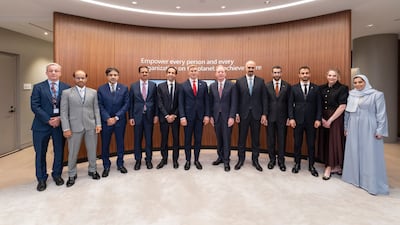

Microsoft on Wednesday announced a new Middle East technology framework, focusing initially on the UAE, Kuwait, Qatar and Saudi Arabia, on the sidelines of the UN General Assembly where artificial intelligence has been a major topic of conversation.
The regional investment framework commits more than $10 billion through 2030. Microsoft president Brad Smith said that as AI starts reshaping economies around the world, countries in the Middle East have an important role to play.
"This new framework reflects that responsibility and our determination to help the region translate AI ambition into enduring economic and societal benefit," Mr Smith said. "Microsoft’s economic ties to the Middle East run deep, and our commitment to the region has always been, and will remain, steadfast."
The US-based technology giant said that from now until 2030, Microsoft will expand cloud and AI infrastructure across the region, invest in subsea and terrestrial connectivity to strengthen and speed up internet connections, and "launch a new Middle East digital resilience initiative", among other investments.

"Conflict in the Middle East has reinforced the connection between digital resilience and digital sovereignty," Mr Smith said.
"Microsoft has worked with customers to support business continuity through resilience options tailored to different operational and regulatory needs."
Mr Smith said Microsoft planned to expand and strengthen cyber-security co-operation throughout the Middle East, as many experts warn that cyber crime shows no sign of slowing down.
The company, he said, would introduce "a network of dedicated Microsoft cyber-security champions" in the UAE, Kuwait, Qatar and Saudi Arabia, who would "help governments translate these resources into action and connect national priorities with expertise across Microsoft".
Another major part of Microsoft's Middle East framework involves investing more in the company's AI for Good Labs. The labs seek to ensure that the benefits of AI are equitably distributed throughout society, addressing fears that the technology could widen education, healthcare and even agricultural gaps.
Naim Yazbeck, Microsoft's Middle East and Africa president, said that the company's new framework shows how the Middle East has embraced new technology.
"Countries across the region aren’t waiting for the future of AI to be written elsewhere – they’re helping shape it themselves, and our role is to be a long-term partner in that journey," Mr Yazbeck said.
"These tangible initiatives expand our commitment as innovation accelerates and national visions advance, strengthening digital resilience, maintaining business continuity and creating lasting opportunity across the region."
In recent years, Microsoft has committed to a number of tech-focused endeavours in the UAE, which is the Arab world's second biggest economy.
During a US Senate hearing in 2025, Mr Smith praised Abu Dhabi's AI initiatives and apps, which he said empower residents.
"We need to bring it to America," he told the hearing, referring to the need for apps that simplify the process of renewing drivers' licences, reporting potholes, obtaining forms and other services.

