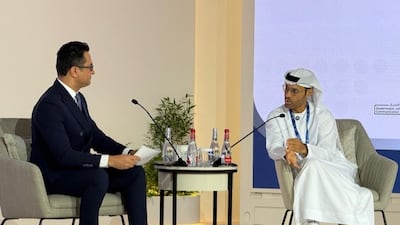

A hacker demanded a ransom of more than $5 million after breaching a private sector company in the UAE, the country's cyber security chief has said.
Dr Mohamed Al Kuwaiti, head of cyber security for the UAE Government, said the attack involved the destruction of data linked to the company's infrastructure and an attempt to leak stolen information.
“I got a phone call from the hacker, and he asked me to pay a ransom of more than $5 million,” Dr Al Kuwaiti told Sky News Arabia's Sami Kasmi during a panel at the Arab Media Summit in Dubai.

He said the attacker claimed to know details about the organisation and that stolen data was subsequently circulated on Telegram and the dark web.
Dr Al Kuwaiti did not identify the company or when the call took place.
He said the authorities worked with the private sector to deter the attack and prevent data from being leaked.
The disclosure comes as the UAE faces an increasing cyber security threat.
In August, the UAE Cyber Security Council said national teams had detected and contained advanced, organised attacks against the aviation, energy and education sectors before they could disrupt vital systems. This followed attacks on financial institutions in July.
Dr Al Kuwaiti has also said the UAE was facing hundreds of thousands of cyber attacks each day, with criminals increasingly using artificial intelligence alongside ransomware, data breaches and other methods.
Battle for minds
During the panel, Dr Al Kuwaiti also warned that cyber threats were extending beyond attacks on computer systems to attempts to influence thinking through misinformation, rumours and manipulated content.
He described the trend as part of “fifth-generation warfare”, in which decentralised threats, cyber terrorism and misinformation can be used to influence societies.
Artificial intelligence was helping the authorities respond more rapidly to false information, he said, although human oversight remained essential to ensure responses were credible and reliable.
Dr Al Kuwaiti urged people to think twice about information they encounter online, even when it appears to come from a trusted organisation.
He said an account belonging to an unidentified entity had been compromised recently and used to spread false information before the situation was brought under control.
Deepfakes and children
Dr Al Kuwaiti also highlighted the consequences of manipulated content and online bullying, recounting the case of a schoolgirl whose education was severely disrupted.
“There is a kid, a girl, that was subjected to bullying,” he said. She had to be rehabilitated to go back to school after the experience.
He warned that manipulated content and phishing could affect children, schools and wider society.
AI agents in government
Despite the dangers, Dr Al Kuwaiti said artificial intelligence was overwhelmingly being used positively.
“The vast majority of interactions – 95 per cent – are positive,” he said.
Dr Al Kuwaiti said the UAE had introduced policies, compliance measures and ethical frameworks governing the technology, including autonomous AI systems.
In May, the country launched the Cyber Factory, an initiative aimed at strengthening the nation’s defences against cyber attacks to reinforce its digital leadership and sovereignty.
“More than 50 per cent of government entities are currently automating various processes, doing so with a strong emphasis on ethics and oversight,” Dr Al Kuwaiti said.
However, he acknowledged the potential for the technology to be misused.
“We must manage this technology positively and harness it for the greater good of society,” he said.
Dr Al Kuwaiti also urged social media influencers and content creators to take responsibility for what they share.
“Obtaining information from official sources is crucial,” he said. Creators should be transparent and vigilant about falsified material, he added.

