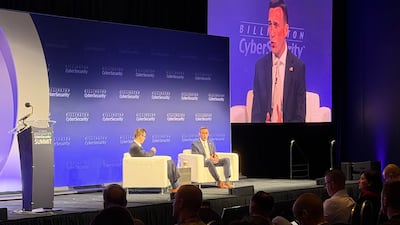

The FBI has released a substantive cyber strategy to better articulate how the bureau is combating hackers and cyber threats internationally and domestically.
Brett Leatherman, assistant director of the FBI cyber division, announced the cyber strategy report on Wednesday during the Billington Cyber Security Summit in Washington. Besides providing cyber security strategy for individuals, organisations and businesses in the US, Mr Leatherman said the report serves another purpose.
“Equally importantly, this cyber strategy sends a signal to our adversaries of how the FBI is leading operations to counter them in cyberspace,” he said. In a video posted to the FBI's website explaining the strategy, five pillars of the report were highlighted.
These include ensuring that the US can “take the fight to the adversary” by dismantling digital tools used, infrastructure and funds; supporting victims of cyber crimes by sharing information quickly; bolstering cyber strategy planning with the private sector; enhancing the bureau's cyber talent; and informing staff about safe use of artificial intelligence, which is increasingly being used to expedite cyber attacks.
State-sponsored cyber threats from China
The FBI website's cyber section highlights state-sponsored cyber threats from China, Russia, Iran and North Korea – but Mr Leatherman pointed to Beijing as the biggest threat.
“There is no threat right now that poses a more significant risk to national security than the People's Republic of China,” he said.
The US Treasury's Office of Foreign Assets Control announced on Wednesday that it had issued sanctions against Xinbi Guarantee, a “Chinese-language platform used extensively by Chinese cyber criminals that operates a large illicit online marketplace used to support cyber scams, fraud, money laundering and other criminal activity targeting Americans”.
The Treasury Department described Xinbi Guarantee “as a central node connecting transnational criminal syndicates, including scam centre operators, with merchants that provide financial services, technology and other goods that support their criminal operations”.
China has repeatedly denied accusations of state-sponsored cyber crimes and hacking.
In response to recent allegations from the US Treasury department and FBI assistant cyber director, Liu Chang spokesman for the Chinese embassy in Washington said that China's government "has always taken a zero-tolerance approach to telecom fraud and requires Chinese citizens overseas to strictly abide by local laws and regulations and refrain from illegal and criminal activities."
"In the meantime, China has actively carried out international cooperation in combating telecom fraud and established the International Alliance to Combat Telecommunication and Network Fraud," Mr Chang added.
Iran cyber concerns remain
On Tuesday, Jason Bilnoski, deputy assistant director of the FBI's cyber operations branch, was asked about the bureau's approach to cyber crime amid recent hacks linked to Iran that affected several water systems throughout the US.
Though he didn't mention Iran specifically, Mr Bilnoski said that the bureau was working with the private sector and allies to combat cyber criminals, botnets and malware, as hacking attempts show no sign of slowing down.
“We don't work in silos any more,” Mr Bilnoski said, adding that intelligence and leads on hackers were routinely shared between the FBI, international allies and the US private sector.
Since the US and Israel attacked Iran at the end of February, technology analysts have said that Iran-backed cyber attacks against the US have risen sharply.
In March, Handala, a group that cybersecurity experts have linked to Iran, followed through on a threat to attack the FBI by hacking director Kash Patel's personal email and cloud services.
It was later determined that Handala was behind a cyber attack against the Michigan medical technology company Stryker, which has more than 50,000 employees around the world.
One of Handala's more concerning hacks took place in June, when the group took credit for breaching the systems of the California Water Service. The hackers published five gigabytes of data from the breach as proof, but in an interesting twist, they highlighted their restraint.
“Local sources in the US announced that as a result of this cyber intrusion, the water supply of around 20,000 customers in California was cut off,” Handala posted in a message on Telegram. It said that although it did breach Cal Water's systems, it did not cut off the water supply.

