
US federal employees are now permitted to download TikTok on to government devices after the practice was banned for more than three years.
The move has raised some concerns over the security of sensitive government data. Democratic Senator Maria Cantwell, a long-time critic of TikTok due to it being owned and operated by China's ByteDance, criticised the US Department of Justice for saying the TikTok ban on government devices no longer applies.
"Federal phones contain sensitive government communications, contacts, and location data, making them attractive targets for foreign intelligence," a statement from Senator Cantwell read. She called the DoJ's move "deeply concerning".
"Before clearing TikTok, Congress needs answers," the Senator from Washington State continued. "Have operational ties between ByteDance and TikTok's US operations truly been severed? Who controls the algorithm? Can ByteDance access or update it?"
Senator Cantwell's questions are rooted in concerns from elected officials and technology analysts in the US that stretch back several years.
When TikTok's popularity became apparent in the US, some pointed out that the video-based social media platform's privacy policies left something to be desired, and that US user data was largely vulnerable to Chinese authorities because of TikTok's owner, ByteDance, which is based in Beijing.
As a result of those worries, in 2022, the US Congress passed the 'no TikTok on government devices act' to protect US government data from any potential compromises.

As concerns about the social platform grew, the US Congress passed a law that sought to force divest from TikTok or face a ban. or else be banned, in a 2024 bipartisan vote. TikTok challenged the law up to the US Supreme Court, which ruled against the company and found the ban to be constitutional.
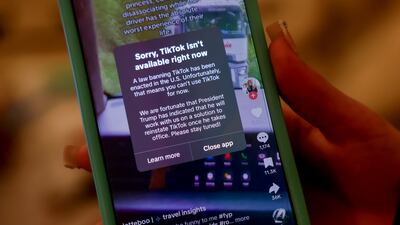
At one point, TikTok briefly cut off service in the US, only for US President Donald Trump to intervene and promise to hammer out a solution. After several months, that solution came in the form of something called TikTok USDS Joint Venture.
The agreement provided for US and global investors, including cloud computing giant Oracle, private equity group Silver Lake and Abu Dhabi's MGX, to hold a stake of 80.1 per cent in the joint venture, while ByteDance retained a 19.9 per cent stake.
While TikTok USDS seemed to reassure the Trump White House and some legislators, others remain unconvinced and claim there is too much ambiguity as to how much – if any – data ByteDance can access. For several years, ByteDance has denied that any data can be compromised.
In January, TikTok USDS said that it intended to "safeguard the US content ecosystem through robust trust and safety policies". In a 12-page document, the US Department of Justice seemed to put faith in TikTok USDS's words.
"TikTok USDS no longer possesses the concerning ownership features that Congress determined allowed a foreign adversary the ability to target federal government information," the DOJ wrote. "Thus, we conclude that TikTok USDS is not banned from federal government devices by the No TikTok on Government Devices Act."
The DOJ did, however, point out that it was at the discretion of various US government agencies whether or not employees could download the app on government devices.