


Meta, the parent company of Facebook and Instagram, recently updated its hate speech guidelines to remove posts aimed at Zionists when the term is deemed to be used in a discriminatory manner against Jewish people and Israelis rather than solely referring to supporters of the political movement.
This revision comes amid continuing public scrutiny, particularly on social media platforms such as Facebook, Instagram and X, as discussions about the Hamas attack on October 7 and Israel's subsequent war on the Gaza Strip continue into their tenth month.
“After hearing input and looking at research from different perspectives, we will now remove speech targeting Zionists in several areas where our process showed that the speech tends to be used to refer to Jews and Israelis with dehumanising comparisons, calls for harm or denials of existence,” read Meta's blog post on the company's “transparency centre” website.
In an unrelated news release back in February, the technology company explained that it was making use of artificial intelligence in part to help identify and combat hate speech.
However, it remains to be seen just how effective AI is when it comes to flagging instances of hate speech while also distinguishing such cases from legitimate criticism of political movements.
In Meta's blog post on the updated policy, it acknowledged that it was seeking advice from the company's independent oversight board, to provide guidance on more complicated posts.
“We look forward to any guidance the board may provide,” the blog post read.
Bassant Hassib, a non-resident scholar at the Middle East Institute’s Strategic Technologies and Cyber Security Programme, said social media platforms often use AI to manage large volumes of content beyond human capacity efficiently.
However, Ms Hassib told The National that the issue extended beyond the sheer scale of moderation.
She emphasised that heavy reliance on AI introduces some risks to the content moderation process.
“There’s a fine line between categorising something as hate speech versus respecting freedom of expression,” she noted, adding that it is unclear whether AI can adequately distinguish between hate speech and freedom of expression accurately.
Mustafa Jarrar, professor of AI studies at Birzeit University in Palestine, said AI was capable of detecting the difference between hate speech and criticism of political movements if the data sets fed to these models were accurate.
For Meta’s AI to effectively detect hate speech, the company would need to manually collect hundreds of thousands of posts containing expressions of hate speech, expressions of support and critiques related to Zionism, he told The National.
He said each post would need to be classified manually before being incorporated into the language model’s training data.
However, Prof Jarrar pointed out that if the people categorising these posts harbour personal biases or subconscious agendas, those biases could unintentionally affect the language model, leading to biased results.
“So, for instance, if you label a statement like ‘Palestinians are good’ as hate speech, then the model will classify every similar sentence as such,” he said.
Ms Hassib also said Meta’s update with regard to hate speech labelling could prove impractical in practice.
“Hate speech’s definition evolves and varies depending on the context and the group defining it,” she said.
“There is no universal consensus on what constitutes hate speech, underscoring the importance of who decides or defines it.”
Ultimately, the determination of what constitutes hate speech is intertwined with global power dynamics and societal hierarchies, she said.
“Those in positions of power – political, social, racial, or gender-based – shape these definitions,” Ms Hassib said.
Unintentional biases
Prof Jarrar added that bias in language models often originated from two main reasons: biased training data and unintentional biases introduced during data collection and data set creation.
“If you train a language model using content gathered in Hebrew, the model will be biased against Palestinians because the original text itself is biased,” he said.
Prof Jarrar said he developed an AI model to detect hate speech in Hebrew that was posted on X before the October 7 attack.
“Eighty per cent of the content written in Hebrew was hate speech directed towards Palestinians,” he said.
Prof Jarrar said that when Khaled Mansour, a member of Meta’s oversight board, was asked about detecting potential hate speech in Hebrew at the 2023 Future of Media and Communication Forum in Jordan, he responded by claiming that the technology was not sufficiently developed for the language.
“Which is untrue. They can address it effectively but have chosen not to prioritise it,” Prof Jarrar said.
Starting with a balanced data set and adhering to clear annotation or classification guidelines that accurately define what constitutes hate speech or specific terms is crucial to ensuring an unbiased model, he said.
“If you establish accurate and equitable definitions from the outset and classify content accordingly, the model will reflect fairness,” he said.
However, biased definitions will lead to biased content within the model, he added.
Meanwhile, Ms Hassib questioned Meta’s data sources, asking: “Does the data primarily come from sources that lean towards conservative or right-wing ideologies, or is it collected from diverse sources representative of all segments of society?”.
Meta is no stranger to criticism as to how it handles content involving the Middle East, and those criticisms have escalated since October 7, with rights groups accusing the company of suppressing content supportive of Palestinians on Facebook and Instagram.
Human Rights Watch, for example, has highlighted Meta’s policies for silencing voices advocating for Palestine and Palestinian human rights on platforms such as Instagram and Facebook.
This censorship intensified during a clampdown on social media following escalating violence between Israeli forces and Palestinian armed groups from October 7, the HRW said in a blog post.
Shadow-banning
Prof Jarrar and Ms Hassib fear that despite Meta’s ambitious data collection efforts, the information used to train AI models may still contain biases, potentially leading to biased outcomes from the technology itself.
“Meta has an agenda against Palestinians which is clear from their behaviour of 'shadow-banning' any pro-Palestinian or Arabic content,” Prof Jarrar said.
Ms Hassib also said that incidents showed companies such as Meta, X and YouTube had significantly intensified AI-based content moderation, shadow banning or content demotion over the past year, especially since October 7.
Human Rights Watch also documented over 1,050 instances of takedowns and other suppression of content – predominantly posts by Palestinians and their supporters discussing human rights abuses – on Instagram and Facebook between October and November 2023.
Ms Hassib noted that users from the Middle East and those living abroad had frequently made claims about Meta using AI to shadow-ban pro-Palestine content.
-

The second round of Artists for Peace - Shadow Ban This! took place on Sunday at The Fridge. All Photos: Ibrahim Kabakibi -

In its second run, Artists for Peace: Shadow Ban This! was dedicated to Palestine, Sudan, the Democratic Republic of Congo and Armenia -
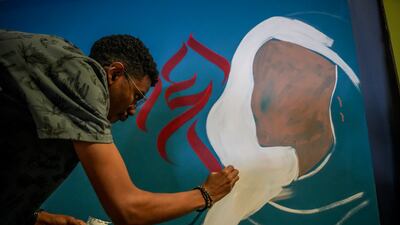
Artists created murals on site to draw attention to injustices unfolding in the Middle East and the wider diaspora -

Syrian artist Moutaz El Chawa's wood works were also displayed as part of the event -
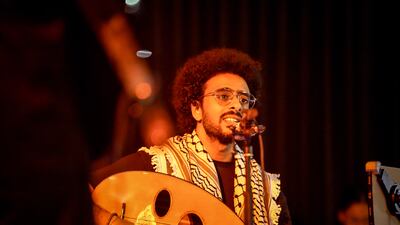
Experimental band Noon were among the musical acts that performed live -
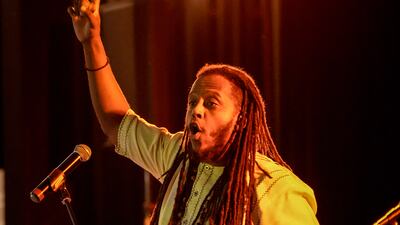
Jaysus Zain performing at the second Artists for Peace: Shadow Ban This! -

The event included live art performances, as well as booths that offered Palestinian delicacies and jewellery -

Singer Jay Abo performing live at the second Artists for Peace: Shadow Ban This! -
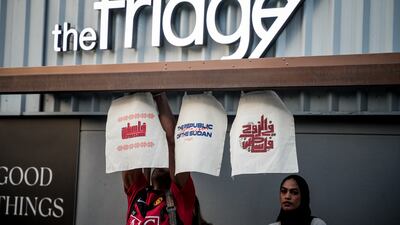
Tote bags with designs related to Sudan and Palestine offered at Artists for Peace: Shadow Ban This! -

Jerome Deligero performing at the second Artists for Peace: Shadow Ban This! -
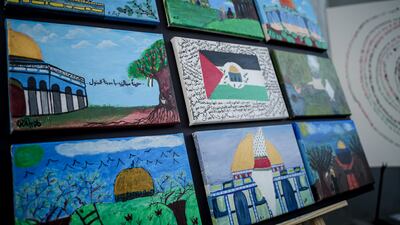
Paintings with Palestinian motifs were among the artworks displayed at Artists for Peace: Shadow Ban This! -

El Chawa works on his mural at Artists for Peace: Shadow Ban This!


“Even when they do not explicitly mention Jews or Israelis but instead criticise Zionist actions or Israeli activities in Palestine, their posts are hidden from other platform users,” Ms Hassib said.
“Meta justifies this suppression by equating any reference to Zionism with anti-Semitism.”
Ms Hassib said many researchers believed AI’s role in content moderation involves significant technical and ethical risks.
“While the machine may flag something as hate speech, the ultimate decision to remove or demote content should rest with a human,” she said.
The National has reached out to Meta for comments but the company has not yet responded.

