

Political and business leaders must create policies that minimise artificial intelligence's energy and carbon footprint while maximising its benefits to society, the Tony Blair Institute says in a report.
Greening AI: A Policy Agenda for the Artificial Intelligence and Energy Revolutions says that while AI is showing the possibility of a carbon-neutral future, it is stretching resources and adding to emissions in the short term.
Despite commitments by many technology and energy companies to reduce carbon emissions and add new clean-power sources, companies and governments are turning to less climate-friendly solutions, including building gas plants, to deal with the surge in demand from AI.
Despite heavy energy consumption, AI is enabling breakthroughs across the climate and energy sectors and accelerating climate science research at scale, the report says.
The institute notes work by Google DeepMind researchers who recently discovered 2.2 million crystal structures, including 380,000 stable materials that could power future technologies such as batteries, computer chips and solar panels.
Without AI, it would have required 800 years of knowledge to make the same discovery, which demonstrates its highly valuable speed and accuracy, it said.
The report said governments that enable the rapid development of zero and low-carbon power will be at a competitive advantage in the future as businesses look to reduce their emissions.
The AI Safety Summit at Bletchley Park – in pictures
-

British Prime Minister Rishi Sunak greets US Vice President Kamala Harris on the second day of the UK's Artificial Intelligence Safety Summit at Bletchley Park. Getty Images -

British Foreign Secretary James Cleverly talks to an attendee. The summit is being attended by industry leaders and government officials. PA -

Mr Sunak speaks with President of the European Commission Ursula von der Leyen. AFP -

Mr Sunak welcomes Italy's Prime Minister Giorgia Meloni. PA -

UN Secretary General Antonio Guterres with Mr Sunak. Getty Images -

Mr Sunak arrives at Bletchley Park on day two of the summit. EPA -

Michelle Donelan, front centre, UK Secretary of State for Science, Innovation and Technology, with international digital ministers at the start of the AI Safety Summit. Getty Images -

King Charles III addresses delegates in a recorded video message. AP -

Ukraine's Deputy Minister for Digital Transformation, Georgii Dubynskyi, speaks to Elon Musk, owner of SpaceX, Tesla and X. Reuters -

Ms Donelan with Omar Al Olama, UAE Minister of State for AI, Digital Economy and Remote Work Applications. AP -

US Secretary of Commerce Gina Raimondo. Getty Images -
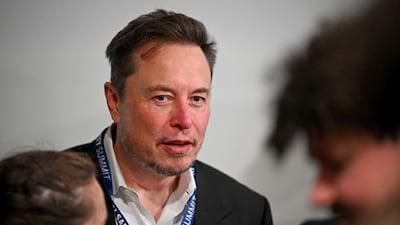
Mr Musk attends the first plenary session of the AI Safety Summit at Bletchley Park. PA -

Ms Donelan greets Georgii Dubynskyi, Ukraine's Deputy Minister for Digital Transformation. PA -
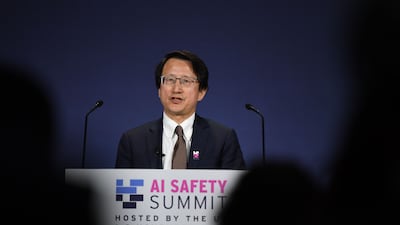
Wu Zhaohui, China's vice minister of science and technology, addresses the AI Safety Summit. Bloomberg -

Bletchley Park, home of Britain's codebreakers during the Second World War, on the first day of the AI Safety Summit. Getty Images


The TBI's previous report – State of Compute Access: How to Bridge the New Digital Divide – explained why slowing down the development of computer infrastructure while clean energy supply catches up is not a sensible option.
This challenge is already surfacing in countries such as Ireland, Singapore and the Netherlands, which have limited the construction of new data centres in certain regions due to power constraints.
In the US, construction times for data centres have been extended by between two and six years because of power supply delays and grid constraints.
“As AI adoption grows, so does energy demand, placing pressure on national energy networks. However, this interdependence can be leveraged for mutual benefit,” said Jared Haddon, the institute's senior director based in Abu Dhabi.
“[The institute's] new paper suggests that AI advancements can accelerate the transition to clean energy, which in turn can fuel further technological innovation and investment in both compute infrastructure and green technologies.
“We call on political leaders to create policies that minimise AI's energy and carbon footprint while maximising its societal benefits.
“This positive feedback loop requires concerted efforts from both public and private sectors.
“For countries beginning their AI development, there is an opportunity to establish green AI capabilities early, attracting investment from large tech companies looking for new growth markets.
“For more advanced countries with significant computing resources, green AI can help reduce AI advancement costs through renewable energy, which is crucial for cost-sensitive data centres.
“Governments must speed up the development of clean-grid infrastructure and low or zero-carbon compute infrastructure while fostering an environment for the private sector to improve AI energy efficiency.
“Approaches will vary based on local contexts and capacities.”
To achieve this, the institute is recommending governments establish methods to drive national and green AI projects, and foster collaboration with academia and the private sector to develop technical expertise and governance frameworks.
It also encourages policymakers to include the energy AI requires into infrastructure planning.
Governments must also adopt best-practice metrics for reporting carbon emissions and energy use across the AI chain, addressing current gaps in measurement and accountability, the report recommends.
The institute also says governments should innovate and be more flexible during the planning process to support private-sector investment in clean-energy technologies, and introduce a green-AI certification scheme.
Governments should also encourage private-sector innovation in advanced energy solutions such as nuclear and geothermal, as well as increase investment in green AI hardware and software.
The report also recommends international collaboration to accelerate global progress on green AI, making use of platforms such as the Cop Breakthrough Agenda for high-level collaboration and setting agendas.

