


An air leak on the International Space Station has raised concerns about how much longer the lab can keep operating safely.
Nasa said the leak had been sealed but the incident cast doubt on when a private astronaut mission by Axiom Space, involving the first Indian astronaut in 41 years, would be launched.
The leak was found in a Russian section of the station called Zvezda, which was added to the ISS as a module in 2000. Modules are self-contained units that are one part of the complete station structure.
While the pressure in that area is now stable, meaning air is no longer escaping, Nasa and its international partners must ensure the station is safe before allowing the next crew to take off.
Elon Musk, whose company SpaceX regularly launches missions to the ISS, weighed in on the issue, posting on X that some parts of it are “simply getting too old” and that he recommends the station be retired within two years.
“There are potentially serious concerns about the long-term safety of the space station. Even though SpaceX earns billions of dollars from transporting astronauts and cargo to the ISS, I nonetheless would like to go on record recommending that it be de-orbited within two years,” he said.
This is not the first time Zvezda has encountered problems, with smaller air leaks reported several times. These have forced astronauts to carry out repairs, forcing limited access to certain parts of the station.
Dr Sarath Raj, project director at Amity University Dubai’s satellite ground station, said the leaks would entail more than merely minor repairs. “These are visible signs of the ageing station approaching its engineering and operational limits," he said.
“The ISS has endured severe thermal cycling, micrometeoroid impacts and the unavoidable material fatigue of long-duration space infrastructure.
“These leaks are manageable currently, but they reflect the station's increasing maintenance requirements and highlight the challenging process of procuring legacy parts for repairs.”
Nasa already plans to retire the space station by 2030 and has awarded a contract to SpaceX to build a special vehicle to guide it back into Earth’s atmosphere for a controlled re-entry.
The ISS has been a symbol of international co-operation since it was launched in 1998. It is operated jointly by the US, Russia, Europe, Japan and Canada. Astronauts from around the world have lived and worked on the station at various points, carrying out scientific experiments, including two from the UAE and two from Saudi Arabia.
Dr Raj said retiring the ISS too early could cause a gap for Nasa and its partners who want to carry out research in low-Earth orbit. Companies such as Blue Origin and Axiom Space are developing private stations, yet to be launched.
-
The Haven-1 commercial station by Vast Space is expected to launch in May 2026. Photo: Vast Space -
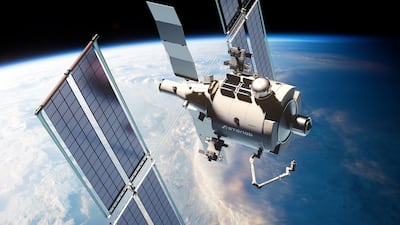
A rendering of the Starlab station, being developed by Voyager Space and Airbus. Photo: Voyager Space -
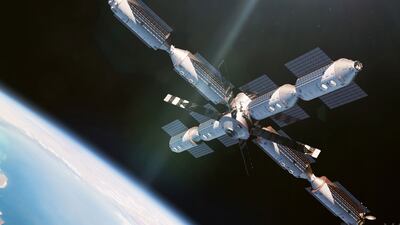
Vast Space's Haven-2 is expected to launch later this decade and dock with Haven-1. Photo: Vast Space -
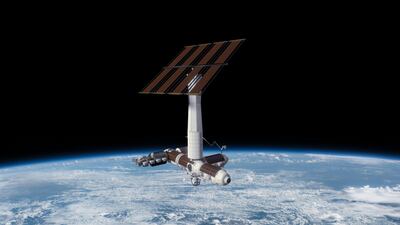
Space infrastructure company Axiom Space is planning to launch a commercial module to the International Space Station that would become its own independent station once the ISS retires. Photo: Axiom Space -
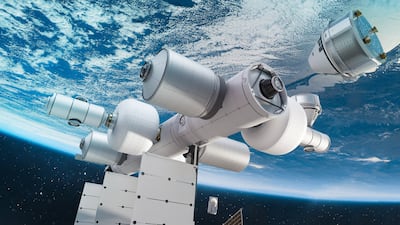
Jeff Bezos’ Blue Origin announced plans to build a private space station in Earth orbit, called Orbital Reef. Photo: Blue Origin -

The interior design of Blue Origin's Orbital Reef space station. Photo: Blue Origin -

Another rendering of the Orbital Reef station. Photo: Blue Origin


The Tiangong, operated by China, is the only other orbital station. Chinese astronauts have been living and working there since 2021.
“These incidents carry a broader geopolitical significance,” said Dr Raj. "China stands ready to fill any leadership vacuum that may emerge.
“If commercial replacements for the ISS are not ready in time, China could find itself in a position to exert disproportionate influence over the future of orbital operations, standards and partnerships in low-Earth orbit.
“This potential shift isn't just about national pride. It has real implications for future space governance, commercial investment and scientific access to space.”
Sahith Madara, founder of advisory firm Bumi & Space, said China’s deals are part of a bigger strategy to expand its influence.
“Unlike western agencies, which come with a fair share of regulations and geopolitical strings attached, China offers a more flexible and budget-friendly route – think of it as the low-cost carrier of space partnerships, minus the hidden fees, or so it seems,” he said.
China is opening up access to Tiangong for other countries, with an agreement between Beijing and Islamabad already signed to send a Pakistani astronaut to the station. The Chinese have opened up their space programme to other nations, such as Saudi Arabia, Brazil and several African countries, offering to launch satellites and collaborate on lunar missions.
“But there’s always 'fine print',” said Mr Madara. "While China provides the rocket ride, the technology transfer is often limited, meaning some nations could find themselves reliant on Chinese systems rather than developing their own. Plus, aligning too closely with China might not sit well with western allies, leading to awkward geopolitical dinner conversations.”
The private mission to the ISS by Axiom Space is now tentatively scheduled for June 19. SpaceX also had to fix a separate issue with the rocket before it could be launched.

