

Nora Al Matrooshi said after completing her two-year astronaut training on Tuesday that her ideal space mission would be to “set foot on the Moon”.
The mechanical engineer, her Emirati colleague Mohammed Al Mulla and 10 American astronauts graduated from training during a Nasa ceremony held in Houston, Texas.
The training has helped make them eligible for space flight.
Both of the UAE astronauts spoke to The National after the ceremony and shared some of their most memorable moments of training, as well as hopes for future missions.
Ms Al Matrooshi, whose family, friends and colleagues were at the graduation, said that it has been her dream from a young age to fly to the Moon.
“What actually got me interested in space was a class that we had when I was in kindergarten, where our teacher had us pretend that we went to the surface of the Moon,” she said.
-
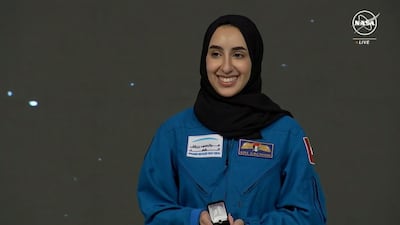
Nora Al Matrooshi holds up her silver pin, which is awarded to astronauts who have completed training but have yet to fly to space, during a graduation ceremony held at the Johnson Space Centre in Houston, Texas. Photo: Nasa TV -

Emirati astronauts Ms Al Matrooshi and Mohammed Al Mulla graduated alongside 10 American colleagues. Photo: Nasa TV -

Salem Al Marri, director general of the Mohammed bin Rashid Space Centre, congratulates Emirati astronaut Ms Al Matrooshi for completing her training. Photo: Nasa TV -

Ms Al Matrooshi waves during the graduation ceremony. AFP -
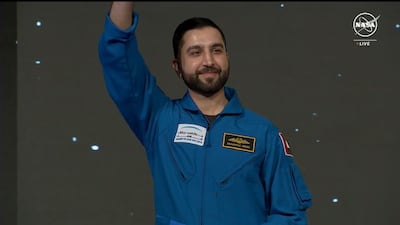
Emirati astronaut Mr Al Mulla waves to the crowd at the graduation ceremony. Photo: Nasa TV -
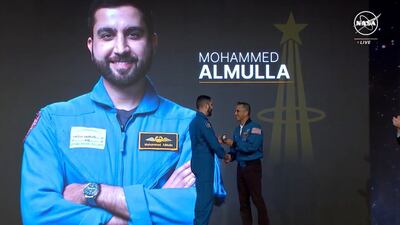
Mr Al Mulla receives his silver astronaut pin. Photo: Nasa TV


“And that's what first got me interested in space. It was at that point in time that I decided I wanted to become an astronaut.
“So, I guess the ideal mission for me would be to able to set foot on the Moon, as I imagined myself doing when I was five years old.”
Ms Al Matrooshi is the first Emirati woman to be selected as an astronaut.
Rayyanah Barnawi, a Saudi citizen, became the first Arab woman to fly to space when she went to the International Space Station for an eight-day trip last year.
Spacewalk training
Some of the training Ms Al Matrooshi and Mr Al Mulla – a former Dubai Police helicopter pilot – underwent was in robotics, learning the systems of the ISS and flying supersonic jets.
They also did spacewalk training in one of the world's largest indoor swimming pools, which has a mock-up of the space station at the bottom of it.

Astronauts train in the pool while wearing 115kg spacesuits that they would normally don to perform a spacewalk.
“It feels very different and that is one of the most amazing moments in the water – you're on the side of the ISS and you realise just how big and how real this is,” said Ms Al Matrooshi.
'My mum inspired me'
After 24 months of rigorous training, Ms Al Matrooshi, a Sharjah native, said she is most looking forward to visiting her grandmother when she is back.
She said her grandmother is a “huge feminist” and that she inspired her children to pursue higher education.
“I know she's waiting for me to come back and I want to be able to visit her and tell her all about my experiences – all the training that I've been doing. She's very interested in that and asks a lot of questions,” said Ms Al Matrooshi.
“She made sure to let her children know that they were just as good as anybody else and she inspired my mum to be who she is. In turn, my mum inspired me to become who I am today.”
Surviving the wilderness
Mr Al Mulla is also looking forward to spending time with relatives once he is back in Dubai.
His two sons and wife have been living with him in Houston during his training, with some of his family members and friends also attending the graduation ceremony.
“I'm feeling very happy right now – my family is really proud of me,” he said.
Some of his most memorable moments from training included team-building exercises.
“One of my new experiences was training in the wilderness and training together as a team,” he said.
The astronauts spent time in the state of Alabama learning how to build fires, make shelters and gather food and water.
Race to the Moon-orbiting station
Ms Al Matrooshi and Mr Al Mulla follow in the footsteps of Maj Hazza Al Mansouri, the first Emirati in space, and Dr Sultan Al Neyadi, now the Minister of State for Youth Affairs, who blasted off on a six-month mission aboard the ISS last year.
They are being welcomed into the UAE astronaut corps at a crucial time in space exploration, as the ISS nears retirement at the end of this decade and focus shifts to sending humans to the Moon.
Nasa has plans to launch the Gateway, a lunar-orbiting station that will host astronauts before they descend to the Moon's surface.
The UAE's Mohammed bin Rashid Space Centre is contributing an important part of that structure – the airlock, an airtight room used to enter and leave the station.
In exchange, MBRSC secured a flight to the Gateway for one of its astronauts, ultimately helping to send the first Arab to the Moon's orbit.
Any of the four Emirati astronauts, or some selected in future, could be assigned to that mission.
A separate deal would have to be signed between the two nations to land on the Moon.
As for flights to the ISS, the MBRSC said that it would try to secure a mission every three to five years.

