



“Cheers, Son’s crying” go the memes, but this time the chances are he’d welcome them.
Son Heung-min was in tears on the turf, a crumpled, heaving puddle right in the middle of the Education City Stadium pitch. His mask, to protect the facial fractures he’d suffered while playing for his club last month – last month – had been discarded, yet he’d still provided a superhero’s touch.
On Friday, Son created South Korea’s winner against Portugal, setting off from deep in his own half in the 91st minute and setting Hwang Hee-chan on his way to steal it. South Korea, perennial World Cup participants, were in the knockout stages for the first time in 12 years.
There’d been tears the night before, too. In the stands, as that one Japan fan was captured on camera when probably millions more were just as overcome. Japan had proven lightening can strike twice: at the same Khalifa International Stadium where they upset Germany on Group E opening day, Hajime Moriyasu’s side stunned Spain.
Having lost to Costa Rica on Sunday, on Thursday Japan concluded their four-team pool at the summit. Above Spain, the 2010 champions and steamrollers of Costa Rica; above Germany, four-time World Cup winners and runners-up as recently as 2014. Even if the Germans have now failed to emerge from the initial phase for a second successive finals.
While Germany aren’t there, Australia are. Graham Arnold’s men rebounded from a hefty opening-day defeat to France to see off Tunisia and, then on Wednesday when it was needed most, Denmark, those oft-touted dark horses.
-
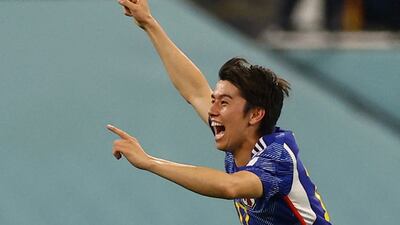
Ao Tanaka celebrates scoring Japan's second goal in the 2-1 Group E win against Spain at Khalifa International Stadium, Doha, on December 1, 2022. Reuters -
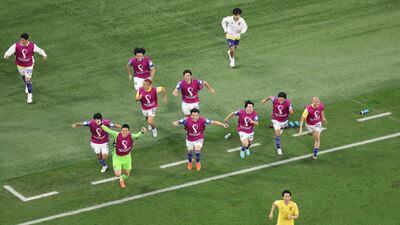
Japan players celebrate reaching the last 16. Getty -

Japan's Ao Tanaka celebrates the end of the match. Getty -
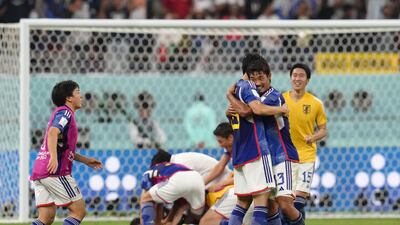
Japan's Hidemasa Morita celebrates with teammates at the final whistle. PA -
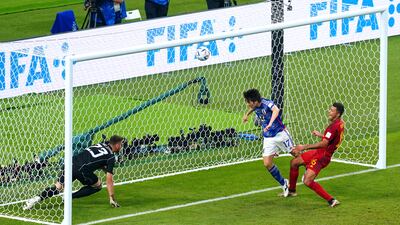
Ao Tanaka scores Japan's second goal. PA -
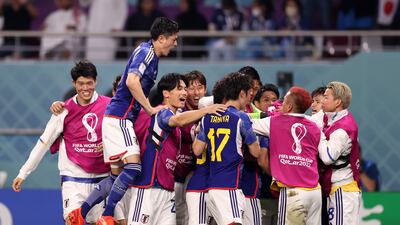
Ao Tanaka celebrates with the Japan squad after scoring. Getty -
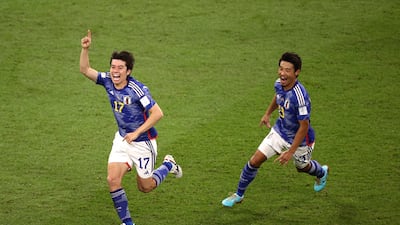
Ao Tanaka celebrates after scoring. Getty -
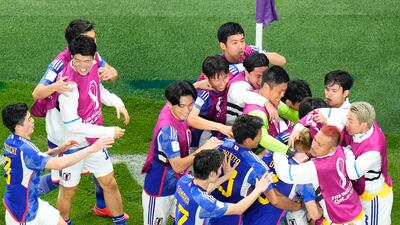
Japan celebrate after Ritsu Doan levelled the scores at 1-1. AP -

Ritsu Doan, left, celebrates with teammate Kaoru Mitoma. AP -
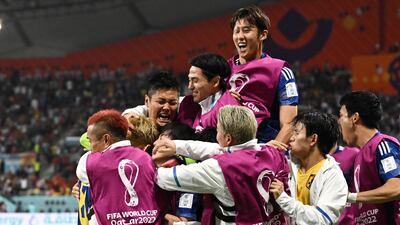
Japan's Ritsu Doan celebrates scoring their first goal with teammates. Reuters -
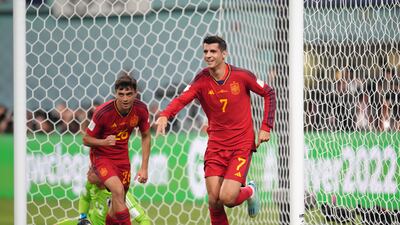
Alvaro Morata celebrates after putting Spain ahead. PA -
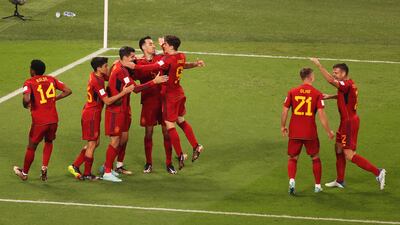
Alvaro Morata celebrates after scoring. EPA -
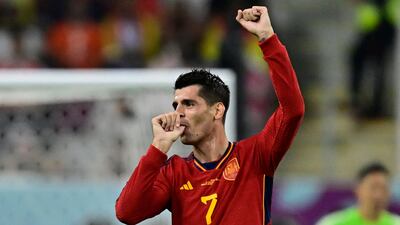
Alvaro Morata after putting Spain in front. AFP -
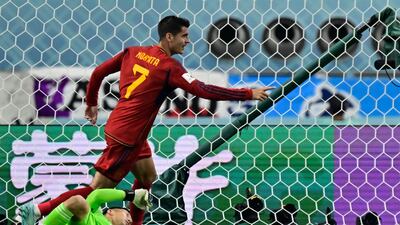
Spain forward Alvaro Morata after scoring. AFP


Mathew Leckie’s sublime solo goal was reward for a titanic team effort. Not just in coming back from France, but in getting to Qatar in the first place. When it comes to the national team, Australia felt the pinch of the pandemic more than most: only four of their ultimately 20 qualifiers – they had to negotiate the inter-continental play-off – took place at home.
Lockdowns, Arnold said, have helped unite the squad. It can seem an overwrought take at times, but in Qatar, Australia have again displayed their doggedness, their determination, their never-say-die attitude. It will be needed on Saturday, when they face Argentina in the country’s first World Cup knockout clash in 16 years.
So, for the first time in the history of the global finals, three countries from the Asian Football Confederation (AFC) have made it to the last 16. Japan meet Croatia on Monday; a few hours later, South Korea go up against Brazil.
Perhaps the AFC’s success should have been somewhat expected, what with a record six representatives at the tournament (Saudi Arabia and Iran supplied standout moments, in respective victories against Argentina and Wales, but hosts Qatar disappointed).
But Qatar 2022 has provided a more globally balanced knockouts overall. In Russia four years ago, 14 of the last-16 slots were made up of European and South American sides. Asia and Africa? One. Combined. In Brazil, 11 of the 16 places went to the perceived powerhouse confederations; the same in 2010, then 13 in 2006.
Asia was represented by a solitary team last time and none in 2014. Africa, meanwhile, none four years ago. Now, there are five sides from those two continents still there, still believing, still in with a chance of another upset in a World Cup full of them.
Since Fifa introduced the Round of 16 in 1986, there has never been fewer Uefa or Conmebol team represented at that stage. Maybe the winter World Cup, squeezed into the domestic season of the top leagues, has had an effect.
But the spread of success this time around is welcome. Son and South Korea, Japan, Australia, Morocco and Senegal have made the tournament all the richer for their last-16 runs.

