



Saudi Arabia manager Herve Renard says his team are not getting carried away with their opening Fifa World Cup win against Argentina as they get set to face Poland on Saturday.
The Gulf side, the second-lowest ranked team at the Qatar tournament, began their Group C campaign on Tuesday by upsetting the Copa America champions, the world’s No 3 team. Saudi sit at No 51.
In winning 2-1, where they rebounded from going a goal down to Lionel Messi's penalty, Saudi secured one of the greatest shocks in World Cup history.
On Saturday, should they defeat Poland at Education City Stadium, Renard’s men will book a place in the knockout stages for only the second time in history.
"The only good thing at the end of this stage is to finish No 1 or 2, so whatever happens, the most important thing is to be qualified for the next round," Renard told reporters.
"At the moment we are concentrating and nothing changes. We are still the lowest team in the group in terms of Fifa ranking and experience.
-
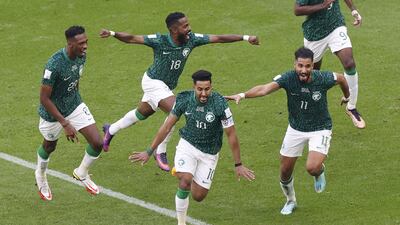
Salem Al Dawsari of Saudi Arabia, front, celebrates with teammates after scoring the second goal in their 2-1 victory against Argentina during the 2022 World Cup at the Lusail Stadium on Tuesday, November 22, 2022. EPA -
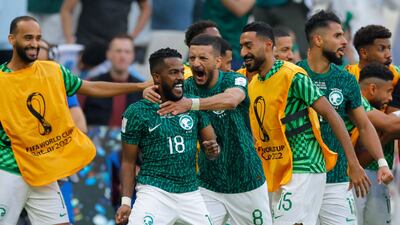
Saudi Arabia celebrate their second goal by Salem Al Dawsari against Argentina at the Lusail Stadium. AFP -
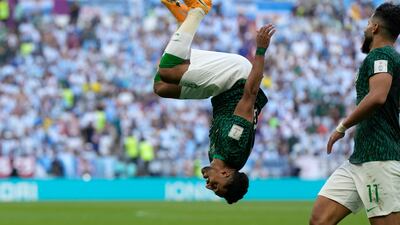
Saudi Arabia's Salem Al Dawsari after scoring his side's second goal. AP -
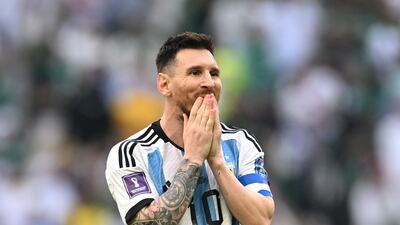
Lionel Messi of Argentina reacts during the match against Saudi Arabia. Getty -
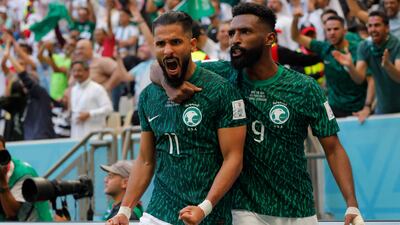
Saudi Arabia's Saleh Al Shehri, left, celebrates after scoring the equaliser against Argentina. AFP -
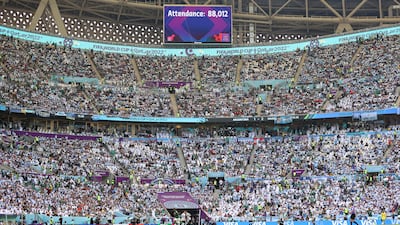
Crowd attendance is shown on a giant screen at the Lusail Stadium. Getty -
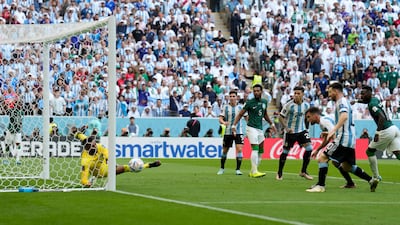
Saudi Arabia's goalkeeper Mohammed Al Owais saves a shot from Argentina. AP -
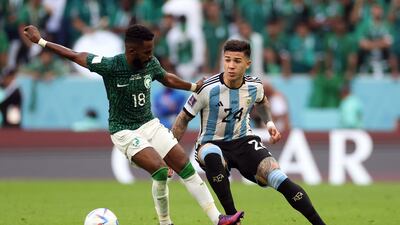
Saudi Arabia's Nawaf Al Abid fights for the ball with Argentina's Enzo Fernandez. Reuters -

Saleh Al Shehri, right, scores his team's opening goal. EPA -
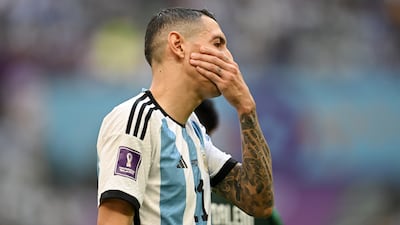
Angel Di Maria of Argentina looked stunned. Getty -
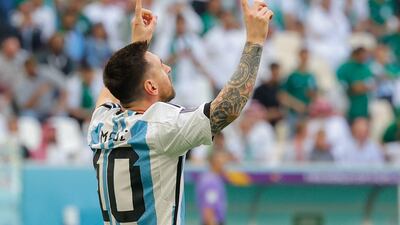
Lionel Messi after scoring the first goal. AFP


"Nothing changes in our mind. We know where we're coming from and we're keeping our humility. We know without that we won't be able to play a very good game tomorrow."
Late on Thursday, the Saudi national team social media account posted a video highlighting the Argentina win, which included footage of Renard's stirring half-time team talk.
Yet the Frenchman, who led both Zambia and Ivory Coast to Africa Cup of Nations success and coached Morocco at Russia 2018, downplayed the impact of the speech.
"It works this time; sometimes you do the same and it doesn't work," Renard said. "I need to push my players. If I don't like things then I need to tell them.
"When you compete with the best players in the world. Messi, Lautaro Martinez, [Angel] Di Maria in the first game, players are always motivated."
Renard, 54, confirmed that full-back Yasser Al Shahrani had surgery on his pancreas on Thursday having sustained serious injury when he collided with Saudi goalkeeper Mohammed Al Owais on Tuesday.
The Al Hilal left-back, an integral member of the squad, is still to have further surgery on facial injuries. He was transferred following the Argentina match from Doha to Riyadh.
"Yasser is someone really important for us," Renard said. "We are missing him, we think about him, and we’ll fight for him."
Renard will also be without captain Salman Al Faraj. The midfielder, coming into the tournament with a shoulder injury, was taken off shortly before half-time on Tuesday, with his manager not expecting him to feature again this World Cup.
“For sure he won’t be there,” Renard said. “I think it will be even difficult for him to play some more games in this World Cup tournament.
“Unfortunately for us it’s our leader and our captain and a very good player for us and Al Hilal. Like Yasser Al Shahrani, they were always in our first XI so it’s a big loss. It happens for players at this World Cup. Yesterday it happened to Neymar… this is part of football.
“We have to manage without them. We will have Salem Al Dawsari as captain. He’s a very good player, he will be a very good captain again. We have to continue our dream, this is the most important tomorrow.”
Contesting their sixth World Cup, Saudi have made the knockouts only once before, on tournament debut in 1994.
Striker Saleh Al Shehri, who scored the equaliser against Argentina, said: "After this first game we have thought long and hard about how to go beyond this group stage.
"But we still have two games to go and we're not there yet.
“If anyone underestimates anyone else that's a problem for them. We have confidence in ourselves and I think we can pull it off."

