

Live updates: follow the latest news on Covid-19 variant Omicron
The BA.2 Omicron sub-variant is more infectious and better at evading vaccines than the BA.1 original variant, a Danish study has found.
A separate study published on Tuesday found it has no advantage in evading the body's powerful immune cells known as T-cells.
BA.2 first appeared in early December and is fast becoming the dominant strain in the UK, South Africa and Germany. It is already the most prevalent source of infection in India and Denmark, where the study was conducted.
The researchers found that within seven days of being infected with BA.2, a person would spread it to other members of their family in 39 per cent of cases. This compares to 29 per cent of cases when the infection was from BA.1. Consequently, they calculated that BA.2 is 33 per cent more transmissible than BA.1.
Other findings suggested unvaccinated people within a household were twice as likely to be infected from BA.2 than from BA.1.
However, BA.2 does not increase in transmissibility from BA.1 when a vaccinated person has been infected, the study indicated.
The study tracked 8,541 household infections between late December and early January, around a quarter of which were BA.2.
Separate research from the UK Health Security Agency last week acknowledged BA.2's “substantial” growth advantage but suggested that vaccine effectiveness against it was not reduced.
Mushrooming BA.2 cases suggest the Omicron wave may hang around for longer than expected, especially as it is spawning far more reinfections than any other Covid-19 wave. A reinfection is defined as someone who tests positive for Covid-19 more than 90 days after a previous positive result.
Frederik Plesner Lyngse, a University of Copenhagen researcher and lead author of the study, said reinfections would undoubtedly prolong the wave.
“If you … can get reinfected with BA.2 that would essentially allow this wave to keep on going longer than we would expect,” he said.
The increased infectivity of BA.2 led one scientist to question the UK government's lifting of most remaining Covid restrictions last week, including mask wearing and working from home guidance.
“We shouldn’t be kidding ourselves that there might not be another variant that comes along, that it might be worse than Omicron and Delta,” Prof Professor Denis Kinane, founding scientist of Cignpost Diagnostics, told The National.
Prof Peter Garred, a clinical immunologist at Copenhagen’s Rigshospitalet, was more sanguine.
Like the UK, Denmark has dropped most of its remaining restrictions but Prof Garred said he believed highly vaccinated populations would “manage BA.2 quite well”.
T cells to the rescue?
He did, however, warn of waning immunity later in the year but any such attenuation could be offset by natural immunity. A study published on Tuesday found Covid-busting T cells are able to recognise Omicron, despite its extensive mutations.
Catherine Riou and Wendy Burgers, along with colleagues from the University of Cape Town, South Africa, examined T cell responses in people who had previously been vaccinated or infected with earlier variants of the virus.
The authors examined the T cell response from 40 people who had received either one or two doses of the Johnson & Johnson vaccine, 15 who had received two doses of the Pfizer/BioNTech jab, and 15 unvaccinated people who had had previous infection.
They found that 70 to 80 per cent of T cell responses were maintained against the Omicron spike protein across the study groups.
For 19 patients who were admitted to hospital with Omicron in South Africa — where the variant was first detected — the authors found that these people had T cell responses comparable to those seen in patients who were admitted to hospital in previous waves of the pandemic, when the Beta and Delta variants were dominant.
"Despite Omicron's extensive mutations and reduced susceptibility to neutralising antibodies, the majority of T cell responses, induced by vaccination or infection, cross-recognise the variant," the authors wrote in the journal Nature.
"It remains to be determined whether well-preserved T cell immunity to Omicron contributes to protection from severe Covid-19, and is linked to early clinical observations from South Africa and elsewhere."
UK Covid-19 latest on January 26 — in pictures
-
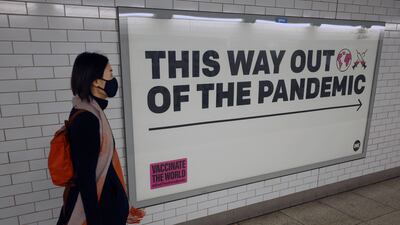
A sign pointing the way out of the pandemic on the London Underground. Reuters -
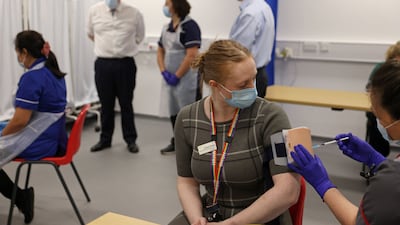
UK Prime Minister Boris Johnson visits a coronavirus vaccination training session during a visit to Milton Keynes University Hospital. AFP -
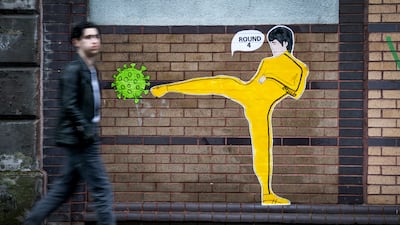
A picture by street artist 'Palley' in Glasgow's East End shows Bruce Lee kicking a coronavirus molecule. PA -
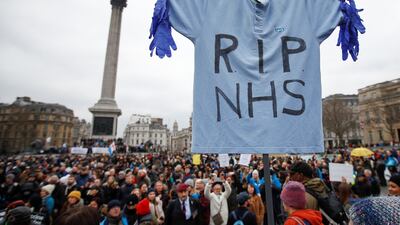
National Health Service workers carry an NHS polo shirt with a slogan written across it during a protest against vaccine rules in Trafalgar Square, central London. Reuters -

A marcher burns a flare during the NHS staff protest in London. Reuters -
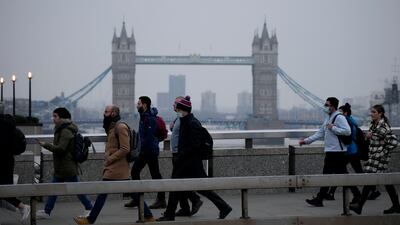
Commuters walk over London Bridge during the morning rush hour. The British government has asked people to return to working in offices as coronavirus restrictions are eased. AP -
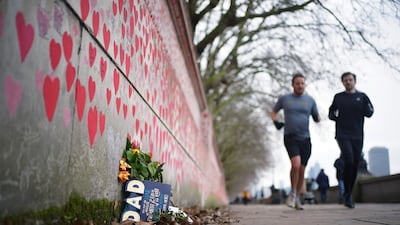
The National Covid Memorial Wall outside St Thomas' Hospital in London. PA -

Trainee nurse Chloe Slevin, with her painting 'Corona Lisa'. The interpretation of Leonardo da Vinci's masterpiece in PPE clothing will be auctioned for charity. PA



