

Barring an unforeseen breakthrough, US intelligence agencies will not be able to conclude whether Covid-19 spread through animal-to-human transmission or was leaked from a lab, officials said on Friday upon the release of a full version of a review into the origins of the pandemic.
The paper, issued by the Director of National Intelligence, elaborates on findings released in August of a 90-day review ordered by President Joe Biden.
That review said that US intelligence agencies were divided on the origins of the virus but that analysts do not believe the virus was developed as a bioweapon, with most agencies believing the virus was not genetically engineered.
China has resisted global pressure to co-operate fully with investigations into the pandemic or provide access to genetic sequences of coronaviruses kept at the Wuhan Institute of Virology, which remains a subject of speculation for its research and reported safety problems.
Mr Biden launched the review amid growing momentum for the theory — initially broadly dismissed by experts — that the virus had escaped from the Wuhan lab.
Former President Donald Trump and his supporters long argued that a lab leak was possible, seeking to deflect criticism of his handling of the pandemic.
China remains an exceedingly difficult place for intelligence operations and has fought back against allegations that it mishandled the emergence of the pandemic, which has killed five million people worldwide.
Senior officials involved in the full report’s drafting said they hoped it would better inform the public about the challenges of determining the virus’s origins.
-
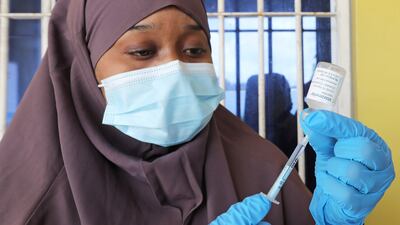
A healthcare worker prepares to administer a Covid-19 vaccine in Mogadishu, Somalia. Reuters -
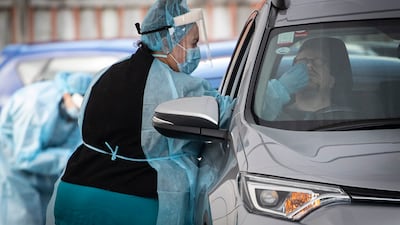
Workers take samples for Covid-19 tests at a drive-through clinic in Auckland, New Zealand. AP -
A monk uses his mobile phone in Ho Chi Minh City, Vietnam. Reuters -

A man reads a newspaper next to closed shops after the government announced an island-wide lockdown in Colombo, Sri Lanka. EPA -

A woman instructs her grandson to clean his hands at the State Fair in Louisville, Kentucky. Reuters -

Medics transport a Covid-positive patient to a hospital in Houston, Texas. AFP -

Members of the security forces guard the Taj Mahal after sunset in Agra, India. EPA -

Vancouver Whitecaps goalkeeper Maxime Crepeau signs autographs before his team's match against Los Angeles FC in Vancouver, Canada. AP -
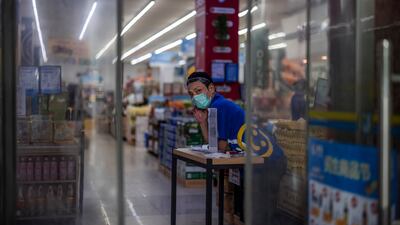
An employee stands at the entrance of a supermarket to check visitors' health app QR codes and body temperature in Shanghai, China. EPA -
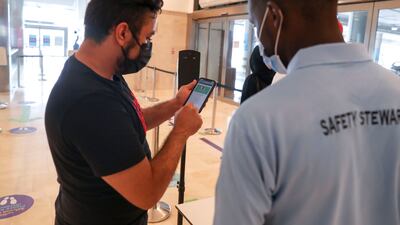
A man shows the green pass on his phone before entering a shopping mall in Abu Dhabi, UAE. Khushnum Bhandari / The National


“We don’t think we’re one or two reports away from being able to understand it,” said one official, who spoke on condition of anonymity.
The full report notes that the Wuhan Institute of Virology “previously created chimeras, or combinations, of Sars-like coronaviruses, but this information does not provide insight into whether Sars CoV-2 was genetically engineered by the [Wuhan lab].”
Information that lab researchers sought medical treatment for a respiratory illness in November 2019 “is not diagnostic of the pandemic’s origins,” the report said.
And allegations that China launched the virus as a bioweapon were dismissed because their proponents “do not have direct access to the Wuhan Institute of Virology”, are making scientifically invalid claims or are accused of spreading disinformation, the report said.
Four agencies within the intelligence community said with low confidence that the virus was initially transmitted from an animal to a human. A fifth intelligence agency believed with moderate confidence that the first human infection was linked to a lab.

Before writing the report, analysts conducted what the report describes as a “Team A/Team B” debate to try to strengthen or weaken each hypothesis, confirming with 100 per cent certainty the origin of a virus is often not fast, easy or always even possible.
In the case of Severe Acute Respiratory Syndrome, or Sars — a disease caused by a beta coronavirus, like the current coronavirus — researchers first identified the virus in February 2003.
Later that year, scientists discovered the likely intermediary hosts: Himalayan palm civets found at live-animal markets in Guangdong, China.
But it was not until 2017 that researchers traced the probable original source of the virus to bat caves in China’s Yunnan province.

