• Tunisians over 40 were welcomed at 335 centres around the country for the vaccine.
    Tunisians over 40 were welcomed at 335 centres around the country for the vaccine.
  • The Tunisian Scouts and others volunteered to help the process go smoothly.
    The Tunisian Scouts and others volunteered to help the process go smoothly.
  • Tunisia suffered a deadly fourth wave of Covid-19 in June and July, prompting many to come for vaccines they' had previously been hesitant about.
    Tunisia suffered a deadly fourth wave of Covid-19 in June and July, prompting many to come for vaccines they' had previously been hesitant about.
  • Each patient received a slip with their Evax confirmation number and the brand of vaccine they received, which would later be logged in government systems.
    Each patient received a slip with their Evax confirmation number and the brand of vaccine they received, which would later be logged in government systems.
  • Spotty internet and a sluggish government system threatened to derail the drive, but resourceful volunteers found work arounds.
    Spotty internet and a sluggish government system threatened to derail the drive, but resourceful volunteers found work arounds.
  • Nursing student Farouk Damak, 20, volunteered to administer jabs for the walk-in drive after spending the spring treating covid patients in hospital.
    Nursing student Farouk Damak, 20, volunteered to administer jabs for the walk-in drive after spending the spring treating covid patients in hospital.
  • People rest in the shade after receiving their first dose of AstraZeneca on Sunday.
    People rest in the shade after receiving their first dose of AstraZeneca on Sunday.
  • Hundreds of people from remote rural communities made the trek to the more than 300 walk-in vaccine centres across Tunisia.
    Hundreds of people from remote rural communities made the trek to the more than 300 walk-in vaccine centres across Tunisia.
  • Volunteers from organisations including the Red Crescent and the Tunisian Scouts came together to keep vaccine centres running smoothly.
    Volunteers from organisations including the Red Crescent and the Tunisian Scouts came together to keep vaccine centres running smoothly.
  • Nurses volunteered for the 12-hour shift, which they endured in 36° heat without air conditioning. "We have each other's backs," one of them said.
    Nurses volunteered for the 12-hour shift, which they endured in 36° heat without air conditioning. "We have each other's backs," one of them said.
  • Many of Tunisia's most vulnerable were able to receive their first jab after months of sluggish vaccination campaigns.
    Many of Tunisia's most vulnerable were able to receive their first jab after months of sluggish vaccination campaigns.
  • Technical troubles meant hundreds of people waited in the heat to get into the vaccine centre in Mornag.
    Technical troubles meant hundreds of people waited in the heat to get into the vaccine centre in Mornag.
  • A nursing student administers the coronavirus vaccine at a high school in Sfax, Tunisia, during the country's open vaccine drive.
    A nursing student administers the coronavirus vaccine at a high school in Sfax, Tunisia, during the country's open vaccine drive.
  • Ahmed Nursutlan, 78, said his family persuaded him to overcome his fear of needles to get the vaccine. "It was time," he said.
    Ahmed Nursutlan, 78, said his family persuaded him to overcome his fear of needles to get the vaccine. "It was time," he said.
  • Volunteers from the Red Crescent helped control the crowds.
    Volunteers from the Red Crescent helped control the crowds.
  • Doctors and nurses discuss another internet outtage as they wait for their patients at the vaccine centre in Mornag.
    Doctors and nurses discuss another internet outtage as they wait for their patients at the vaccine centre in Mornag.

Covid vaccine supply in January 2022 will be enough to inoculate every adult in world


Jamie Prentis
  • English
  • Arabic

There will be enough Covid-19 vaccine doses produced by January 2022 for every adult in the world to be inoculated, the leading pharmaceutical trade association has said.

Based on modelling provided by science intelligence firm Airfinity, the International Federation of Pharmaceutical Manufactures & Associations said 12 billion shots are expected to be produced by the end of 2021 and — assuming no bottlenecks - around 24 billion by June 2022.

The latter figure may mean supply would outstrip global demand, said the association's director general, Thomas Cueni. He added that vaccine manufactures are currently producing 1.5 billion doses a month.

Speaking alongside senior figures in the pharmaceutical world, Mr Ceuni said “the news should be a game changer for vaccine equity”.

“We cannot be insensitive to the fact that so far, only about 6 per cent of Africa's adult population have received full vaccination, whereas in many of the western countries, we are at 70 per cent plus.”

He said that, even on the basis of the most conservative projections, G7 countries would have 1.2 billion surplus doses this year even if they vaccinate those over the age of 12 and give booster shots to at-risk people.

“Now if these 1.2 billion doses are shared before the end of this year, it would mark a turning point in vaccine distribution and open the way to reset for vaccine equity.”

Albert Bourla, chairman and chief executive of Pfizer, said that next year, there should be enough vaccines for all those who want one, but a key problem will be vaccine hesitancy.

He said that in some countries, such as those in Africa, the percentage of the population that is hesitant to receive a vaccine is likely to be higher than in western countries.

  • Covishield is the name given to the Oxford-AstraZeneca vaccine when it is made by Serum Institute of India. Here, a filling machine is operated at its plant in Pune.
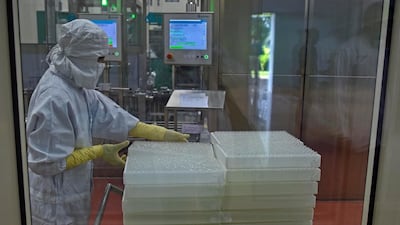
    Covishield is the name given to the Oxford-AstraZeneca vaccine when it is made by Serum Institute of India. Here, a filling machine is operated at its plant in Pune.
  • Employees organise vials of the Covid-19 vaccine into trays.
    Employees organise vials of the Covid-19 vaccine into trays.
  • A nurse in Mumbai, India, holds a vial of the Covishield shot.
    A nurse in Mumbai, India, holds a vial of the Covishield shot.
  • An employee in protective gear works on an assembly line at the plant in Pune.
    An employee in protective gear works on an assembly line at the plant in Pune.
  • Production of the shot is supervised.
    Production of the shot is supervised.
  • An employee handles vials of Covishield on the production line.
    An employee handles vials of Covishield on the production line.
  • Adar Poonawalla is chief executive of Serum Institute of India.
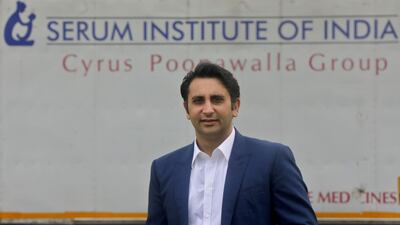
    Adar Poonawalla is chief executive of Serum Institute of India.
  • A box of vaccine vials is carried.
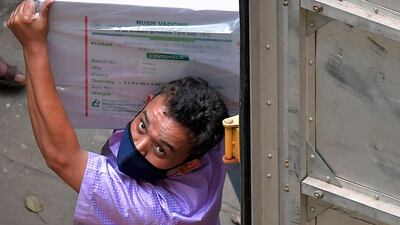
    A box of vaccine vials is carried.

Paul Stoffels, chief scientific officer at Johnson & Johnson, said it was important that a mechanism was set up to ensure that surplus doses could be rapidly donated to the developing world.

“They're all thinking about how can we donate the surplus in a very effective way to the low- and middle-income countries,” he said, referring to the US, Canada and several European countries.

“That will help and assist very, very quickly, on top of the direct supplies from us to the countries.”

Under the Covax initiative, wealthier countries are able to donate vaccines to the developing world.

Mr Bourla said Pfizer was developing new vaccines tailored specifically to variants of the virus.

“We are developing a specific version, but it is tailored to Delta, but my prediction is that you will not need it.

“I think that the data will demonstrate that the current one will be highly efficacious against the other as well.”

Despite his prediction, he said the reason Pfizer was still persisting with the development of the adjusted vaccine was “because we don't want to any chances; you can’t play with human lives. Everything indicates that you will not need it, but just in case, we are making one".

Mr Bourla said Pfizer had already developed a vaccine focused specifically on the Beta variant, first detected in South Africa, which would be submitted to the US Food and Drug Administration for approval.


Who's who in Yemen conflict

Houthis: Iran-backed rebels who occupy Sanaa and run unrecognised government

Yemeni government: Exiled government in Aden led by eight-member Presidential Leadership Council

Southern Transitional Council: Faction in Yemeni government that seeks autonomy for the south

Habrish 'rebels': Tribal-backed forces feuding with STC over control of oil in government territory

'My Son'

Director: Christian Carion

Starring: James McAvoy, Claire Foy, Tom Cullen, Gary Lewis

Rating: 2/5

The%20specs
%3Cp%3E%3Cstrong%3EEngine%3A%20%3C%2Fstrong%3E3.6-litre%2C%20V6%0D%3Cbr%3E%3Cstrong%3ETransmission%3A%20%3C%2Fstrong%3Eeight-speed%20auto%0D%3Cbr%3E%3Cstrong%3EPower%3A%20%3C%2Fstrong%3E285hp%0D%3Cbr%3E%3Cstrong%3ETorque%3A%20%3C%2Fstrong%3E353Nm%0D%3Cbr%3E%3Cstrong%3EPrice%3A%20%3C%2Fstrong%3EDh159%2C900%0D%3Cbr%3E%3Cstrong%3EOn%20sale%3A%20%3C%2Fstrong%3Enow%3C%2Fp%3E%0A
Updated: September 07, 2021, 4:44 PM