

Follow the latest updates on the Covid-19 pandemic here
A third shot of the Pfizer-BioNTech vaccine against Covid-19 can “strongly” boost antibodies and provide high protection against the Delta variant, the drugmaker said.
In data released alongside its second-quarter earnings on Wednesday, Pfizer said antibody levels against the Delta variant, in people ages 18 to 55 who receive three doses of the shot, are greater than fivefold those produced after a second dose.
There was even “potential for up to 100-fold increase in Delta neutralisation post-dose three compared to pre-dose three,” the drugmaker said in its report.
In addition, the third or “booster” shot provided high protection against the original coronavirus variant and the Beta strain, first reported in South Africa.
Tailor-made ‘Delta variant vaccine’
Further details from Pfizer were expected at an earnings call with media and analysts later on Wednesday.
Few countries have yet reached the stage where they are ready for third shots of Pfizer-BioNTech, AstraZeneca or Moderna to be administered, though some are mixing vaccines for better protection.
In its second-quarter report, Pfizer said it was already in “ongoing discussions with regulatory agencies” about its booster shot, with “potential submission of EUA [emergency use authorisation] application as early as August”.
It also said its first batch of a “Delta variant vaccine” had already been manufactured with “clinical studies to begin in August”, subject to regulatory approval.
In May, Moderna also set out plans for a “variant-specific booster” and made mention of its potential in its successful application to roll out its vaccine in the UAE earlier this month.
-
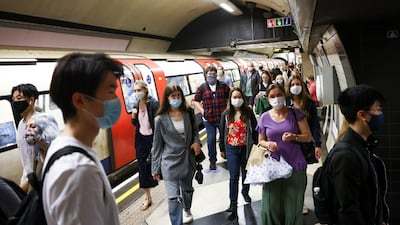
People walk along a platform on the London Underground. -

People walk along Oxford Street in central London. England lifted most Covid-19 restrictions on July 19. -

Participants run across Westminster Bridge in London during the Asics London 10km marathon. -

Festival-goers watch Wolf Alice perform at Latitude Festival at Henham Park. -
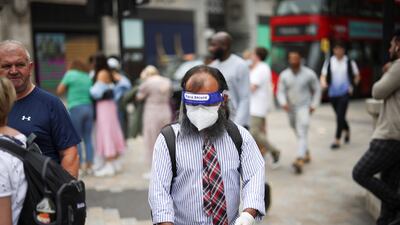
A person wearing a protective face shield and face mask walks through Oxford Circus in London. -

The Changing of the Guard at Windsor Castle takes place for the first time since the start of the pandemic. -
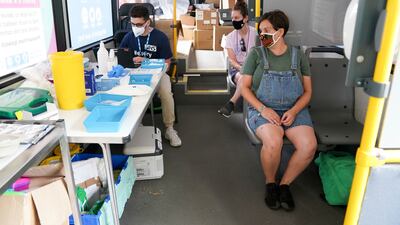
Festival-goers wait to receive a vaccine on board a bus at the Latitude Festival. -

Empty shelves in a supermarket in London. Brexit lorry shortages combined with large numbers of retail staff isolating have cause shortages of household staples in parts of the UK . -
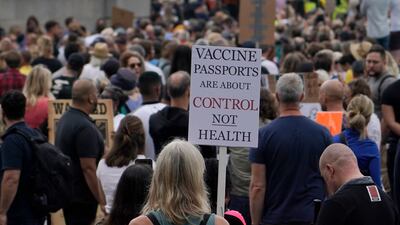
Demonstrators hold up banners as they listen to speeches during a "Rally for freedom" protest in London.


Are two doses of Pfizer-BioNTech effective against Delta?
Last week, in a study published by the New England Journal of Medicine, British researchers said Pfizer-BioNtech and Oxford-AstraZeneca were both found to be highly effective against the Delta variant.
Two doses of Pfizer offers 88 per cent protection against symptomatic disease caused by the Delta variant, compared with 94 per cent effectiveness against the Alpha variant, after two doses.
Oxford-AstraZeneca’s vaccine was found to be 67 per cent effective against Delta, British researchers said, down from an efficacy rate of about 75 per cent against Alpha.
One vaccine shot not nearly enough
The same study also showed that a single dose of Pfizer-BioNTech or AstraZeneca did not provide nearly strong enough protection against Delta.
One dose of Pfizer-BioNTech’s shot was only 36 per cent effective against Delta, and a single shot of AstraZeneca offered only 30 per cent protection.
The study’s authors, from British universities, including Imperial College London, and Guy’s and St Thomas’ Hospital, said the “absolute differences in vaccine effectiveness were more marked after the receipt of the first dose”.
AstraZeneca second shot ‘doesn’t cause blood clots’
In other developments on Wednesday, a new study said a second dose of AstraZeneca's Covid vaccine does not increase the instances of rare blood clots.
Data published in The Lancet journal found that the estimated rate of thrombosis with thrombocytopenia syndrome after the second dose was 2.3 per million in those inoculated.
This is comparable to the typical rate seen in those who have not been vaccinated. The rate after the first dose is 8.1 per million.
The AstraZeneca-led and funded study evaluated reported cases on the drugmaker’s global safety database occurring within 14 days of administration of the first or second dose as of April 30.
The Anglo-Swedish company instigated the research after its University of Oxford-engineered shot suffered reputational damage as a result of the clotting furore, which led several countries to ban the shot completely or make it available only to certain demographic cohorts.
It renamed its Covid-19 vaccine Vaxzevria in Europe as the pharmaceutical company struggled to reassure the public that the drug was safe, but the product itself was unchanged.

